
 Support
Euro strengthens following notable inflation slowdown
The euro appreciated against the US dollar following the release of inflation data, which revealed a prominent deceleration in consumer prices across the Eurozone. While falling inflation typically exerts downward pressure on a currency, the market response suggests a shift in focus toward the European Central Bank’s (ECB) potential capacity to pivot toward growth-supporting measures.

The headline inflation rate in the European Union decelerated from 2% to 1.7%, while core inflation eased marginally from 2.3% to 2.2%.
This deceleration provides the ECB with greater scope to support the Eurozone economy, particularly as major economies like Germany grapple with subdued productivity and weak domestic consumption.
Although the long-term trajectory for the EUR/USD pair remains bullish, short-term price action is currently oscillating within a triangle pattern, indicating market indecision.
European Union inflation rate decelerates in line with consensus
According to data released by Eurostat, the headline inflation rate fell from 2% in December to 1.7% in January, aligning with analyst estimates. This figure represents the lowest level recorded since October 2024 and brings inflation comfortably below the European Central Bank’s (ECB) 2% target. Simultaneously, the core inflation rate—which strips out volatile food and energy costs—slowed from 2.3% to 2.2%, marking its lowest point since November 2021. Information from Trading Economics indicates that the primary drivers of this disinflation were a 4% year-on-year (YoY) decline in energy prices, alongside a marginal slowdown in the costs of services and processed goods. Conversely, unprocessed food prices rose by 4.2%, while non-energy industrial goods saw a slight acceleration of 0.4%.
This updated data alleviates pressure on the ECB, allowing policymakers to navigate a landscape of cooling prices and unemployment rates that remain near historical lows. However, the central bank faces mounting pressure to address flagging economic growth, as weak productivity and sluggish consumption continue to impact key member states, most notably Germany.
Despite the fact that lower inflation typically correlates with currency depreciation, the EUR/USD pair defied conventional trends, appreciating by 0.28% to reach $1.1804.
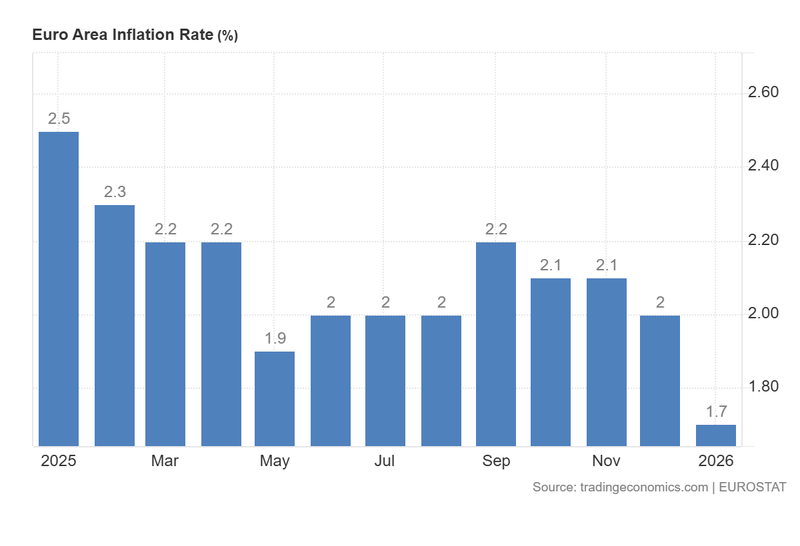
Figure 1. Euro Area Inflation Rate (2025–2026). Source: Data from the EUROSTAT; Figure obtained from Trading Economics.
Technical analysis of the EUR/USD pair
From a technical perspective, the EUR/USD pair remains embedded within a broader bullish trend; however, short-term price action is currently restricted within a triangle pattern that signals mounting uncertainty. Key observations include:
- Trend Context: Over the long term, the EUR/USD pair has maintained a bullish market structure defined by a series of higher highs and higher lows. The price continues to trade above the 50, 100, and 200-day Simple Moving Averages (SMAs). Nevertheless, in the short term, the Euro is consolidating within a triangle pattern in close proximity to a structural resistance level that is currently inhibiting further upward momentum.
- Resistance Levels: Should the immediate short-term resistance at $1.1860 be breached, the next significant technical ceiling is identified at $1.2113—a level that marks the upper boundary of a short-term bullish channel. A decisive breakout above this zone would signal the potential for an extension toward higher price levels.
- Support Levels: If the $1.1660 support level is compromised—a critical zone where the 200-day SMA converges with the floor of the bullish channel—the next relevant floor is located at the $1.1230 structural pivot point. A breach of the $1.1230 zone would significantly increase the probability of a deeper market correction.
- Momentum Indicators: Both the Moving Average Convergence Divergence (MACD) and the Relative Strength Index (RSI) are currently hovering near neutral zones, reinforcing the hypothesis of a period of range-bound uncertainty.
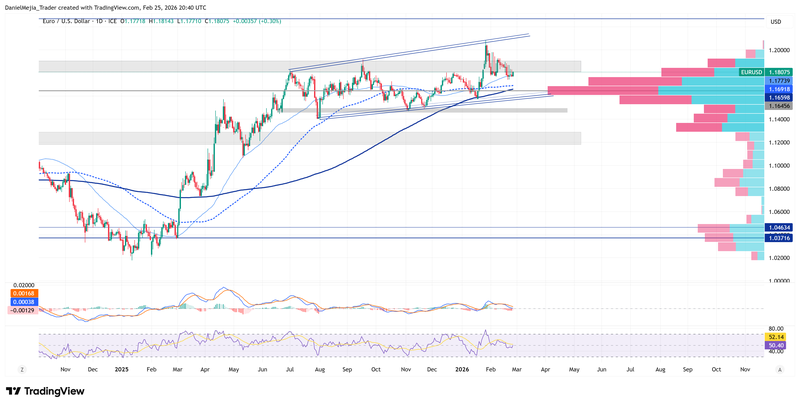
Figure 2. EUR/USD pair (2024–2026). Source: Data from the Intercontinental Exchange (ICE); own analysis conducted via TradingView.


