
 Support
EUR/USD pulls back as German economic sentiment falls sharply
The EUR/USD pair is currently testing a critical technical juncture, under pressure from a darkening economic outlook in Germany. This follows a significant decline in the ZEW Economic Sentiment Index, which plummeted into negative territory, falling substantially below both analyst estimates and previous readings.

The German ZEW Economic Sentiment Index dropped to –0.5, a sharp reversal from the previous reading of 58.3 and well below the market consensus.
German investors are increasingly wary of renewed inflationary pressures driven by rising energy costs, stemming from oil and natural gas supply chain disruptions in the Middle East.
Price action in the EUR/USD pair suggests a potential breakdown of its medium-term bullish structure—defined by higher highs and higher lows—following a pull-back from the lower boundary of a multi-month ascending channel.
German economic sentiment plummets amid rising concerns of potential inflation pressure
Data released by the Centre for European Economic Research (ZEW) revealed that the German Economic Sentiment Index fell precipitously from 58.3 in February to –0.5 in March. This result was significantly lower than the 39 points anticipated by analysts. This move into negative territory marks the lowest sentiment level since April 2025—coinciding with the announcement of global tariffs by US President Donald Trump—and it is similar to the volatility seen in March 2022 following the outbreak of the Ukraine-Russia conflict.
According to the ZEW report, German investors are concerned about the escalating US-Israel-Iran conflict, which is causing severe disruptions to energy supply chains in the Middle East. This geopolitical instability has already driven oil prices up by 50% over the past month. Analysts suggest that the long-term impact on energy prices will depend heavily on the duration of the hostilities and the extent of damage to regional energy infrastructure. Should infrastructure be significantly compromised, the capital investment and timeframe required for restoration would pose a substantial threat to the global supply chain.
The current conflict has persisted for over two weeks with no clear resolution in sight. While US officials suggest the engagement may last several weeks, Iranian counterparts have alluded to a timeline spanning months if needed. Recently, US president Trump requested military support from US allies to secure the Strait of Hormuz—a vital maritime corridor currently contested by Iranian forces. However, NATO nations have thus far expressed a reluctance to participate directly in the conflict.
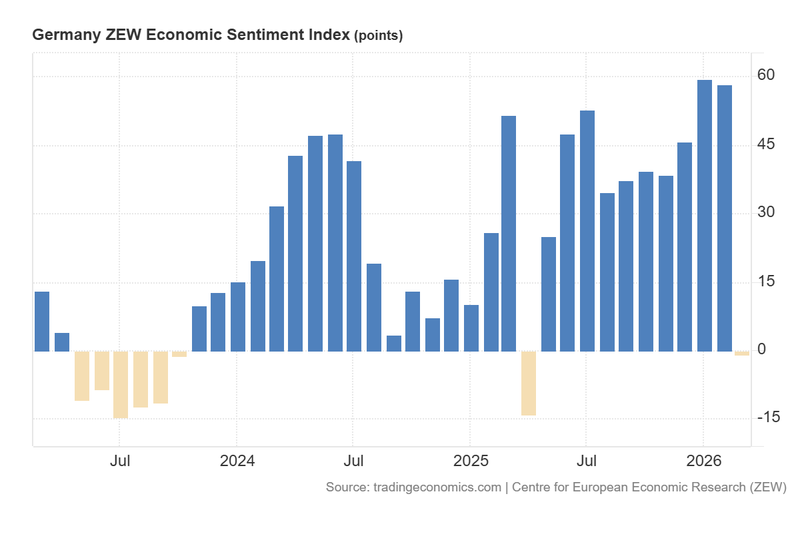
Figure 1. Germany ZEW Economic Sentiment Index (2023–2026). Source: Data from the Centre for European Economic Research (ZEW); Figure obtained from Trading Economics.
Technical analysis of the EUR/USD pair
From a technical perspective, the EUR/USD pair maintains a broad bullish posture in the long term, yet it is currently challenging a critical support zone within its short-term structure. Key observations include:
- Trend Context: Over the long term, the pair has preserved a market structure of higher highs and higher lows. However, the spot price is currently trading below the 50, 100, and 200-day Simple Moving Averages (SMAs). In the short term, the Euro is testing significant support (now acting as resistance) at the base of an ascending channel, exhibiting a "pull-back" structure against this newly established resistance level.
- Resistance Levels: Should the immediate short-term resistance at $1.1680 (coinciding with the 200-day SMA) be breached, the next major technical ceiling is identified at $1.1850—a significant long-term structural resistance zone. A decisive breakout above this level would indicate potential for further extension toward higher valuations.
- Support Levels: If the $1.1480 support level is compromised, the next relevant floor is situated at the $1.1230 structural pivot point. A breach of the $1.1230 zone would significantly increase the probability of a deeper market correction.
- Momentum Indicators: The Moving Average Convergence Divergence (MACD) reflects a prevailing downward trend, though it is approaching oversold territory. Similarly, the Relative Strength Index (RSI) is testing oversold levels. Given the current patterns of uncertainty, fundamental catalysts are likely to determine the next major directional shift.
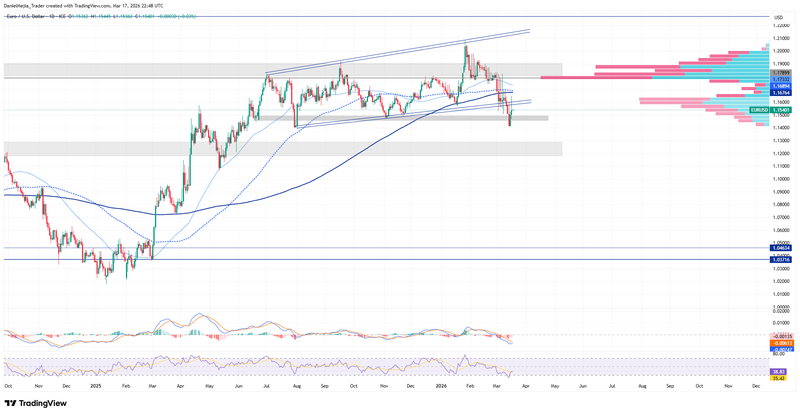
Figure 2. EUR/USD pair (2024–2026). Source: Data from the Intercontinental Exchange (ICE); own analysis conducted via TradingView.


