
 Support
GBP/USD rises as US–Iran ceasefire hits oil, offsetting hawkish Fed signals
The GBP/USD pair climbed as news of a tentative ceasefire between the United States and Iran prompted a decline in global energy prices, providing much-needed relief to the UK economy while sustaining expectations for future rate adjustments. Within the US context, despite hawkish Federal Reserve minutes indicating a readiness to implement further hikes if inflation persists, the resulting broad-based dollar weakness worked in favour of the pound.

Hopes for peace between the US and Iran led to a sharp contraction in energy costs, weighing on the dollar. However, domestic inflationary pressures in the United Kingdom remain a primary concern, as the country continues to report the highest inflation levels in the Western world.
The latest FOMC minutes reveal a hawkish tilt driven by inflationary risks, though a subset of members continues to prioritise labour market stability through potential rate cuts.
Technically, GBP/USD maintains its position within a long-term bullish channel, yet price action remains confined within a consolidative range that lacks a definitive directional bias.
Fed minutes signal a potentially restrictive stance if inflation exceeds targets
According to the Federal Reserve minutes pertaining to the March meeting, an increasing number of Federal Open Market Committee (FOMC) members are contemplating interest rate hikes in forthcoming sessions, given that current inflation levels remain stubbornly above the central bank’s 2% mandate. While US headline inflation is currently holding at 2.4%, the recent surge in energy prices following the US-Israel-Iran conflict in the Middle East has reignited fears of a secondary inflationary rebound. Furthermore, the core inflation rate has shown resistance to further declines, remaining stagnant around the 2.5% zone.
However, the committee appears to be navigating a bidirectional scenario. Some members advocate for lower rates to safeguard the US employment sector, citing the risk that a prolonged Middle Eastern conflict could dampen consumption, investment, and overall economic growth, thereby undermining labour conditions. These diverging perspectives highlight a non-linear policy path; consequently, the evolution of the geopolitical conflict is expected to be the primary determinant of upcoming monetary policy decisions.
At the market close, the US Dollar Index (DXY) fell following a significant decline in oil prices—with major crude benchmarks falling by more than 10%. This followed reports of a potential two-week ceasefire negotiated between Washington and Tehran. Nevertheless, recent Israeli strikes in Lebanon have cast doubt on the sustainability of the agreement. While Iranian officials assert that any peace deal must encompass Lebanese territory, US and Israeli representatives have stated that the aforementioned territory is excluded from the current framework.
The British pound emerged as one of the primary beneficiaries among Western currencies against the US dollar. The United Kingdom remains highly sensitive to fluctuations in energy costs, as it continues to report some of the highest inflation rates among Western economies. As a result, mounting pressure on the Bank of England (BoE) to bring inflation under control remains a key driver of sterling’s valuation.
Technical analysis of the GBP/USD pair
From a technical perspective, the GBP/USD pair continues to trade within a well-defined long-term bullish channel. However, the immediate market structure exhibits a consolidation pattern:
- Trend Context: Although the long-term trajectory for sterling remains technically bullish, the price is currently trading below its 50, 100, and 200-period Simple Moving Averages (SMAs). In the short term, the pair is oscillating within a consolidative range, reflecting a distinct absence of definitive directional momentum.
- Resistance Levels: Should the pair breach immediate resistance at 1.3420—a level where the 50, 100, and 200-period SMAs currently converge—the next significant technical ceiling is identified at the structural resistance of 1.3670. A decisive daily close above this threshold would signal a potential extension into higher price territory and a resumption of the primary bullish trend.
- Support Levels: If the short-term support at 1.3232 is invalidated, the next critical floor is situated at 1.3050, representing the lower boundary of the current ascending channel. A breach of the 1.3050 zone would significantly increase the probability of a more profound market correction.
- Momentum Indicators: Both the Moving Average Convergence Divergence (MACD) and the Relative Strength Index (RSI) are positioned in neutral territory, further confirming the current lack of a predominant market direction.
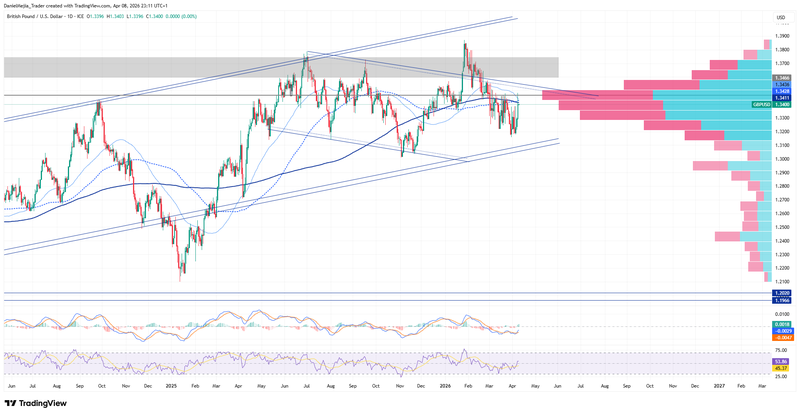
Figure 1. GBP/USD pair (2024–2026). Source: Data from the Intercontinental Exchange (ICE); own analysis conducted via TradingView.


