
 Support
Gold surges on US tariff concerns and economic pressure on the Fed
The gold futures contract (GCG26) advanced by more than 3% as a confluence of factors drove investors and hedgers toward safe-haven assets. This rally reflects heightened market anxiety regarding new trade barriers and shifting expectations for US monetary policy.

Gold futures climbed approximately 3.31% to reach $5,249 per ounce, propelled by renewed concerns over the implementation of trade tariffs by the Trump administration.
The precious metal found additional support as market participants re-evaluated the Federal Reserve’s trajectory amidst a deceleration in GDP growth and a simultaneous rebound in PCE inflation.
The long-term trend for gold remains resolutely bullish, with prices trading consistently above the 50, 100, and 200-period Simple Moving Averages (SMAs).
Gold prices jump amid fresh US tariff concerns and diverging economic pressures
Recent US Supreme Court rulings and executive policy statements have catalysed a significant move in the gold market. The gold futures contract (GCJ26) rose approximately 3.31% to $5,249 per troy ounce, driven by renewed uncertainty surrounding US trade policy. Following reports that the Supreme Court ruled certain tariffs imposed without congressional authorisation as unlawful, President Donald Trump announced intentions to increase temporary tariff rates from 10% to 15%. This move utilises emergency authority under Section 122 of the Trade Act of 1974—a time-limited measure typically capped at 150 days. Historically, such periods of acute political and legislative uncertainty stimulate demand for safe-haven assets.
Furthermore, geopolitical tensions in the Middle East—compounded by increased US naval deployments near Iran—have bolstered risk premia, further supporting safe-haven inflows. Simultaneously, recent US economic data has presented a challenging "stagflationary" signal: weakening GDP growth coupled with rising PCE inflation. This has led market participants to speculate that the Federal Reserve may be forced to maintain restrictive policy rates for a longer duration. While higher real interest rates typically create headwinds for non-yielding assets, the current intensity of geopolitical and trade risk appears to be the dominant driver for bullion.
Technical analysis of gold
From a technical perspective, gold futures maintain a robust long-term bullish trajectory. A detailed analysis of the current market structure reveals several key observations:
- Trend Context: Over the long term, gold exhibits a clear market structure defined by a series of "higher highs" and "higher lows". Prices remain significantly above the primary 50, 100, and 200-period Simple Moving Averages (SMAs), confirming the underlying strength of the prevailing trend.
- Resistance Levels: Should the current record high of $5,350 be breached, the next significant technical ceiling is identified at $5,500—a prominent psychological barrier. A sustained move above this level would signal a potential extension into uncharted price territory.
- Support Levels: In the event of a technical pullback, immediate short-term support is identified at $5,100. If this level is invalidated, the next structural floor is located at $4,850. This zone is particularly significant as it converges with the 50-day SMA and the support of an ascending trend line. A breach of the $4,850 level would notably increase the probability of a deeper market correction.
- Momentum and Volume: Both the Moving Average Convergence Divergence (MACD) and the Relative Strength Index (RSI) exhibit increasing upward pressure. Meanwhile, the Volume Profile and contract volumes indicate consistent demand, suggesting that fundamental hedging requirements continue to underpin the current price action.
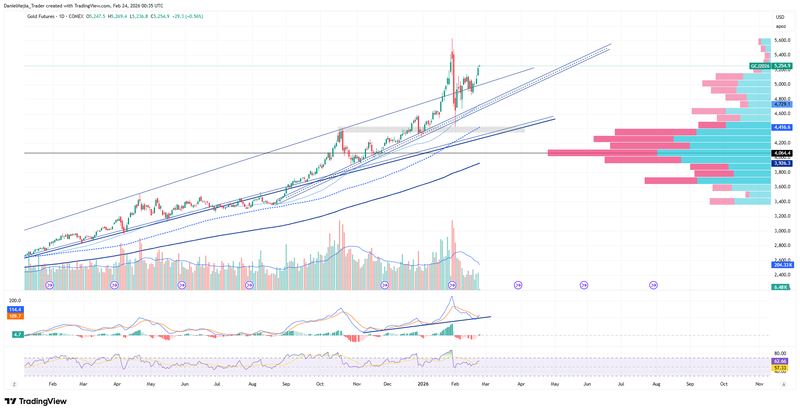
Figure 1. Gold Future Contract GCG26 (2025–2026). Source: Data from the COMEX Exchange; own analysis conducted via TradingView.


