
 Support
Oil market structural shifts, geopolitics, and technical outlook
The global oil market entering 2026 is shaped by long-term structural changes in production shares, evolving geopolitical risks, and increasingly technical-driven price behavior. OPEC’s declining production share and its implications for price-setting power, the constrained impact of Iranian and Venezuelan oil on global balances due to quality and logistical limitations.

Production has steadily declined from approximately 40% in the mid-1990s to the mid-30% range today.
Upside risk for oil prices, largely due to Iran’s strategic position near the Strait of Hormuz.
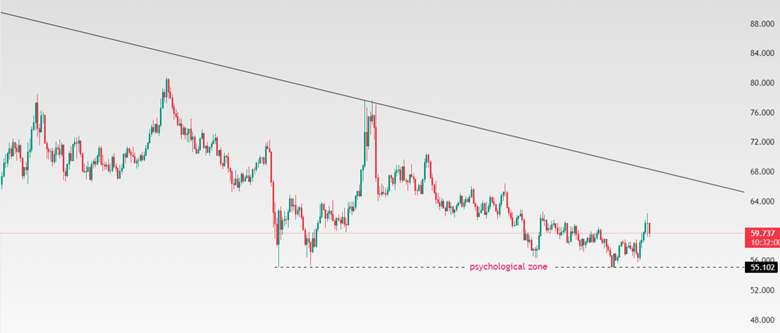
Current price behavior indicates that crude WTI is forming a medium-term range.
OPEC decline production
OPEC’s share of global crude oil production has declined steadily from nearly 40% in the mid-1990s to about 36.2% in 2024, according to the OPEC Annual Statistical Bulletin. Global crude production stood at roughly 72.6 million barrels per day in 2024, meaning OPEC no longer controls a majority of supply. This erosion in influence has been driven largely by the rise of U.S. shale production. U.S. crude output reached record levels near 13.6 million barrels per day in 2025, up from around 5–6 million barrels per day in the early 2000s and is expected to average approximately 13.5 million barrels per day in both 2025 and 2026. As a result, non-OPEC supply has become increasingly flexible and responsive to price changes, limiting OPEC’s ability to sustain higher prices without losing market share. The broader OPEC+ group reflects the same structural pressure. Its share of global oil supply has fallen from about 53% in 2016 to an estimated 46% in 2025–2026 as non-OPEC output continues to expand. With global liquids production projected by the EIA to rise from 105.9 million barrels per day in 2025 to 107.2 million barrels per day in 2026, OPEC’s policy focus has shifted toward managing volatility and preventing inventory builds rather than aggressively tightening the market.

Source: Macro Micro
Geopolitical tensions impact
Geopolitical tensions between Iran and the United States remain a key upside risk for oil prices, primarily because of Iran’s proximity to the Strait of Hormuz, through which roughly 20% of globally traded oil transits. However, recent market behavior suggests that this risk is increasingly priced as a volatility catalyst rather than a trend driver. In January 2026, Brent crude briefly rallied toward $66.82 per barrel amid heightened tensions, only to retreat more than 4% to around $63.60 once fears of immediate escalation subsided. This pattern reflects a market that reacts quickly to geopolitical headlines but rapidly reassesses once physical supply flows remains uninterrupted.
Looking ahead, the most likely outcome of continued Iran–U.S. conflict is a persistent geopolitical risk premium embedded in prices rather than a sustained supply shock. Iran’s estimated pre-sanctions export capacity of around 2 million barrels per day is significant, but against a global demand base of approximately 104.0 million barrels per day in 2025, rising to 105.1 million barrels per day in 2026, fluctuations in Iranian exports alone are insufficient to materially tighten the global balance. As a result, future flare-ups are more likely to trigger short-lived price spikes, followed by retracements as non-OPEC supply particularly U.S. shale responds and inventories absorb disruptions.
Technical outlook
Oil prices entering 2026 remain locked in a broad consolidation phase that has developed since the post-pandemic highs. Price action over the past two years shows repeated failures to sustain breakouts above key resistance zones, while downside moves have been contained by levels associated with marginal production costs, particularly for U.S. shale producers. This structure suggests that the market is transitioning from a trend-driven environment to one dominated by mean reversion and volatility.
Current price behavior indicates that WTI is forming a medium-term range, with downside support reinforced by cost-based supply responses and upside capped by producer hedging and incremental non-OPEC supply. Each rally triggered by geopolitical headlines or temporary supply cuts has tended to lose momentum once prices approach levels that incentivize increased output or forward selling. This pattern implies that upside moves in early 2026 are likely to be corrective rather than the start of a sustained bullish trend.
Momentum indicators further support this outlook. Medium-term oscillators point to weakening trend strength, suggesting that directional conviction remains limited. Volatility spikes are increasingly short-lived, consistent with a market that reacts quickly to news but lacks follow-through absent structural change. This technical backdrop favors sharp swings rather than sustained breakouts, reinforcing the probability of range-bound trading.
Source: Trading View


