
 Support
How to trade EUR/USD
If you are starting your trading journey, EUR/USD is the most important currency pair to understand. It is the most traded financial instrument in the world, which means high liquidity, tight spreads, and smooth price movement. For beginners, this makes EUR/USD easier to trade and easier to learn from than most other markets.

EUR/USD = 1.1867, it simply means that 1 euro is worth 1.1867 US dollars.
EUR/USD is mainly a battle between US interest rates and European interest rates.
The best trading hours are during the London and New York session overlap.
Many beginners enter trades without knowing what major economic events are coming. Interest rate decisions, inflation data, and employment reports.
Understanding the EUR/USD quote
When you see EUR/USD = 1.1867, it simply means that 1 euro is worth 1.1867 US dollars.
The euro is called the base currency, and the US dollar is the quote currency.
If you buy (go long) EUR/USD, you are betting that the euro will strengthen or that the US dollar will weaken.
If you sell (go short) EUR/USD, you are betting that the euro will weaken or that the US dollar will strengthen.
As a general rule, when economic news is negative for the United States, EUR/USD tends to move higher. When US data is strong, the pair usually moves lower.
What really moves EUR/USD
EUR/USD is mainly a battle between US interest rates and European interest rates. Capital flows toward the currency that offers higher returns.
In early 2026, the market is focused on when the Federal Reserve will start cutting rates. Mixed US labor and inflation data has created uncertainty. If the Fed cuts rates sooner or faster than expected, the US dollar usually weakens, pushing EUR/USD higher.
On the European side, the European Central Bank has been more cautious, holding rates steady. Because the ECB is not easing as aggressively as markets expect the Fed to, the euro has remained relatively stable, keeping EUR/USD near the 1.18 level.
Geopolitics and sentimental risk
The US dollar is considered a safe-haven currency. When global uncertainty rises, investors often move money into the dollar.
Recent geopolitical tensions, including disputes involving Greenland and renewed discussions around US tariffs on Europe, have increased short-term risk aversion. During these periods, the dollar tends to strengthen temporarily, which can push EUR/USD lower even if fundamentals favor the euro.
When to trade EUR/USD
EUR/USD does not move equally throughout the day. Timing matters.
The best trading hours are during the London and New York session overlap, from 1:00 PM to 4:00 PM GMT. This is when large banks and institutional traders are active, creating higher volatility and better trading opportunities.
The worst time for beginners is during the late Asian session, roughly 9:00 PM to 11:00 PM GMT. Price movement is usually slow, spreads feel larger, and trades often stall.
Trading approach
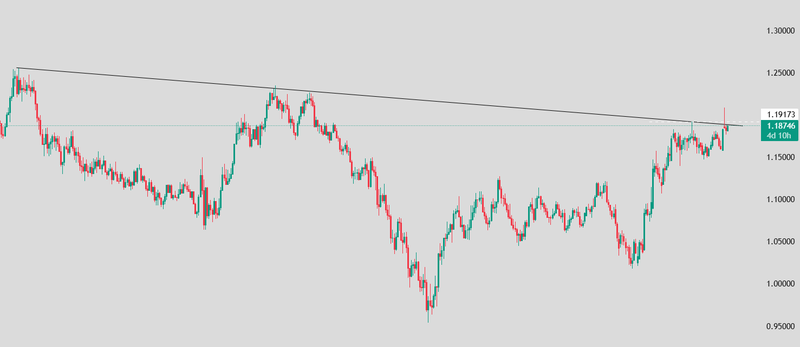
Start with the daily chart (D1). Ask one basic question: is the market trending up, trending down, or correcting?
For example, if EUR/USD recently rallied toward 1.20 and is now pulling back to 1.18, this is a correction within a larger trend. A beginner should avoid chasing price and instead wait to see whether 1.18 holds as support.
Source: Trading View
If the price stabilizes and shows signs of bouncing, that area may offer a lower-risk buying opportunity. If it breaks clearly below support, staying out is often the smartest decision.
Common EUR/USD trading mistakes beginners should avoid
Trading without understanding the news
Many beginners enter trades without knowing what major economic events are coming. Interest rate decisions, inflation data, and employment reports can move EUR/USD sharply within minutes. Trading blindly during these releases often leads to sudden losses, even if the technical setup looks perfect.
Overtrading during low-volatility hours
EUR/USD is not active all day. Trading during quiet sessions, especially late Asian hours, often results in small, choppy moves where spreads and fees slowly eat into your account. Fewer trades during high-quality hours usually outperform constant trading.
Ignoring the higher timeframe
Focusing only on short-term charts can be dangerous. Beginners often sell into an uptrend or buy into a downtrend because they ignore the daily or weekly direction. Always check the daily chart first to understand the broader market context.
Using too much leverage
High leverage magnifies small mistakes. Many new traders blow accounts not because they are wrong often, but because one bad trade is oversized. EUR/USD moves slowly compared to crypto or stocks, so patience and smaller position sizes are essential.
Chasing breakouts after big moves
Buying after a strong rally or selling after a sharp drop usually means entering late. By the time beginners react, professional traders are often taking profits. Waiting for pullbacks to key levels is usually safer.
FQAs
What is the best time of day to trade EUR/USD?
The most profitable time to trade EUR/USD is during the London and New York session overlap, typically from 1:00 PM to 4:00 PM GMT. This window offers the highest liquidity and volatility, leading to tighter spreads and more significant price movements.
How do US interest rates affect the EUR/USD pair?
Interest rates are the primary driver of the EUR/USD. Generally, if the Federal Reserve raises interest rates, the US Dollar strengthens, causing EUR/USD to fall. In 2026, the market is highly sensitive to Fed rate cuts; a faster-than-expected cut usually weakens the Dollar and pushes the EUR/USD higher.
What are the biggest risks for EUR/USD traders in 2026?
Key risks include geopolitical tensions (such as trade tariffs or regional disputes) and economic data surprises. Because the USD is a "safe-haven" currency, global uncertainty often causes the pair to drop as investors flee to the safety of the Dollar, regardless of the Eurozone's economic health.
Can I trade EUR/USD with a small account?
Yes, most brokers allow you to trade using micro lots (1,000 units), which makes EUR/USD accessible for beginners. However, it is essential to use leverage cautiously. While it can magnify gains, it also increases the risk of significant losses on a small balance.
What economic reports should I watch for EUR/USD?
Traders must monitor three major reports: Non-Farm Payrolls (NFP) for US employment, Consumer Price Index (CPI) for inflation, and Central Bank Policy Statements from the Fed and the ECB. These events can cause the pair to move hundreds of pips in a matter of minutes.


