Support
Gold consolidation paves the way for new highs in 2026
Central bank buying, falling real yields and heightened geopolitical tensions remain the three dominant forces shaping the gold market, supporting prices into 2026 and reinforcing gold’s role as a strategic hedge.

China has increased its reserves for 13 consecutive months.
U.S. real yields entered a downward trajectory during the second half of 2025.
Gold ETFs experienced their strongest inflows since 2020.
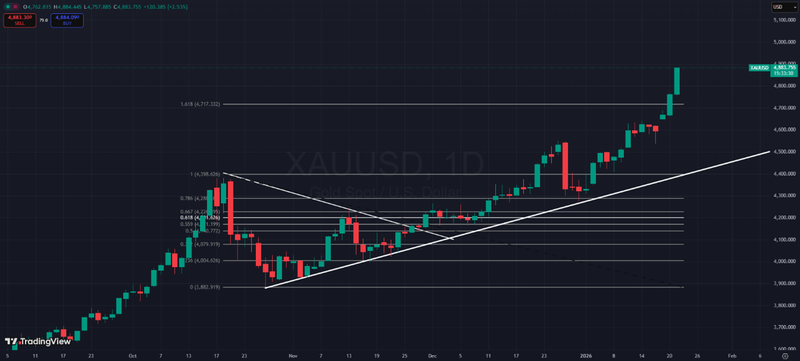
The $4,700 level remains a critical breakout point, potentially opening the path toward $4,820 and then $4,900.
Central bank buying remains gold’s key driver
2025 witnessed one of the strongest central bank gold-buying cycles since the 1970s.
What stood out was not only the scale of purchases, but their structural nature. China increased its gold reserves for 13 consecutive months, Gulf countries raised gold allocations as part of reserve-diversification strategies and emerging economies such as Turkey and Kazakhstan added aggressively for financial-stability reasons.
This shift has pushed gold to trade, for the first time in years, more like a de facto alternative international currency than merely a commodity or store of value.
As a result, central bank demand has effectively created a long-term price floor around $3,300, giving gold strong structural support.
Falling real yields: A crucial financial catalyst
US real yields moved onto a downward trajectory in the second half of 2025, driven by expectations of rate cuts in 2026.
Each decline in real yields reduced the relative appeal of government bonds, boosted demand for gold and encouraged hedge funds to build larger long positions.
Gold’s sensitivity to real yields reached its highest level since 2019. The inverse correlation between gold and real yields has become stronger than gold’s relationship with the US dollar itself.
Gold ETFs make a strong comeback
In addition to central bank demand and falling real yields, gold-backed ETFs played a renewed and significant role in 2025.
After two years of outflows, gold ETFs recorded their strongest inflows since 2020, with holdings rising by more than 220 tonnes over the year, according to the World Gold Council.
These inflows amplified price momentum by increasing market sensitivity, reducing available liquidity and creating immediate physical and hedging demand. This helped push prices rapidly towards new highs.
In 2025, ETF flows mirrored the dynamics seen in 2020, but this time amid higher geopolitical risk and lower confidence in monetary policy, reinforcing gold’s status as the preferred institutional hedge.
Geopolitical tensions boost safe-haven demand
The geopolitical landscape in 2025 was marked by heightened uncertainty, including:
- Renewed US–China trade tensions
- Escalating conflicts in the Middle East
- Widespread protests inside Iran
- Erosion of confidence in US monetary-policy stability
- Recession fears in Europe
These factors strengthened gold’s role as a systemic-risk hedge, driving demand from institutional investors and sovereign wealth funds.
Technical outlook: Uptrend still unfolding
Gold is trading around $4,850, maintaining strong upside momentum. Price is consolidating above a key support zone at $4,740–$4,660, keeping any downside moves within a healthy corrective range.
The broader trend remains bullish, with oscillators cooling after coming off overbought levels.
A break above $4,900 would open the way toward $5,060 and $5,220. A move below $4,660 would point to a contained pullback toward $4,510, without undermining the primary uptrend.