Support
OPEC+ control and geopolitical risk keep oil resilient in Q1
Brent should remain supported in Q1 as OPEC+ actively manages supply and geopolitical tensions keep risk pricing elevated. However, softer demand and improving fuel efficiency are likely to cap rallies, keeping the market rangebound.

OPEC’s ability to stabilize the market despite global supply pressures.
Demand from India and the Middle East is supportive, but insufficient alone to drive oil prices higher.
Regional disruptions add a “risk premium” of roughly $4–$7 per barrel for Brent crude.
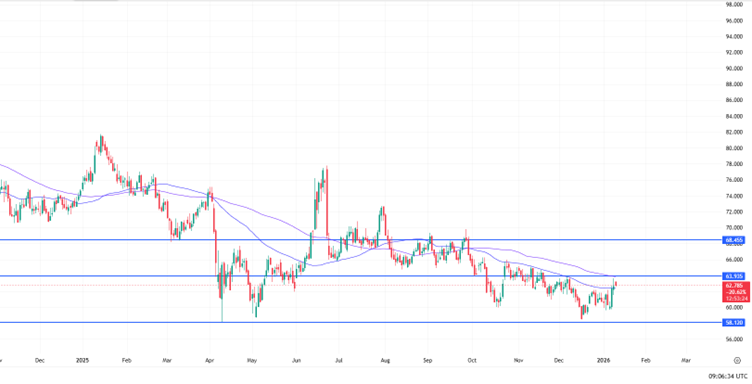
A breakout above $64 marks the first real reversal signal in a year, potentially pushing prices toward $66–$68 per barrel.
OPEC+ managing a fragile market
Throughout 2025, OPEC+ maintained one of its most flexible and dynamic policy frameworks, combining calibrated gradual cuts with monthly production reviews and swift intervention when prices softened.
This strategy successfully prevented Brent from falling below $58–60, keeping prices within a relatively tight $60–64 range in the final quarter of 2025, reflecting the alliance’s strong grip on market balance despite global oversupply.
Slow demand growth with persistent risks
The International Energy Agency expects oil demand growth in 2026 to be the slowest in 12 years. This reflects weakness in China’s industrial sector, stagnation in Europe, rising fuel-efficiency standards and slower energy-transition momentum, with coal consumption rising again in parts of Asia.
While India and the Middle East remain bright spots, their demand growth alone is insufficient to push Brent beyond $65 without OPEC+ support.
Geopolitical risk premium supporting prices
Tensions in the Red Sea, sanctions on Russian oil and broader regional instability continue to add a risk premium of $4–7 per barrel.
This premium has been the primary factor preventing Brent from falling below $60 despite weak macro demand, acting as the key stabilising force in the current price structure.
Technical outlook: Bearish trend still dominant
Oil has remained in a sustained downtrend since mid-2024, with repeated failures to break above the 200-day moving average at $63.8–64, which now serves as the dominant resistance zone.
The 50-day moving average around $62.3–62.5 is providing near-term support, while remaining below $64 keeps the broader downtrend intact.
Key support sits at $60, followed by $58, while a breakout above $64 would represent the first genuine trend reversal in a year and open upside towards $66–68.
Until then, Brent is likely to remain trapped within the $60–64 descending channel.
Brent has traded within a broader $65–88 range since 2023. In 2026, upside could extend to $95–100 in the event of renewed geopolitical shocks or aggressive OPEC+ tightening, while downside risk sits around $63–65 if global demand deteriorates sharply.