Support
Japan’s yen intervention likely topped $34 billion as authorities defend the 160 line
Japan likely spent about $34.5 billion in the market on Thursday to halt the yen’s slide, marking its first currency intervention since July 2024. The move appears to have been large, deliberate and politically significant, signaling that Tokyo still sees the 160-per-dollar area as a red line even under a new prime minister and finance minister.
Japan likely spent around ¥5.4 trillion, or about $34.5 billion, on Thursday’s yen-buying intervention.
The action appears to be the first currency intervention since July 2024.
The yen rebounded sharply after weakening to 160.72 per dollar, its softest level since mid-2024.
Markets are now watching for a possible follow-up move during Japan’s Golden Week holiday period.
Japan appears to have stepped back into the currency market
Japan likely spent about $34.5 billion to support the yen on Thursday, according to a Bloomberg calculation based on Bank of Japan account data and forecasts from money-market brokers. The estimated size of the move, around ¥5.4 trillion, would make it a major intervention and the first such operation since July 2024.
The scale matters. It suggests Japanese authorities did not simply want to slow the yen’s fall. They wanted to send a message.
The 160 level still looks like Tokyo’s line in the sand
The intervention came after the yen weakened to 160.72 per dollar earlier in the day, its softest level since the middle of last year. The speed of the rebound that followed strongly suggested official action, even if top currency official Atsushi Mimura declined to confirm it publicly. A person familiar with the matter later told Bloomberg that authorities had entered the market.
That response also carries a political message. This was the first intervention under Finance Minister Satsuki Katayama and the first since Sanae Takaichi became prime minister. Yet the market signal looks familiar: Japan’s tolerance for yen weakness still appears to run out around the 160 area.
The intervention was large, but the job may not be finished
The yen surged after the move, briefly pulling back toward the 155 level against the dollar before giving up part of those gains. By Friday evening in Tokyo, it was trading around 156.59.
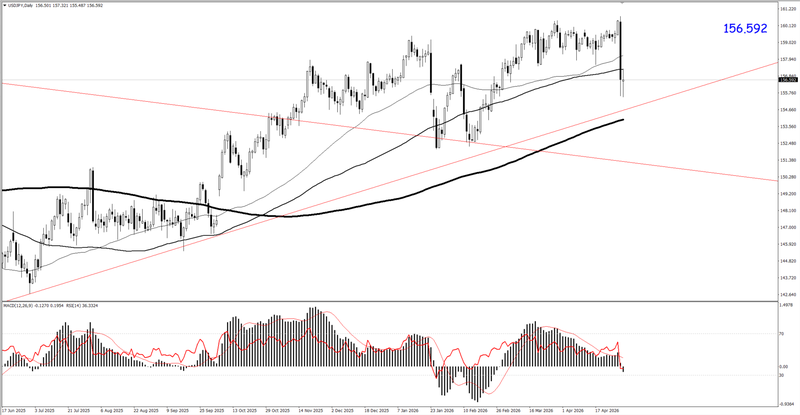
That is the risk Japan now faces. The first strike can jolt speculators, but unless it is followed by either more intervention or a convincing shift in the underlying rate outlook, the market may begin to test the authorities again.
The timing echoes Japan’s playbook from two years ago
Thursday’s move recalled Japan’s intervention campaign at the start of Golden Week two years ago. On that occasion, authorities spent a record ¥5.92 trillion in their first operation, then came back with another round to reinforce the impact. That follow-up move helped push the yen down into the 153 range against the dollar.
The comparison matters because it shapes what traders expect next. With markets already volatile and Japan entering a holiday period, investors are asking whether Tokyo is preparing to repeat that pattern.
Bank of Japan data point to a sizable market operation
Friday’s central-bank data added weight to the view that intervention took place. The BOJ said it expects its current account to fall by ¥9.48 trillion next Thursday, the first business day after the Golden Week break. That was far larger than the roughly ¥4.08 trillion decline projected by major money brokers.
The gap between those figures is what underpins the estimate that around ¥5.4 trillion was spent in the market.
Oil may also be part of the story
Mimura also suggested on Friday that Japanese authorities were prepared to intervene in the crude oil futures market if necessary. That introduced another possible dimension to Thursday’s action, though it remains unclear whether Tokyo actually entered the oil market or whether the moves in crude and the yen merely happened at the same time.
That question is not trivial. Japanese officials have repeatedly argued that speculative activity in oil futures has worsened pressure on the yen by amplifying import-cost concerns. If authorities did intervene in both markets, the overall scale of Thursday’s operation may have been even larger than the estimated ¥5.4 trillion.
Markets are now focused on whether Japan acts again
For now, the bigger question is not whether Tokyo intervened. It is whether it is prepared to do it again.
Katayama’s warning to traders not to put their phones down during the holiday period was a pointed reminder that Japanese officials remain on alert. The message was clear enough: even during Golden Week, the market should not assume the authorities are off duty.
That is why Thursday’s operation may matter beyond the headline number. It was not only an effort to support the yen. It was also a warning shot aimed at speculative positioning.
Japan has bought time, not solved the problem
The intervention appears to have been effective in the immediate sense. It pulled the yen away from a level that officials clearly find unacceptable and reminded traders that Japan is still willing to spend heavily when the currency weakens too far, too fast.
But it has not removed the broader pressure on the yen. As long as the gap between Japanese and US rates remains wide and market volatility stays elevated, the risk of renewed weakness remains.
Japan has shown it will defend the 160 line. The market’s next move will be to find out how often, and how forcefully, it is willing to do so.