
 Support
 Stocks retreat as US–Iran tensions persist; US retail sales jump, UK jobless rate dips
Global equities retreated as escalating US–Iran tensions exacerbated geopolitical uncertainty and drove energy prices higher. Conversely, the US economy demonstrated notable resilience, with retail sales reaching a one-year high. Meanwhile, the UK unemployment rate declined to 4.9%, reflecting a recovery in the labour market despite a cooling in overall employment growth.

Escalating US–Iran tensions and naval blockades triggered a global retreat in equities and propelled Brent crude oil prices toward $98.48 per barrel.
US retail sales surged 1.7% in March, surpassing forecasts to mark the strongest growth since 2025, supported by robust consumer and gasoline expenditure.
The UK unemployment rate fell to 4.9%, its lowest level since September 2025, signalling a recovery despite a visible slowdown in the rate of job creation.
The US dollar strengthened following the positive retail data, whereas the British pound depreciated as markets awaited the upcoming UK inflation figures.
Rising US–Iran tensions impact global equities and heighten economic concerns
US President Donald Trump has announced an indefinite extension of the ceasefire with Iran shortly before its scheduled expiration. The White House maintains that this move is intended to allow peace negotiations to continue. However, President Trump’s remarks also indicated that the US naval blockade of Iranian ports will remain in force. In response, Iranian Foreign Minister Abbas Araqchi stated that the US blockade is viewed as an ‘act of war’ and a direct violation of the ceasefire. Additionally, a senior Iranian official informed Reuters that Iran may participate in talks with the US in Pakistan, provided Washington abandons its policy of pressure and threats.
Prior to these declarations, global stock markets retreated amidst heightened geopolitical uncertainty. In the United States, the S&P 500, the Dow Jones Industrial Average, and the Nasdaq 100 indices fell by an average of 0.55%. In Europe, the French CAC 40 decreased by 1.14%, the UK’s FTSE 100 fell by 1.05%, and the Spanish IBEX 35 depreciated by 0.65%, while the German DAX 40 dropped by 0.60%. Results in Asia were mixed: the FTSE China A50 decreased by 0.75% and the Hang Seng index fell by 1.02%, while the Japanese Nikkei 225 appreciated by 0.89%.
In contrast, oil prices rose as concerns mounted regarding the duration of the conflict and its potential impact on energy supply chains. The Brent futures contract (BRNM6) appreciated by 3.14% to $98.48 per barrel. Simultaneously, the West Texas Intermediate (WTI) futures contract (CLM6) rose by 2.5% to $89.65 per barrel, while gasoline futures (RBM6) advanced by 3% to $3.12 per gallon.
US retail sales reach highest level since March 2025
According to data from the US Census Bureau, retail sales increased by 1.7% on a monthly basis in March, slightly exceeding analyst forecasts of a 1.4% rise. This reading represents the highest growth rate since March 2025, occurring despite the Middle Eastern conflict’s significant impact on consumer confidence. Consequently, year-on-year retail sales grew by 4% during the same period.
An analysis by Trading Economics suggests that consumer spending remains robust, although the primary driver of this monthly increase was a significant surge in gasoline station receipts.
Regarding the market reaction, the US Dollar Index (DXY) rose by 0.36% to 98.41 points. Retail sales are considered a critical economic indicator and typically provide support to the greenback when results exceed expectations.
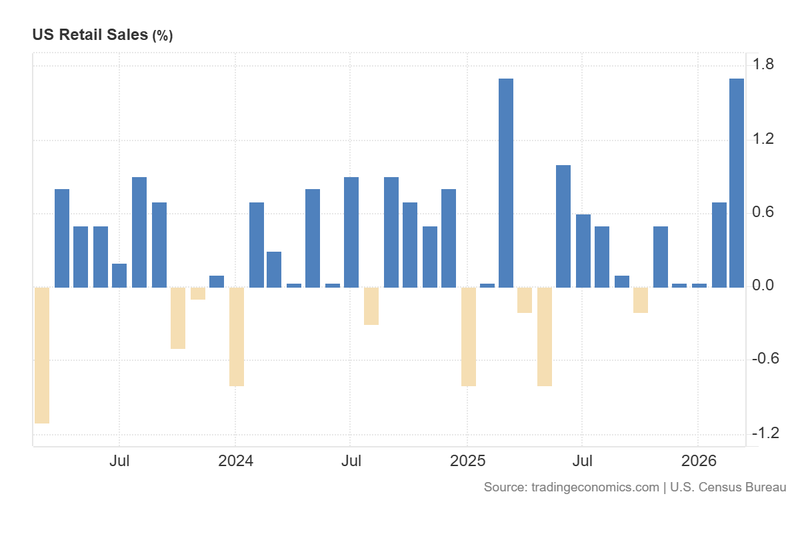
Figure 1. US Retail Sales (2023–2026). Source: Data from the US Census Bureau; Figure obtained from Trading Economics.
UK unemployment rate declines below analyst forecasts
According to the Office for National Statistics (ONS), the UK unemployment rate decreased from 5.2% in January to 4.9% in February, outperforming analyst estimates which had anticipated the rate to remain unchanged. This figure marks the lowest level since September 2025, suggesting a significant recovery in the labour sector. Previously, a weaker job market had been placing pressure on the Bank of England (BoE) to implement more accommodative monetary policies. Concurrently, however, the employment change data indicated a deceleration, falling from 84,000 to 25,000.
Market participants have now shifted their focus to the UK inflation data for March. Analysts are keen to assess the extent to which the sharp rise in energy prices, resulting from the Middle Eastern conflict, has permeated UK inflationary pressures.
Following these economic releases, the British pound depreciated by 0.24% against the US dollar, trading at 1.3497.

