
 Support
 EU retail sales surpass forecasts but decelerate marginally; Euro retreats
European Union (EU) retail sales outperformed March expectations at 1.2%, though a cooling trend persists as consumer spending reaches a two-year low. A divergent performance across member states, coupled with geopolitical headwinds, has exerted downward pressure on the Euro.
March retail sales grew by 1.2% year-on-year, beating forecasts but marking a deceleration from February’s 1.3%—current reading is the lowest level of consumer demand recorded since July 2024.
National data revealed significant disparities; Germany and Italy recorded monthly declines, whereas Spain, the Netherlands, and France posted gains in sales.
The EUR/USD pair is currently rangebound within a consolidation phase, with momentum indicators such as the MACD and RSI remaining in neutral territory, signalling a lack of definitive market direction.
EU retail sales surpass forecasts but decelerate slightly; Euro retreats
According to data from Eurostat, retail sales in the European Union decelerated from 1.3% in February to 1.2% in March on a year-on-year basis, though this figure remained above the analysts’ consensus forecast of 1%. Despite outperforming expectations, the result underscores a prevailing downward trend over the past twelve months, suggesting that consumer spending is retrenching amidst heightened geopolitical and economic instability.
The updated figures represent the weakest level of retail activity since July 2024. Additionally, an analysis from Trading Economics indicates that, on a month-on-month basis, retail sales contracted by 2.1% in Germany and 0.1% in Italy. Conversely, growth was observed elsewhere, with sales rising by 1.2% in Spain, 1.1% in the Netherlands, and 0.2% in France. In response to these mixed data points, the Euro softened against the US Dollar, falling by 0.17% to $1.1725 as the pair continued to oscillate within a consolidation pattern.
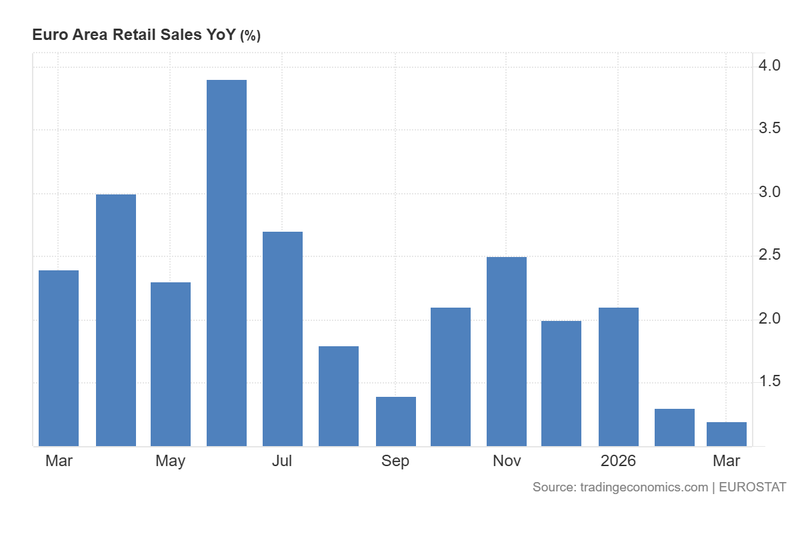
Figure 1. Euro Area Retail Sales YoY (2025–2026). Source: Data from Eurostat; Figure obtained from Trading Economics.
Technical analysis of the EUR/USD pair
From a technical perspective, the EUR/USD pair is currently characterised by short-term consolidation. Key observations include:
- Trend Context: Over recent months, the pair has remained rangebound, reflecting a period of market indecision. Notably, the price action continues to respect the 50, 100, and 200-day Simple Moving Averages (SMAs), which are currently functioning as a significant support zone.
- Resistance Levels: Should the long-term structural resistance at $1.1850 be breached, the next major technical ceiling is identified at the $1.2000 psychological barrier. A decisive breakout above this level would suggest the potential for a sustained extension toward higher valuations.
- Support Levels: If the $1.1680 support level is compromised, the next relevant floor is situated at $1.1470 (the lower boundary of the consolidation range). A breach of the $1.1470 zone would significantly increase the probability of a deeper market correction.
- Momentum Indicators: Both the Moving Average Convergence Divergence (MACD) and the Relative Strength Index (RSI) are trading near their neutral mid-points, suggesting a lack of predominant momentum. Consequently, fundamental developments are likely to be the primary determinants of the market’s prevailing trend in forthcoming periods.
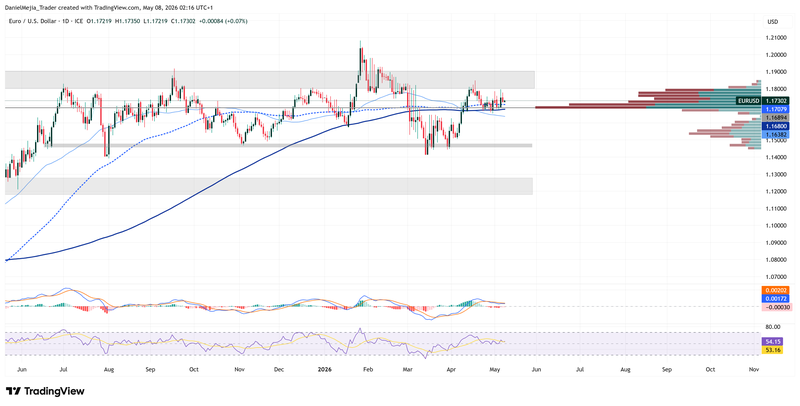
Figure 2. EUR/USD pair (2025–2026). Source: Data from the Intercontinental Exchange (ICE); Own analysis conducted via TradingView.


