
 Support
China warns U.S. after 245% tariff shock, but Q1 GDP beats expectations
Beijing warns it “won’t stay silent” after the U.S. slaps Chinese imports with tariffs as high as 245%. Yet on the same day, China reports stronger-than-expected GDP growth, highlighting an economy defying pressure but still burdened by structural cracks.

The White House confirms tariffs on Chinese goods have been raised to as high as 245%.
China’s Foreign Ministry accuses Washington of “wanton force” and urges dialogue over pressure.
White House confirms massive tariff escalation
In a sharp escalation of trade tensions, the White House confirmed that Chinese imports are now subject to tariffs of up to 245%. The increase—described by officials as a countermeasure to Beijing’s ongoing retaliatory actions—signals a hardening U.S. stance on trade just as diplomatic relations continue to erode.
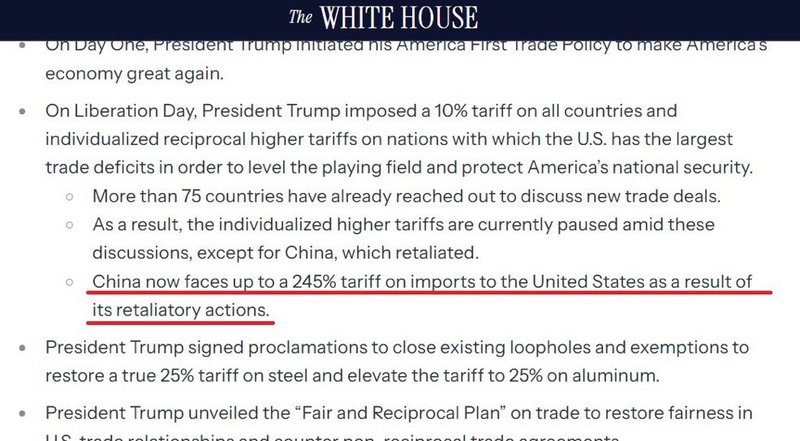
The announcement is the most aggressive tariff move in recent years, exceeding the 145% rate announced just weeks ago. Washington cited China’s alleged unfair practices and export controls as justifications for the increase, despite growing fears that such actions could trigger further global supply chain disruptions and consumer price volatility.
Beijing strikes a defiant tone: “Won’t stay silent”
Responding to the tariff hike, China’s Foreign Ministry stressed it does not seek confrontation, but made clear it would not remain passive under pressure. “If the U.S. truly wants to resolve issues through dialogue, it must stop exerting maximum pressure,” said spokesperson Zhang Xiaogang.
He added that the current path chosen by Washington only deepens conflict, labeling the U.S. moves as a “wanton use of force.” In a pointed rebuke, Zhang warned that tariffs “won’t restore American greatness,” a reference to U.S. domestic political rhetoric.
China has not yet announced direct countermeasures, but analysts expect targeted retaliation if tensions continue to escalate in coming weeks.
Beijing denies Boeing delivery suspension rumors
In a separate development, China's Foreign Ministry dismissed recent reports that it had ordered local airlines to suspend deliveries of Boeing aircraft. “We are not aware of such a directive,” a spokesperson said, in response to growing speculation about China leveraging its aircraft market as a bargaining chip in the trade standoff.
The comment may be an attempt to manage market perceptions, especially as Boeing’s stock has come under pressure amid geopolitical uncertainty and China’s increasing scrutiny of U.S. firms.
Q1 GDP data: Strength with structural fragility
On the economic front, China reported surprisingly strong Q1 GDP growth of 5.4% year-on-year—above consensus estimates of 5.1%. The quarterly pace, however, slowed to 1.2% from 1.6% in Q4, suggesting momentum is easing beneath the surface.
March’s data was broadly supportive. Industrial production surged by 7.7% year-on-year, handily beating the 5.6% forecast, while retail sales climbed 5.9%, outperforming expectations of 5.1%. These figures point to a resilient domestic consumer and industrial base despite mounting external pressures.
However, the recovery narrative remains hampered by the property sector’s continued slump. Real estate investment fell 9.9% in Q1, worse than the -9.8% decline seen in January-February, and signals ongoing weakness in a sector that historically accounted for nearly 30% of China’s GDP.
Private sector fixed asset investment rose by just 0.4%, indicating subdued business confidence amid regulatory uncertainty and weak credit demand.
