
 Support
 Oil volatility surges amid Hormuz instability; RBA raises rates, ISM PMI expands
Oil prices have experienced heightened volatility amidst significant instability in the Middle Eastern region. Simultaneously, the Reserve Bank of Australia (RBA) increased interest rates to 4.35% to mitigate energy-driven inflationary pressures. In the United States, the ISM Services PMI indicated continued expansion at 53.6, although the figure fell short of analyst forecasts.

Crude prices retreated by 4% amidst escalating tensions in the Strait of Hormuz and United Nations discussions regarding potential sanctions and the authorisation of force against Iran.
The RBA raised its benchmark rate to 4.35% to address a 4.3% inflation rate, citing Middle Eastern energy disruptions as a primary catalyst for the 25-basis-point hike.
The ISM Services PMI reached 53.6, missing expectations; elevated energy costs are impacting new orders despite resilience in employment and general business activity.
Global tensions are mounting as the US seeks support from NATO and Asian countries for maritime security, increasing the risk of a broader regional escalation.
Oil prices signal high volatility amidst geopolitical instability in the Strait of Hormuz
Oil prices are exhibiting significant volatility driven by geopolitical instability in the Middle East. The Brent crude futures contract (BRNN6) fell by 4% to $109.80 per barrel, while the West Texas Intermediate (WTI) futures contract (CLM6) decreased by 3.9% to $102.26 per barrel.
According to a report by Reuters, United Nations (UN) Security Council members are set to begin deliberations on a draft resolution—backed by the US, Saudi Arabia, the United Arab Emirates, Kuwait, and Qatar—aimed at imposing sanctions against Iran. The resolution potentially would authorise the use of force should the country fail to cease its military actions in the maritime region. Concurrently, the United States has announced an initiative designated "Project Freedom", involving the deployment of the US Navy to escort commercial vessels through the Strait of Hormuz.
The White House has requested support from several nations in Asia and Europe, most notably China and members of NATO, to guarantee the freedom of navigation through the Strait. However, direct involvement by additional foreign powers could exacerbate the regional conflict. At present, the solicited nations have not issued a formal response to the US requirement. Meanwhile, Iran maintains its firm stance regarding its sovereignty over the Strait of Hormuz, which it borders alongside Oman.
RBA increases interest rates in line with analyst expectations
The Reserve Bank of Australia (RBA) has elected to increase its benchmark interest rate by 25 basis points to 4.35%, aligning with market consensus. This move represents the third rate hike of the current year. According to the RBA’s official statement, the decision was reached via a nearly unanimous 8–1 vote. The Australian central bank expressed grave concerns regarding the US–Israel–Iran conflict, noting that disruptions to the energy supply chain have placed upward pressure on inflation and the general cost of living.
Currently, the RBA is contending with a headline inflation rate of 4.3% alongside a decelerating employment sector. Consequently, the central bank has returned interest rates to the 4.35% peak, a level not seen since January 2025. Following the announcement, the Australian dollar appreciated by 0.35% against the US dollar, trading at $0.7207.
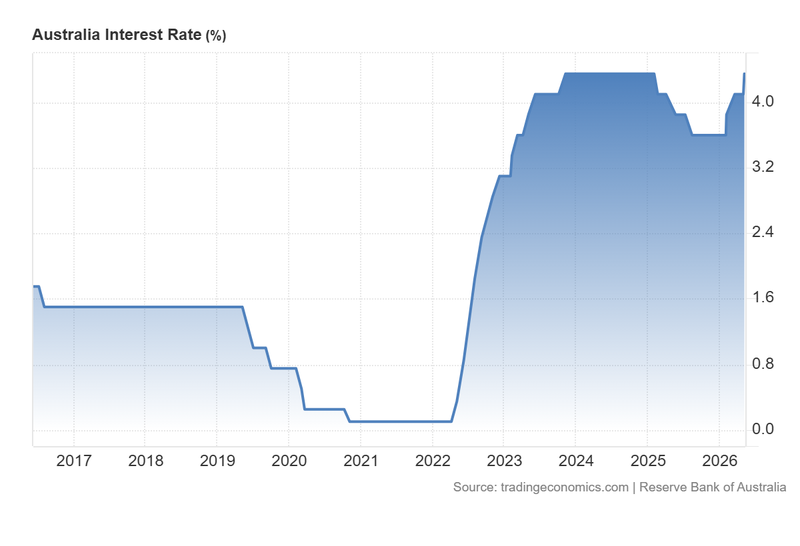
Figure 1. Australia Interest Rate (2016–2026). Source: Data from the Reserve Bank of Australia; Figure obtained from Trading Economics.
US ISM Services PMI indicates expansion but misses forecasts
According to data from the Institute for Supply Management (ISM), the US Services PMI experienced a marginal decrease from 54.0 in March to 53.6 in April, falling slightly below the forecast of 53.7. Although this reading confirms continued expansion—as it remains above the neutral 50.0 threshold—it suggests a subtle weakening within the services sector.
The ISM report indicates that this slight deterioration was driven by a month-on-month decline in new orders and heightened price pressures resulting from the sharp appreciation of energy commodities. Conversely, the sub-indices for business activity, production, and employment rose in tandem, demonstrating a degree of economic resilience within the broader services industry despite the prevailing geopolitical headwinds.
