Support
 IMF sees wide policy flexibility for BoJ on inflation
The International Monetary Fund (IMF) suggests that Japan maintains considerable policy flexibility despite the impact of global energy shocks, categorising current inflationary pressures as manageable. The IMF considers that the Bank of Japan (BoJ) has the necessary room for manoeuvre to pursue its long-term monetary objectives.

The IMF posits that energy-driven inflation stemming from Middle Eastern instability may have a restricted impact on Japan.
A BoJ interest rate level of 1.5% by late 2027 is viewed as a reasonable by the IMF, reflecting confidence in the nation’s underlying economic stability.
The USD/JPY pair is currently oscillating within a technical triangle pattern, encountering significant resistance at the ¥160 mark amidst high market volatility.
IMF suggests inflationary pressures may be limited, enhancing BoJ’s policy flexibility
According to reports from Reuters, the International Monetary Fund (IMF) has indicated that inflationary pressures arising from the US-Israel-Iran conflict—which has prompted a sharp escalation in global energy prices—may have a limited effect on Japan. This outlook highlights a significant "room for manoeuvre" for the Bank of Japan (BoJ) as it continues to navigate its monetary policy objectives. The IMF considers a potential BoJ interest rate target of approximately 1.5% by the mid-to-late 2027 period. Furthermore, the international body suggests that the BoJ should allow market forces to determine the value of the Japanese yen at appropriate levels, as this is unlikely to generate excessive inflationary pressure through imports. In summary, the IMF observes that the Japanese economy has exhibited high resilience despite headwinds such as US tariffs and rising energy price pressures.
The Bank of Japan remains confronted by a dual dilemma: escalating inflationary risks and yen depreciation exert pressure on the central bank to adopt a more restrictive (hawkish) stance. Conversely, the BoJ must navigate these challenges within a broader context of subdued economic growth.
Regarding market sentiment, the Japanese yen experienced a marginal appreciation following these remarks. However, the USD/JPY pair continues to oscillate within a technical triangle pattern, signalling a period of prevailing market uncertainty.
Technical analysis of the USD/JPY pair
From a technical perspective, the USD/JPY pair currently exhibits bullish momentum as it tests critical resistance levels within a long-term consolidation pattern. Key observations include:
- Trend Context: In the long term, the pair remains confined within a broad consolidation range, reflecting persistent market indecision. However, the medium-term trajectory maintains a technically bullish structure—defined by a sequence of higher highs and higher lows—as the price tests a pivotal resistance zone.
- Resistance Levels: Should the immediate short-term resistance at ¥160 be breached, the next significant technical ceiling is the historical peak of ¥161.50. A decisive break above this level would signal the potential for further bullish extension.
- Support Levels: If the short-term support at ¥156.80 is invalidated—a level where the 50-day and 100-day Simple Moving Averages (SMA) are currently converging—the next critical floor is identified at ¥153.80. This level serves as the base of the current bullish channel; a breach of this zone would significantly increase the probability of a deeper market correction.
- Momentum Indicators: The Moving Average Convergence Divergence (MACD) and the Relative Strength Index (RSI) are currently forming higher lows. While this often suggests that a downward impulse is gathering strength in the short term, the lack of a clear directional breakout indicates that fundamental developments will likely serve as the primary catalyst for the next major market move.
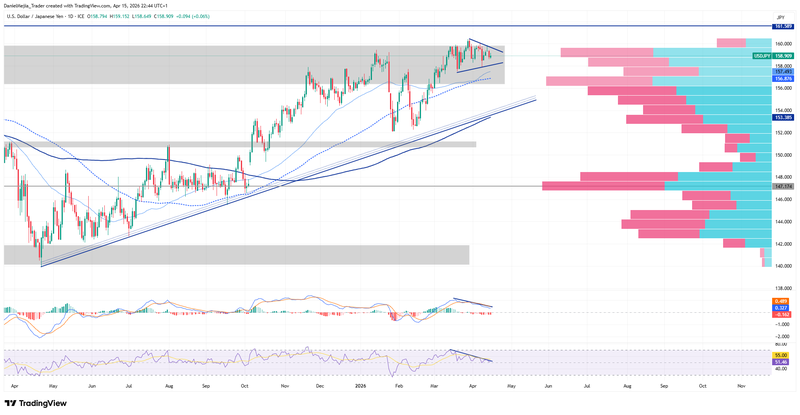
Figure 1. USD/JPY Pair (2025–2026). Source: Data from the Intercontinental Exchange (ICE); Own analysis conducted via TradingView.