
 Help
Help
Bitcoin hits 7-week high as risk appetite returns
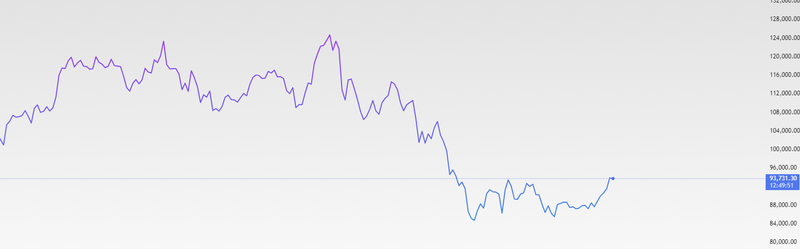
Bitcoin climbed toward the $95,000 level, reaching its highest price in seven weeks as risk appetite returned across global markets at the start of the year. The rally comes after a relatively weak fourth quarter for crypto compared with equities and commodities, and reflects a mix of improving liquidity conditions, renewed institutional interest, and expectations of easier US monetary policy. Despite ongoing geopolitical tensions, including developments in Venezuela and broader global conflicts

Global equities added roughly $3 trillion in market value.
Growing expectations of US interest rate cuts later this year.
Increased activity in options markets around higher price targets.
Liquidity conditions and macro data support risk assets
Bitcoin’s rally has coincided with a broad risk-on move across asset classes. Global equities added roughly $3 trillion in market value in early January, while industrial commodities, including copper, reached record highs. In the US, weaker-than-expected manufacturing data reinforced expectations of monetary easing. The ISM Manufacturing PMI fell to 47.8, remaining in contraction territory, while job openings declined toward 8.7 million, signaling a cooling labor market. Interest rate expectations have shifted accordingly.
Fed funds futures are now pricing roughly 75–100 basis points of rate cut this year, with markets assigning a high probability that policy rates begin easing by mid-year. For Bitcoin, which historically responds positively to expanding liquidity and lower real yields, this macro backdrop has been a key driver. As real yields eased and the dollar softened, capital rotated into higher-beta assets, including crypto.
Derivatives data and institutional positioning
Options and futures markets show rising participation rather than speculative excess. Open interest in Bitcoin futures has climbed above $22 billion, up nearly 18% from December lows. In options markets, contracts clustered around the $100,000 strike now account for roughly 30% of near-term open interest, reflecting upside expectations. At the same time, significant positioning remains around the $80,000 level, indicating active downside hedging. Spot Bitcoin ETFs have also contributed to demand.
Since the start of the year, net inflows into US-listed spot Bitcoin ETFs have exceeded $1.2 billion, with average daily inflows of around $150–200 million during risk-on sessions. Assets under management across these ETFs now exceed $55 billion, reinforcing Bitcoin’s growing role as an institutional asset rather than a retail-driven trade.
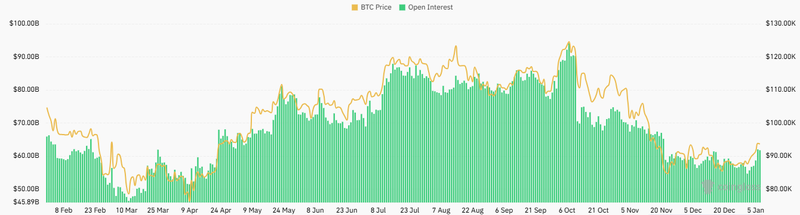
Source: coinglass
Why Bitcoin is rising despite geopolitical risks
Geopolitical tensions, including developments surrounding Venezuela, have so far had limited impact on Bitcoin pricing, even as the cryptocurrency pushed to a seven-week high near $95,000. This behavior reflects how the market currently views Bitcoin: not primarily as a geopolitical hedge, but as a liquidity-sensitive risk asset. Historically, Bitcoin has shown mixed performance during acute geopolitical crises, but in periods dominated by financial conditions and policy expectations, macro liquidity and interest-rate outlooks tend to carry far more weight in driving prices.
Speculation around undisclosed Bitcoin holdings by sanctioned governments have added narrative interest, but on-chain data shows no signs of abnormal state-level flows influencing the market. Daily transaction volumes remain stable at around $30–35 billion, while long-term holder supply remains elevated, with more than 70% of Bitcoin not moved in the past six months. Together, these indicators suggest that the rally toward $95,000 is being driven by steady confidence and positioning rather than panic buying or geopolitical fear.
Source: Trading View


