
 Help
Help
Energy prices surge as global stocks slide on geopolitical tensions
Energy prices—specifically crude oil, natural gas, and gasoline—have rallied sharply in response to escalating tensions in the Middle East. Conversely, global equity markets have faced significant selling pressure as investors grapple with heightened concerns over economic stability and the resurgence of inflationary risks.

Tensions in the Middle East have intensified recently, sparking fears regarding regional stability and potential systemic disruptions to the global energy supply chain.
Consequently, energy benchmarks have seen substantial appreciation: Brent crude futures rose 4.71%, breaching the $80 psychological threshold; natural gas gained 2.70%; and gasoline futures advanced by 3.80%.
Global stock indices have declined prominently as market participants price in the economic implications of higher energy costs and the potential for a more restrictive inflationary environment.
Energy prices maintain upward momentum amid escalating Middle East tensions
Energy markets have recorded prominent gains over the past 48 hours following a coordinated US-Israeli strike on Iranian territory. This action has triggered a wave of retaliatory military responses from Tehran across the Middle East, targeting locations in Israel and regional nations hosting US military installations. Military exchanges between US-Israeli forces and Iranian assets have intensified in recent hours.
A critical consequence of this escalation has been the compromise of regional energy infrastructure. Most notably, Iranian military forces have asserted control over the Strait of Hormuz, a strategic maritime chokepoint through which approximately 20% of the world's oil and natural gas supplies typically transit. Furthermore, according to reports from Reuters, Iraq—the second-largest crude producer within OPEC—has announced a production cut of roughly 1.5 million barrels per day, that could worsen if the conflict drags on.
Additional production curtailments or refinery closures have been reported in Saudi Arabia, Israel, and Qatar. Notably, Qatar—a leading global exporter of liquefied natural gas (LNG)—has announced the temporary closure of its LNG facilities due to regional instability. These combined supply-side shocks have disrupted global energy distribution, providing a strong fundamental floor for higher prices.
In terms of market reaction, the Brent futures contract (BRNK26) rose by 4.71% to $81.40, while the WTI contract (CLJ26) appreciated by 5.19% to settle at $74.96 per barrel. In turn, the natural gas futures contract (NGJ26) increased by 2.70% to $3.04 per unit. Meanwhile, the gasoline futures contract (RBJ26) appreciated by 3.80% to 2.46 per unit.
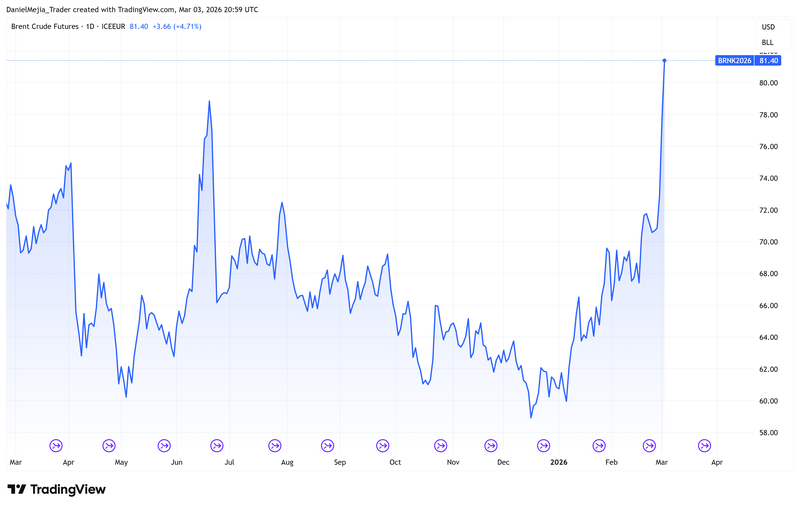
Figure 1. Brent Futures Contract BRNK26 (2025–2026). Source: Data from the Intercontinental Exchange (ICE-EUR); Figure obtained from Trading Economics via TradingView.
Global stocks decline in unison on heightened geopolitical concerns
Equity markets across Asia, Europe, and the Americas have retreated in tandem amidst profound economic and geopolitical uncertainty. The escalation in the Middle East has propelled energy prices higher, significantly elevating the risk of a potential wave of inflation if infrastructure damage proves severe or the conflict persists. Should inflation rebound due to these supply chain disruptions, Western central banks may be forced to maintain interest rates at elevated levels or even return to a hawkish, restrictive stance to anchor price expectations.
European markets have experienced the most severe depreciations. Given their heavy reliance on imported natural gas and crude oil, European economies are particularly vulnerable to sustained energy price spikes. The DAX index fell 3.44% to 23,790, the CAC 40 decreased 3.46% to 8,103, and the IBEX 35 dropped 4.55% to 17,062. The UK’s FTSE 100 also depreciated, losing 2.75% to close at 10,484 points.
In the United States, markets slid as participants lowered the probability of near-term interest rate cuts. According to the CME FedWatch Tool, expectations for monetary easing are being deferred toward the July and December meetings. Persistently high inflation would limit the Federal Reserve's capacity to continue its pivot toward a more accommodative stance. Consequently, the S&P 500 decreased 0.94% to 6,816, the Dow Jones fell 0.83% to 48,501, and the Nasdaq 100 depreciated by 1.09% to 24,720.
In Asia, the FTSE China A50 dropped 0.96% to 14,583, while the Japanese Nikkei 225 saw a sharper decline of 3.06%, closing at 56,279 points.
