
 Help
Help
Fed holds rates as energy prices fuel inflation uncertainty; Stocks slide
The Federal Reserve has elected to maintain its benchmark interest rate, aligning with market expectations. However, the central bank underscored heightened uncertainty stemming from the ongoing conflict in the Middle East. US equity markets retreated in unison amid mounting concerns that persistent geopolitical tensions could exacerbate inflationary pressures.

The Federal Reserve maintained the federal funds rate at 3.75%, meeting consensus forecasts while flagging potential volatility ahead.
The US central bank updated its economic projections, noting that forecasts remain highly sensitive to shifts in the Middle East conflict.
The Bank of Canada held its benchmark rate at 2.25%, though it expressed readiness to tighten policy should rising energy costs drive inflation above target.
Brent and WTI crude benchmarks closed higher despite a significant build-up in US inventories, as reported by the Energy Information Administration (EIA).
Fed flags inflation uncertainty amid rising energy prices; US stocks fall
The Federal Reserve decided to keep its benchmark interest rate unchanged at 3.75%, a move widely anticipated by analysts. Concurrently, the central bank updated its economic outlook for the coming years. Regarding growth projections, the GDP forecast for 2026 was revised upward from 2.3% to 2.4%. While the unemployment rate estimate remained stable at 4.4%, the PCE inflation forecast was adjusted from 2.4% to 2.7%. This revision reflects the significant volatility introduced by the surge in energy prices over the past month. Despite these shifts, the projected federal funds rate for the end of 2026 was held at 3.4%, implying a single interest rate cut within the calendar year.
In the post-meeting press conference, Chair Jerome Powell emphasised that the implications of developments in the Middle East for the US economy remain opaque. The Federal Reserve stated it would continue to monitor risks to both sides of its dual mandate, particularly as elevated energy costs threaten to bolster near-term inflation. The overall tone was cautious; while policymakers view the economy as expanding at a solid pace, they remain reluctant to commit to a predetermined expansive path while geopolitical and inflationary risks remain elevated.
Reacting to the Fed’s message of prolonged uncertainty, US stock indices declined in tandem. The S&P 500 fell by 1.36% to 6,624, the Dow Jones Industrial Average dropped 1.63% to 46,225, and the Nasdaq 100 depreciated by 1.43% to 24,425 points.
Simultaneously, the yield on the 10-year US Treasury note rose by 6.5 basis points to 4.26% as investors priced in potential inflationary headwinds. Meanwhile, the US Dollar Index (DXY) appreciated by 0.67% to 100.23 points, reflecting market sentiment that the Federal Reserve may maintain a "higher-for-longer" restrictive stance.
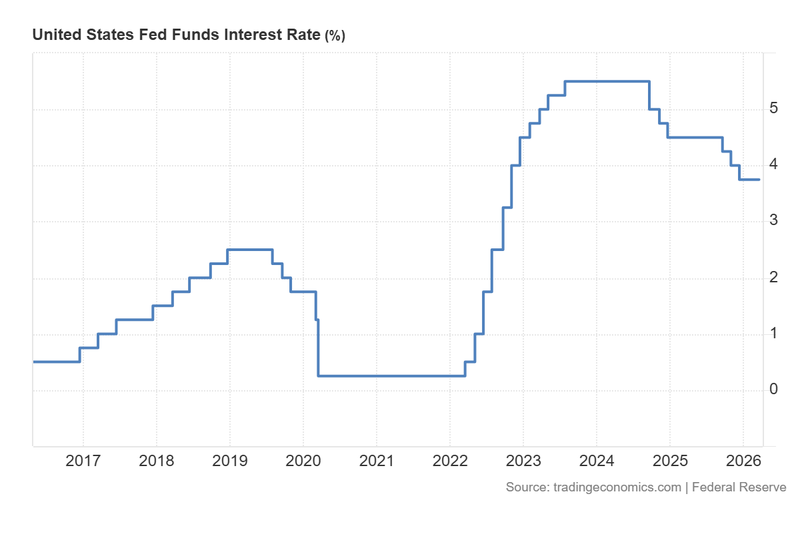
Figure 1. US Fed Funds Interest Rate (2016-2026). Source: Data from the Federal Reserve; Figure obtained from Trading Economics.
BoC leaves interest rates unchanged in line with expectations; USD/CAD decreases
The Bank of Canada (BoC) maintained its key policy rate at 2.25%, consistent with analyst expectations. Although Canada’s current inflation rate of 1.8% sits comfortably near the BoC’s 2% target, Governor Tiff Macklem warned that the bank stands ready to intervene should energy price pressures destabilise inflation levels. The Governor noted that while it is premature to fully quantify the impact of recent energy spikes, the bank is closely assessing potential risks. The primary concern for policymakers remains the duration of the regional conflict and the potential impacts to energy infrastructure.
Following the announcement, the Canadian dollar depreciated by 0.11% against the US dollar to 1.3733. Market participants appear to be pricing in a simultaneous extension of restrictive stances from both the Fed and the BoC.
Persisting Middle East tensions drive oil higher despite growing US inventories
The primary oil benchmarks, Brent and WTI, advanced as the conflict in the Middle East continues. The Brent futures contract (BRNK6) surged by 3.83% to $107.38 per barrel, while West Texas Intermediate (WTI) appreciated by 0.75% to $95.39 per barrel. Both benchmarks reached their highest valuations since July 2022.
These gains occurred despite data from the US Energy Information Administration (EIA) showing that crude oil inventories rose by 6.156 million barrels in its weekly assessment. This figure significantly exceeded the analyst estimate of a 0.4 million-barrel build and the previous reading of 3.824 million barrels. Notably, this marks the fourth consecutive week that US inventories have surpassed expectations.
The slight appreciation in WTI despite the stock accumulation suggests that market participants are prioritising the risk of supply disruptions in the Middle East over domestic overcapacity. As of today, the US-Israel-Iran conflict has entered its 19th day, maintaining a high risk premium in global energy markets.
