
 Help
Help
Geopolitical pressures weigh on equities and gold as energy prices rise
Global equity markets retreated in unison as diplomatic hopes for a resolution to the US-Israel-Iran conflict continued to fade. While systemic uncertainty usually supports precious metals, gold prices have depreciated significantly alongside stocks. Conversely, energy markets have seen a sharp appreciation as participants price in possible prolonged supply chain disruptions across the Middle East.

Stalled negotiations between Washington and Tehran have diminished market expectations of a swift resolution, exerting downward pressure on global risk assets.
Gold prices have faced a sharp sell-off, driven by a strengthening US dollar and market anticipation of a more hawkish stance from the Federal Reserve to counteract potential energy-led inflation.
Energy benchmarks have surged as the continued closure of the Strait of Hormuz threatens approximately 20% of the global oil and liquefied natural gas (LNG) supply.
Global stocks retreat amid persistent conflict in the Middle Eastern
Global equity indices declined in tandem as prospects for a diplomatic breakthrough in the US-Israel-Iran conflict deteriorated. According to reports from Reuters, a senior Iranian official characterised the recent US peace proposal as “one-sided and unfair”. This diplomatic friction was further exacerbated by comments from US president Donald Trump, whose rhetoric has shifted back toward explicit threats of aggressive military action should a peace agreement fail to materialise.
The conflict, which commenced on 28 February following coordinated US-Israeli strikes on Iranian territory, is now approaching the one-month mark. The Strait of Hormuz—a critical maritime artery through which roughly 20% of the world's petroleum and LNG transits—remains blockaded by Iranian forces, resulting in a severe disruption to global energy flows and a subsequent spike in prices. Furthermore, a series of targeted strikes against energy infrastructure in the Gulf has heightened concerns regarding a global inflationary shock.
Consequently, major central banks are adjusting their rhetoric, signalling a potential shift toward more restrictive monetary policy if energy prices drive inflation beyond mandate targets. This shift in the economic outlook has unnerved equity markets; higher financing costs and uncertain interest rate trajectories threaten corporate growth projects and valuation multiples. The ultimate economic impact remains contingent upon the conflict's duration and the extent of the damage to regional energy infrastructure.
Market Reaction:
- United States: The S&P 500 fell 1.74% to 6,477 points, while the Dow Jones Industrial Average dropped 1.01% to 45,960. The Nasdaq-100 recorded the sharpest decline, retreating 2.38% to 23,587 points.
- Europe: The French CAC-40 declined 0.98% to 7,769, the UK FTSE-100 fell 1.33% to 9,972, the Spanish IBEX-35 dropped 1.21% to 16,962, and the German DAX-40 depreciated by 1.50% to 22,612 points.
- Asia: Regional markets saw more tempered losses; the Chinese FTSE A-50 fell 0.08% to 14,503, the Hang Seng in Hong Kong dropped 0.03% to 24,782, and the Japanese Nikkei-225 retreated 0.27% to 53,603.
High volatility in commodity markets: Energy surges as gold declines
Energy markets advanced sharply as the failure of diplomatic efforts between the United States, Israel, and Iran heightened fears of prolonged regional instability. As kinetic operations continue and reciprocal threats escalate, market participants have aggressively sought hedges against supply shortages. The Brent futures contract (BRNM6) rose 4.76% to $101.89 per barrel, while the West Texas Intermediate (WTI) contract (CLK6) appreciated by 4.97% to $94.57 per barrel. Similarly, gasoline futures (RBK6) climbed 4.06% to $3.08 per unit, and LNG futures (NGK6) increased 1.5% to $2.99 per unit.
In a notable divergence from typical safe-haven behaviour, the gold futures contract (GCJ6) fell 3.90% to $4,370 per ounce. The precious metal is facing significant headwinds from a strengthening US dollar and rising expectations of a hawkish Federal Reserve response to possible energy-driven inflation. Bullion prices traditionally soften as real yields rise, as government bonds begin to offer more attractive risk-adjusted returns compared to non-yielding assets.
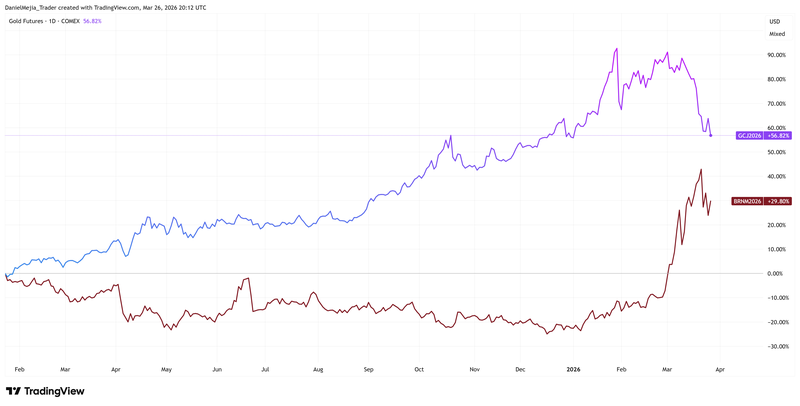
Figure 1. Gold versus Brent prices (2025-2026). Source: Data from the COMEX and ICE-EUR Exchanges; Own analysis conducted via TradingView.
