
 Help
Help
Oracle misses revenue forecasts, adding AI uncertainty
Oracle’s share price tumbled after revenues marginally missed analyst expectations, reigniting investor concerns about high AI-related spending and potential overvaluation in the technology sector. Gold rallied on lower US interest-rate expectations following the Fed’s recent decision, and Australia’s unemployment rate held steady, easing some pressure on the RBA.

Oracle reported total revenue up 14.2% year-on-year and EPS rising 54%, yet the revenue shortfall prompted a share-price fall of about 10.8%.
Investors expressed renewed scepticism about the near-term returns on heavy AI capital expenditure, and concerns around valuation in the tech sector intensified.
Gold futures (GCG26) rose c. 2.14%, reflecting lower US rates and elevated uncertainty over the Fed’s future path.
Australia’s unemployment rate remained at 4.3%, relieving some immediate pressure on the Reserve Bank of Australia amid still-elevated inflation.
Oracle misses revenue expectations; shares slide despite EPS beat
Oracle’s stock fell sharply—approximately 10.8%—after the company narrowly missed revenue expectations for the third quarter. Reported revenue of US$16.06 billion fell short of the consensus US$16.19 billion, although earnings per share comfortably exceeded estimates at US$2.26 versus a forecast of US$1.64. On a year-over-year basis, revenue rose 14.2% and EPS increased 54%.
Despite solid profitability, investors were disappointed by the revenue miss and reacted to commentary about elevated capital expenditure. Oracle said it intends to increase fiscal-2026 capital spending, raising its capex guidance to roughly US$15 billion, above prior expectations. The scale of planned investment in AI infrastructure and other projects — sometimes financed through debt — has prompted questions about the timing and magnitude of returns on those commitments.
Broader market sentiment reflected this tension. The S&P 500 rose 0.21% to 6,901, the Dow Jones advanced 1.34% to 48,704, but the Nasdaq-100 declined 0.35% to 25,686, illustrating sectoral divergence as investors rotated away from some high-growth tech names.
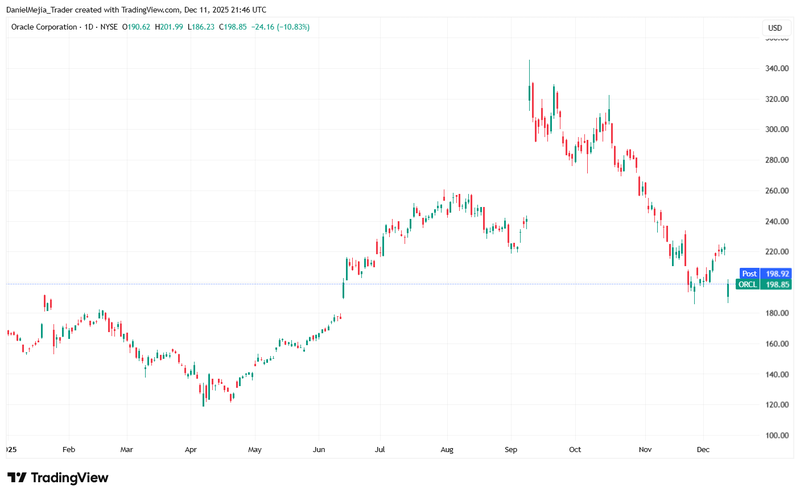
Figure 1. Oracle’s share price (Year-to-Date). Source: NASDAQ; chart via TradingView.
Gold benefits from softer rate outlook and safe-haven demand
Gold futures (GCG26) gained around 2.14%, trading near US$4,310/oz. The rally followed the Federal Reserve’s recent rate cut and market uncertainty about the trajectory of subsequent policy moves. Lower interest rates reduce the opportunity cost of holding non-yielding assets such as gold, while persistent macro, geopolitical and trade risks have kept demand from central banks, institutional funds and private investors robust.
Gold remains near its record peaks and is being supported by a combination of liquidity, central-bank purchases and risk-off flows. It is possible that future direction could be sensitive to real rates, the dollar’s path and any further adjustments to monetary policy.
Australian unemployment steady; RBA pressure eases marginally
Australia’s unemployment rate held at 4.3%, below some forecasts that anticipated a modest rise. The reading follows a period of gradual improvements from the summer peak of 4.4% and precedes the RBA’s cautious stance on further rate moves. The Bank of Australia has paused after a sequence of reductions from the highs seen in early 2025; headline inflation remains elevated and the central bank has signalled a data-dependent approach.
Markets reacted modestly: the Australian dollar saw a small move, while policymakers emphasised the need for sustained evidence of disinflation before considering further easing.
