
 Help
Help
Trump suggests talks with Iran, sending energy prices lower
Energy prices depreciated considerably following renewed hopes for a de-escalation of the US–Israel–Iran conflict. US President Donald Trump stated that "productive talks" with Iran had taken place, though Iranian officials have denied. Concurrently, policymakers from both the European Central Bank (ECB) and the Federal Reserve (Fed) have reaffirmed that inflation remains their primary concern, particularly in light of recent volatility in the energy sector.

Crude oil benchmarks Brent and WTI plummeted by approximately 10% following President Trump’s comments regarding bilateral discussions with Tehran.
Despite the White House’s optimistic tone, Iranian officials have denied the existence of any formal productive talks.
ECB Governing Council member Peter Kazimir indicated that the central bank remains prepared to adopt a more restrictive monetary stance if inflationary pressures persist.
Chicago Fed President Austan Goolsbee emphasised that the Federal Reserve is prioritising inflationary risks over labour market easing, noting that elevated energy costs could dampen domestic demand and consumer expectations.
Energy prices decrease considerably amid potential US–Iran talks; Iran denies
Energy prices retreated sharply during the trading session as markets priced in a potential de-escalation of the conflict involving the United States, Israel, and Iran. The US president Donald Trump declared that he has engaged in "productive conversations" with Iranian leadership. Consequently, the president ordered the postponement of military strikes against Iranian energy infrastructure—targets that had been under threat of attack over the weekend. However, according to reports from El País, Iranian officials have formally refuted the Trump's assertions.
The primary oil benchmarks—Brent and West Texas Intermediate (WTI)—alongside gasoline and liquefied natural gas (LNG), fell in tandem. The Brent futures contract (BRNK6) decreased by 11% to $99.95 per barrel, while the WTI futures contract (CLK6) fell by 10% to $88.35 per barrel. Similarly, the gasoline futures contract (RBK6) depreciated by 9.5% to $2.92 per unit, and the LNG futures contract (NGJ6) dropped by 6.37% to $2.90 per unit.
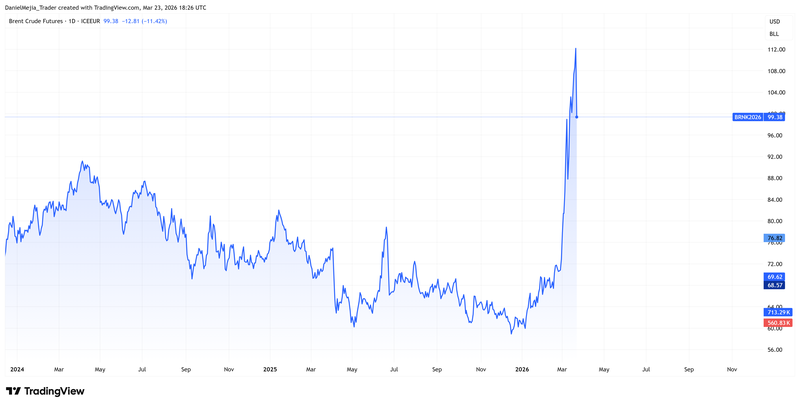
Figure 1. Brent Futures Contracts (2024–2026). Source: Data from ICE-EUR Exchanges; Figure obtained from TradingView.
ECB could apply a more restrictive stance if energy prices drive inflation
ECB policymaker Peter Kazimir stated, according to Reuters, that "The European Central Bank will not hesitate to tighten policy if needed." These declarations leave the door open for future interest rate hikes should headline inflation rise above the ECB’s 2% target. Currently, inflation in the Eurozone stands at 1.9%, which is broadly considered to be under control. Nevertheless, surges in energy prices remain a significant risk for the Euro area, given the region’s high dependency on imported energy commodities.
Fed member highlights inflation risks as predominant
In an interview with CNBC, Chicago Fed President Austan Goolsbee remarked that inflation remains the primary risk to the US economy, even while describing the current unemployment rate as stable. The policymaker identified price stabilisation as the Federal Reserve’s top priority, particularly during a period where volatile energy costs—most notably gasoline prices—threaten to impact household budgets and consumer sentiment.
Key economic events this week
Several critical economic indicators are scheduled for release this week. The most significant include:
Monday
- Japan: Inflation Rate
Tuesday
- Germany: HCOB Manufacturing PMI
- UK: S&P Global Manufacturing PMI
- UK: S&P Global Services PMI
Wednesday
- UK: Inflation Rate
- Germany: Ifo Business Climate
- US: EIA Crude Oil Stocks Change
Thursday
- Germany: GfK Consumer Confidence
Friday
- UK: Retail Sales
