
 Help
Help
US consumer sentiment plunges, inflation speeds up; China inflation eases
US consumer sentiment has plummeted to levels not seen since 1980, while headline inflation reached 3.3%, driven largely by surging energy costs. Conversely, inflationary pressures in China cooled to 1.0%, falling short of market forecasts. Despite the evident economic strain and heightened Middle Eastern tensions, US markets remain mixed as investors pivot their attention toward critical diplomatic negotiations between the United States and Iran.

The University of Michigan consumer sentiment index fell to 47.6 in April, its lowest reading since 1980, as geopolitical conflict and persistent inflation erode household purchasing power.
US headline inflation accelerated to 3.3% in March, fueled by significant price surges in gasoline and fuel oil resulting from instability in the Middle East.
China’s inflation rate slowed to 1.0% in March due to cooling food prices, despite the implementation of energy price controls intended to shield domestic consumers.
Investors are closely monitoring Pakistan-based diplomatic talks between Washington and Tehran, hoping for a de-escalation of the conflict and the reopening of the vital Strait of Hormuz supply route.
Michigan consumer sentiment drops to historical lows while US headline Inflation accelerates sharply
According to data released by the University of Michigan, US consumer sentiment fell from 53.3 in March to 47.6 in April, marking its lowest level since May 1980. The report indicates that business conditions expectations declined by 20%, while assessments of personal finances dropped by 11%. Simultaneously, buying conditions for durable goods and vehicles deteriorated considerably. Qualitative feedback from consumers suggests that this decline is heavily linked to the ongoing US-Israel-Iran conflict and its anticipated economic ramifications. Meanwhile, inflation expectations for the year ahead rose from 3.8% to 4.8%, with the five-year outlook increasing from 3.2% to 3.4%.
Concurrently, the US Bureau of Labor Statistics (BLS) reported that year-on-year headline inflation accelerated from 2.4% in February to 3.3% in March—the highest level recorded since May 2024—aligning with market consensus. An analysis by Trading Economics highlights that the most significant increases occurred within energy costs (+12.5%), with gasoline (+18.9%) and fuel oil (+44.2%) leading the surge. Furthermore, core inflation—which excludes the volatile components of energy and unprocessed food—accelerated slightly from 2.5% to 2.6%, marginally below the 2.7% anticipated by analysts.
Despite these negative economic releases, US equity markets closed the session mixed. Market participants remain focused on the upcoming US-Iran talks in Pakistan, reflecting growing optimism for a resolution. The S&P 500 index eased by 0.11% to 6,816 points, and the Dow Jones Industrial Average fell 0.56% to 47,916 points. In contrast, the Nasdaq 100 index gained 0.14% to reach 25,116 points. In the fixed-income market, the 10-year US Treasury yield increased by 3.4 basis points to settle at 4.32%.
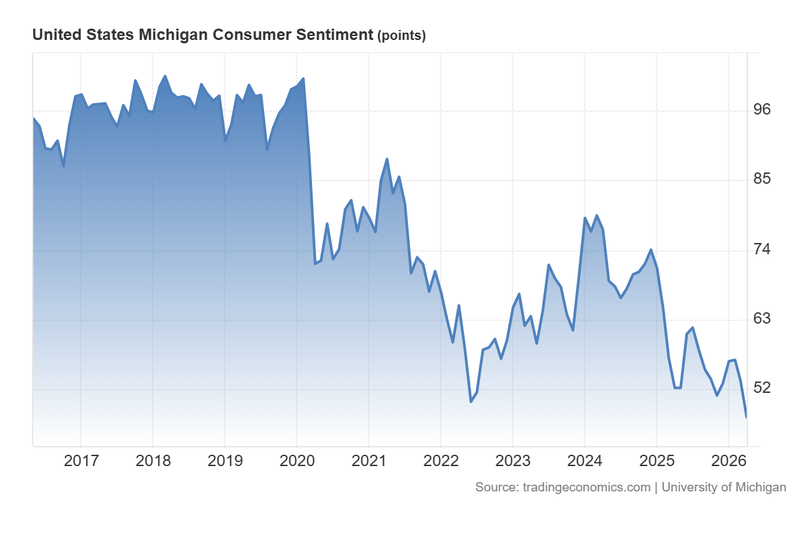
Figure 1. US Michigan Consumer Sentiment (2016–2026). Source: Data from the University of Michigan; Figure obtained from Trading Economics.
Chinese inflation rate eases, falling below analyst forecasts
Data from the National Bureau of Statistics of China reveals that the headline year-on-year inflation rate decelerated from 1.3% in February to 1.0% in March, undershooting the 1.2% estimated by analysts. During the same period, Chinese core inflation eased from 1.8% to 1.1%. According to the official inflation report, the most significant deceleration occurred in food prices, which fell from 1.7% in February to 0.3% in March. Meanwhile, non-food inflation experienced a marginal slowdown from 1.3% to 1.2%. Although the Chinese government has implemented domestic fuel price controls to protect households from global energy volatility, domestic consumption may still face headwinds due to deteriorating consumer confidence.
Market reaction to the data was mixed within Chinese equities. The FTSE China A-50 depreciated by 0.25% to 15,001 points, while the Hang Seng index rose by 0.16% to 25,964 points.
Markets await US-Iran diplomatic talks in Pakistan
Although a two-week ceasefire was recently announced in the Middle East—following the intensification of the US-Israel-Iran conflict—recent actions have threatened the stability of the agreement. On one front, Israel has continued intensive operations within Lebanese territory. Conversely, Iran has maintained the closure of the Strait of Hormuz—a critical maritime chokepoint through which approximately 20% of the global oil and natural gas supply transits—despite a bilateral agreement to reopen the passage.
However, reports from CNBC indicate that delegates from the United States and Iran are scheduled to meet this Saturday in Pakistan, which is serving as a mediator in the current crisis. Global market participants are now intensely focused on the outcome of these discussions and the potential impact a resolution would have on global trade and energy markets.

