
 Help
Help
US indices fall as PPI tops expectations; oil prices rise on US-Iran talks impasse
US equity indices declined in unison following the release of Producer Price Index (PPI) data, which exceeded analyst expectations and suggested persistent inflationary pressures. Concurrently, crude oil prices advanced as negotiations between the United States and Iran reached an impasse. Regional uncertainty has been further heightened by an increasing concentration of US naval assets in the Middle East.

The US PPI monthly increase surpassed forecasts, resulting in a year-on-year (YoY) rate that, while slightly lower than the previous period, remained above market estimates.
US stock indices retreated as market participants questioned the sustainability of the Federal Reserve’s monetary easing cycle, given a stabilising labour market and resurgent price pressures.
Oil prices rose after inconclusive US-Iran Geneva talks, with negotiations set to resume in Vienna next week.
Germany’s inflation rate decelerated more sharply than anticipated, signalling continued weakness in domestic consumption within the Eurozone’s largest economy.
US PPI exceeds forecasts: US stock indices retreat
According to data released by the US Bureau of Labour Statistics, the Producer Price Index (PPI) increased by 0.5% month-on-month (MoM) in January, surpassing the analyst estimate of 0.3% and the previous reading of 0.4%. Consequently, the YoY rate updated to 2.9%, exceeding the 2.6% forecast. Although this represents a marginal deceleration from the prior level of 3.0%, the reading signals persistent price pressures to the Federal Reserve as it continues to navigate an unconventional inflationary environment.
The PPI data follows a week in which continuing jobless claims declined, suggesting a degree of normalisation within the labour market. In response, the CME FedWatch Tool indicates that market participants now anticipate only two interest rate cuts this year—likely during the June and October meetings—reflecting a perceived delay in the expected monetary easing cycle.
Regarding the market reaction, major US indices dropped in tandem. The S&P 500 fell by 0.43% to 6,878, the Dow Jones Industrial Average dropped 1.05% to 48,977, and the Nasdaq 100 depreciated by 0.30% to close at 24,960 points.
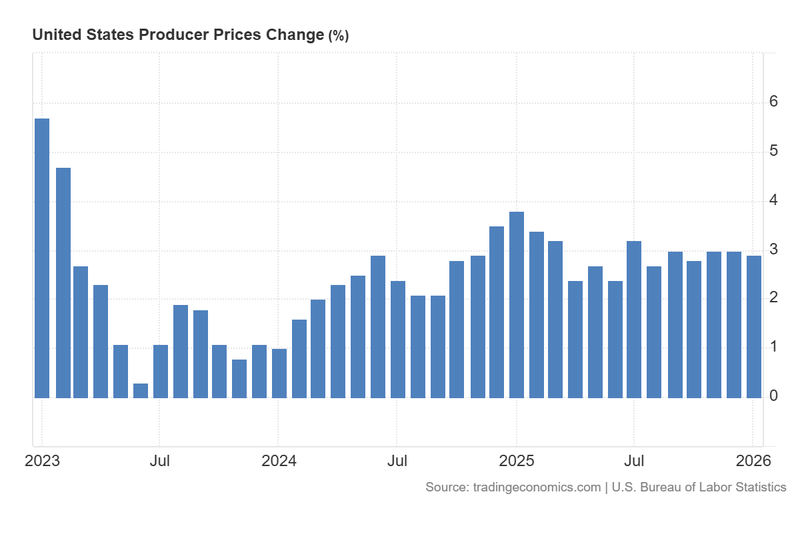
Figure 1. US Producer Prices Change (2023-2026). Source: Data from the US Bureau of Labour Statistics; Figure obtained from Trading Economics.
Oil prices rise amid negotiation impasse between the US and Iran
Global oil benchmarks advanced following the conclusion of US-Iran talks in Geneva, which ended without a definitive agreement. As reported by Reuters, bilateral discussions are expected to resume next week in Vienna. Uncertainty has intensified due to the rising accumulation of US warships in the Middle East, increasing concerns of a potential direct confrontation should the United States opt for military action as a form of pressure.
The rising geopolitical risk premium continues to support energy prices, as market participants hedge against potential supply chain disruptions involving major producers and exporters like Iran. Brent crude futures (BRNK26) increased by 2.87% to $72.87 per barrel, while West Texas Intermediate (WTI) futures (CLJ26) appreciated by 2.78% to $67.02 per barrel. Both benchmarks have reached their highest levels since August 2025.
German inflation decelerates beyond analyst estimates
According to the Federal Statistical Office of Germany, the annual inflation rate decelerated from 2.1% in January to 1.9% in February, falling below the 2.0% consensus forecast. While these levels suggest that inflation is largely under control, the data also points to subdued domestic consumption, as demand fails to exert upward pressure on prices. Consequently, the DAX 40 index closed with a marginal depreciation of 0.02% following a trading session defined by prevailing uncertainty.
