
 Help
Help
US stocks drop on weak GDP revision and geopolitical uncertainty
US equity markets retreated in tandem following lacklustre economic data—specifically the second revision of GDP and durable goods orders—and mounting concerns of a potential inflationary rebound driven by a sharp escalation in energy prices.

US Gross Domestic Product (GDP) was revised downwards for Q4 2025, while durable goods orders stagnated, falling well short of market expectations.
Major stock indices declined in unison as investors weighed weak economic readings and inflationary risks posed by the recent surge in energy costs.
Oil and gasoline benchmarks advanced amid heightening concerns over Middle Eastern supply chain stability. Saudi Arabia has announced a production cut of approximately 2 million barrels per day, citing regional instability.
US stock markets fall on weak GDP revision and rising geopolitical tensions
According to data from the US Bureau of Economic Analysis (BEA), the second revision of Gross Domestic Product showed a deceleration from 4.4% in Q3 2025 to 0.7% in Q4 2025, missing the analyst consensus estimate of 1.4%. While the initial estimate had already indicated a significant slowdown, this further downward revision suggests the US economy is contending with compounding pressures from political instability, geopolitical tensions, and broader economic risks. Furthermore, on the consumer side, the US Census Bureau reported that month-on-month durable goods orders remained unchanged (0%), significantly below the 1.2% increase forecast by analysts.
Concurrently, oil and gasoline prices continued their ascent despite the US president Donald Trump’s announcement of an easing of sanctions on Russian oil—a move intended to mitigate supply concerns stemming from the conflict in the Middle East. Over the past month, the West Texas Intermediate (WTI) crude contract has surged by approximately 57%, while gasoline futures have risen by 38%. Consequently, market participants are increasingly concerned that these elevated energy costs could trigger a resurgence in inflation, thereby pressuring the Federal Reserve to maintain interest rates at restrictive levels for a prolonged period.
As a result of these headwinds, US equity markets closed lower across the board. The S&P 500 fell by 0.61% to 6,632, the Dow Jones Industrial Average decreased by 0.26% to 46,558, and the Nasdaq 100 depreciated by 0.62% to 24,380 points.
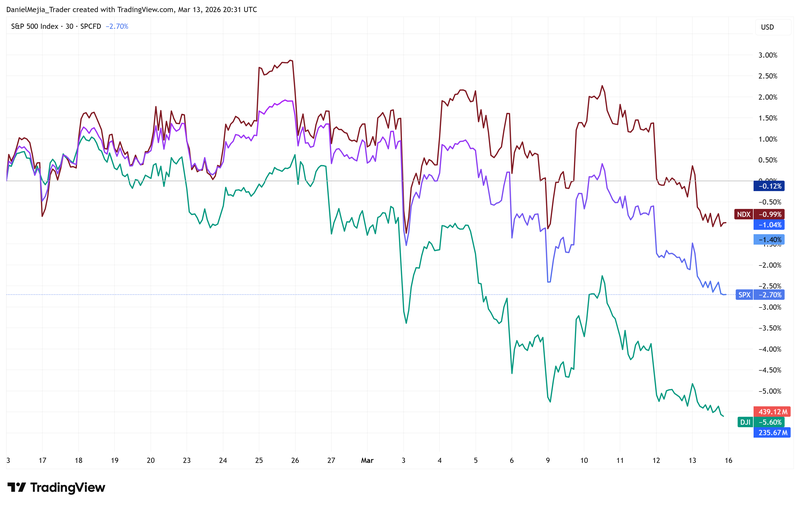
Figure 1. S&P 500, Nasdaq 100, and Dow Jones Industrial Average indices (over the last month). Source: Data from the NYSE and NASDAQ Exchanges; Own analysis conducted via TradingView.
Oil prices rise amid supply chain concerns following Saudi Arabian production cuts
The primary oil benchmarks, Brent and WTI, continued their appreciation as tensions in the Middle East intensified. Since the escalation of the conflict involving the US, Israel, and Iran from 28 February, regional instability has worsened. According to reports from Reuters, Saudi Arabia has reduced its oil production by approximately 2 million barrels per day following disruptions at two major offshore fields. This reduction is largely attributed to regional volatility and the ongoing closure of the Strait of Hormuz, which has created a critical bottleneck in global energy distribution.
This week, the International Energy Agency (IEA) released a report indicating that the current disruption to energy supplies in the Middle East is among the most severe in historical terms. The agency further noted that Gulf nations, including Saudi Arabia, Iraq, the United Arab Emirates, Kuwait, and Qatar, have implemented a collective production cut of approximately 10 million barrels per day.
Against this backdrop of tightening energy markets, the Brent futures contract (BRNK6) rose by 2.67% to $103.14 per barrel, while the WTI futures contract (CLJ6) appreciated by 3.11% to $98.71 per barrel. Simultaneously, the gasoline futures contract (RBK6) increased by 2.59% to 3.04 per unit. In all instances, prices have reached their highest levels since August 2022.
