
 Help
Help
US stocks retreat sharply while gold and oil gain on geopolitical concerns
US equity markets experienced a sharp contraction as the tripartite conflict involving the United States, Israel, and Iran persisted. Market participants are increasingly pricing in a more restrictive monetary stance from the Federal Reserve, weighing heavily on risk assets. Conversely, oil prices continued their ascent, while gold benefited from potential safe-haven inflows amidst the heightened global instability.

The confrontation between the US, Israel, and Iran remains unresolved; as diplomatic hopes fade, global markets are grappling with elevated volatility.
The CBOE Volatility Index (VIX) reached its highest level since April 2025, while major US equity indices have retreated by an average of 10% from their recent record highs.
Gold prices appreciated as investors and hedgers sought refuge from geopolitical risk, while crude oil benchmarks rose in response to the deepening Middle Eastern crisis.
The University of Michigan’s inflation expectations for March rose significantly, surpassing analyst forecasts and underscoring growing anxiety regarding price stability.
US stocks fall sharply as Middle Eastern conflict and inflation risks persists
US stock indices dropped in tandem as tensions between the US, Israel, and Iran showed no signs of abating. Despite a 10-day ceasefire proposal announced by US president Donald Trump—aimed at the reopening of the Strait of Hormuz—market participants exerted significant selling pressure on equity markets. Furthermore, reports from Deutsche Welle (DW) indicated that Israeli forces conducted strikes against Iranian nuclear facilities during the day, directly contrasting the previous tone of the White House’s commentary.
The conflict has now entered its second month, and the absence of formal negotiations suggests a potentially protracted duration. While US Secretary of State Marco Rubio stated that the administration could achieve its strategic objectives in Iran without a ground invasion, the deployment of additional US troops to the region has intensified fears of a major military re-escalation.
Simultaneously, data from the CME FedWatch Tool reveals that market participants are now pricing in a "higher-for-longer" hawkish stance from the Federal Reserve on 2026. This shift is driven by rising inflation risks stemming from elevated energy prices—a significant pivot for equity markets that, only two months ago, had anticipated two interest rate cuts this year. Historically, restrictive monetary contexts adversely affect equities by increasing financing costs and hindering the implementation of capital-intensive growth projects.
Regarding the market reaction, US indices declined sharply: the S&P 500 fell by 1.67% to 6,368 points, the Dow Jones Industrial Average dropped 1.73% to 45,166, and the Nasdaq 100 depreciated by 1.93% to 23,132. Conversely, the VIX rose by 13.16% to 31.04 points, its highest level in nearly a year.
Gold rises as a safe-haven asset while oil surges amidst geopolitical tensions
The instability in the Middle East has triggered high volatility across commodity markets. Gold futures (GCM6) rose by 2.66% to $4,492 per ounce as investors and hedgers aggressively sought refuge. Although a hawkish Federal Reserve typically pressures bullion—as a stronger US dollar and rising bond yields increase the opportunity cost of holding non-yielding assets—the demand for a safe-haven hedge against a prolonged US-Israel-Iran conflict today weighted over monetary headwinds. Additionally, gold prices have retraced approximately 8% from their all-time highs, creating what many investors perceive as attractive entry points at a discount.
In the energy sector, the primary oil benchmarks rallied in unison. The Brent crude futures contract (BRNM6) increased by 3.37% to $105.32 per barrel, while the West Texas Intermediate (WTI) futures contract (CLK6) appreciated by 5.46% to $99.64 per barrel. This surge notably reduced the high spread between WTI and Brent that had persisted for the previous fortnight.
Michigan inflation expectations surpass analyst forecasts
Data from the University of Michigan revealed that one-year inflation expectations climbed from 3.4% to 3.8% in March, exceeding consensus forecasts that had predicted the rate would remain unchanged. The report highlighted that consumer concern regarding inflation intensified markedly after 28 February, a pattern that is expected to become more pronounced in the April release.
However, at present, these expectations do not yet mirror the extreme nervousness observed in 2025 following the imposition of global tariffs. Therefore, the assessment for the coming month will be critical in determining whether consumer sentiment will trigger a broader impact on general domestic consumption amidst these rising inflationary risks.
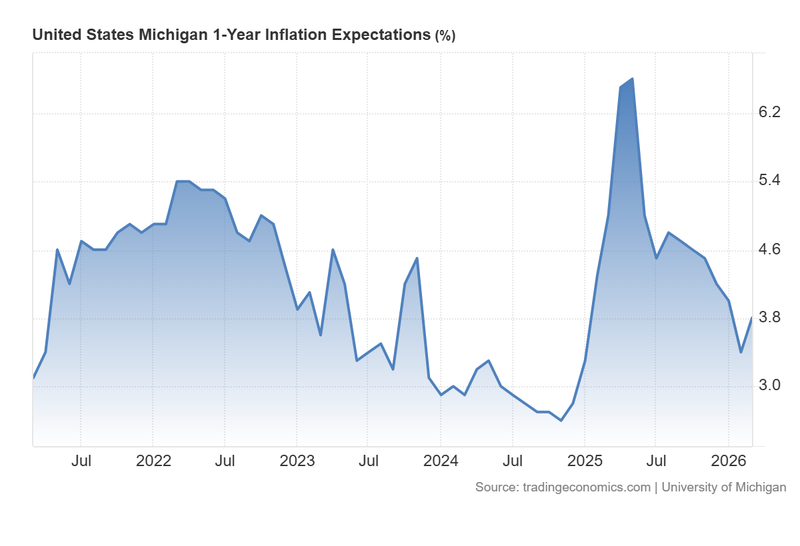
Figure 1. US Michigan 1Y Inflation Expectations (2021-2026). Source: Data from the University of Michigan; Figure obtained from Trading Economics.
