
 Help
Help
Brent rises amid geopolitical tensions but steady OPEC output
The oil benchmark Brent rose by approximately 1.44 per cent, amidst a complex backdrop of market drivers. On one hand, conflicts involving Russian infrastructure and Venezuelan airspace have heightened concerns regarding crude supply chains. On the other hand, OPEC+ members decided to maintain their supply targets for the first quarter of 2026 in order to stabilise supply growth.

Brent crude rose by approximately 1.44 per cent (reaching $63.27), driven by supply fears following Ukrainian drone strikes on Russian fleets and escalating US-Venezuela friction affecting export logistics.
To stabilise supply growth expectations amid market uncertainty, OPEC+ members agreed to maintain their current production targets unchanged through the first quarter of 2026.
Despite the daily uptick, the crude benchmark remains approximately 17 per cent lower for the year (YTD), weighed down by fragile economic demand in China and economic uncertainty in the US.
Geopolitical tensions and market dynamics
The Brent future contract (BRNG26) appreciated by approximately 1.44 per cent to $63.27 per barrel, trading amidst a mixed landscape of geopolitical tensions and unchanged OPEC+ strategic plans.
On one hand, Ukraine launched drone attacks against a Russian fleet, disrupting the Russian supply chain within a context where Ukraine faces pressure from the United States to resolve the ongoing conflict. Furthermore, the closure of Venezuelan airspace by the US is impacting the outlook for crude exports from one of the world's most relevant oil producers, largely because the conflict between the United States and Venezuela is escalating.
A significant volume of crude oil is exported by sanctioned nations—Russia, Iran, and Venezuela. Consequently, numerous nations are declining these oil flows due to the risk of Western sanctions, which in turn disrupts the global supply chains required for crude refinement.
On the other hand, the Organization of the Petroleum Exporting Countries and Allies (OPEC+) agreed to maintain its production targets for the first quarter of 2026 in order to stabilise expectations for supply growth.
However, despite the daily increase in oil prices, the Brent benchmark has experienced significant deterioration year-to-date (YTD), with a depreciation of approximately 17 per cent. A combination of concerns regarding global demand stemming from economic weakness in China and the United States, supply chains impacted by armed conflicts, and fears of oversupply due to increased production from OPEC+ members, has resulted in mixed market reactions.
Technical analysis of the Brent futures contract
From a technical perspective, the Brent futures contract remains confined within a bearish channel pattern and is trading below its long-term moving averages. Key observations include:
- Trend context. In the long term, the Brent futures contract maintains its position within a bearish channel and trades below its 50, 100, and 200-period moving averages. However, in the short term, a key support is being respected (specifically, the short-term support near $60 per barrel).
- Resistance levels. Should the resistance at $67 per barrel (a structural resistance coinciding with the 200-day moving average) be breached to the upside, the next significant ceiling is $77 (the upper boundary of the bearish channel). A decisive break above these levels would suggest the potential for an extension into higher price zones.
- Support levels. Should the support at $60 per barrel (short-term support and a relevant psychological level) be breached to the downside, the next relevant floor is $55 (the lower boundary of the bearish channel). A loss of the $55 zone would increase the probability of a deeper correction.
- Momentum indicators and volume. The MACD is exhibiting neutral momentum, hovering close to the zero line. Meanwhile, both the volume profile and daily contract volumes point to significant distribution around key support zones.
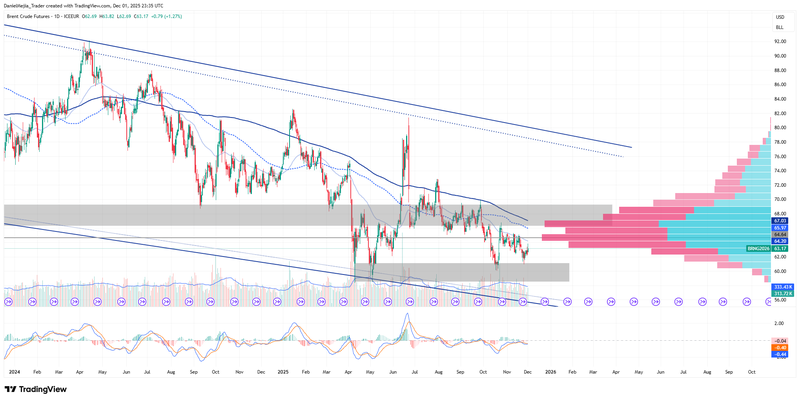
Figure 1. Brent futures contract BRNG26 (2024-2025). Source: Data from the Intercontinental Exchange (ICEEUR); own analysis conducted via TradingView.


