
 Help
Help
Euro holds steady amid ECB neutrality and regional resilience
The European Central Bank (ECB) has decided to maintain its benchmark interest rates, citing economic resilience within the region and emphasising a neutral, data-dependent stance.

The ECB opted to keep its benchmark interest rate unchanged at 2.15%.
The central bank highlighted a resilient economy and reinforced its commitment to making future policy decisions based on updated economic data.
The EUR/USD pair is currently oscillating within a consolidation phase amidst uncertainty regarding the future trajectories of both the ECB and the Federal Reserve.
ECB maintains interest rates while citing prominent resilience in the euro area
The European Central Bank has decided to maintain its benchmark interest rate at 2.15%, in line with market expectations. This decision was made within a context where inflation rates are nearing the bank's 2% target (with headline inflation currently at 2.1%), and the unemployment rate remains near a twenty-year historical low of 6.4%.
During the press conference, ECB President Christine Lagarde stated that the central bank views the Eurozone economy as resilient to global trade shocks, representing a positive outlook for the region. The President noted that, despite challenges in international trade, geopolitical uncertainty, commodity market disruptions, and a shifting global landscape, the Euro area remains stable and adaptable.
Furthermore, it was confirmed that the ECB will continue to a "meeting-by-meeting" framework, predicated entirely on the latest economic data. Additionally, President Lagarde expressed the central bank’s support for investment in artificial intelligence (AI), suggesting that the resilience of the economy could be further bolstered by innovation and technological advancement.
Regarding the inflation outlook, Lagarde remarked that future performance remains difficult to predict due to prevailing global uncertainty. For instance, if US tariffs were to reduce Eurozone exports, nations with overcapacity might increase their internal exports within the Euro area to diversify trade, potentially driving prices lower to secure new clients. Conversely, an increase in defence and infrastructure spending could gradually stoke inflation. These shifting paradigms can influence prices in opposing directions, complicating the formulation of definitive forecasts.
In terms of market reaction, the Euro saw a marginal appreciation of 0.03% against the US Dollar, trading at approximately $1.3381.
Technical analysis of the EUR/USD pair
From a technical perspective, the EUR/USD pair remains within a broader bullish trend; however, in the short term, the price is forming a consolidation structure. Key observations include:
- Trend context. In the long term, the EUR/USD pair has exhibited a bullish trend—defined by a structure of higher highs and higher lows; however, in the short term, the Euro is trading within a range or consolidation phase between $1.1470 and $1.1860.
- Resistance levels. Should the short-term resistance at $1.1860 be breached to the upside, the next significant ceiling corresponds to the level of $1.2270 (a long-term structural resistance). A decisive break above these levels would suggest the potential for an extension into higher price zones.
- Support levels. If the short-term support at $1.1470 is broken to the downside, the next relevant floor is located at $1.1230 (a structural pivot point). A loss of the $1.1230 zone would increase the probability of a deeper market correction.
- Momentum indicators. The MACD is beginning to recover its upward momentum. Meanwhile, the RSI oscillator is exhibiting a bullish structure but is currently approaching the overbought zone.
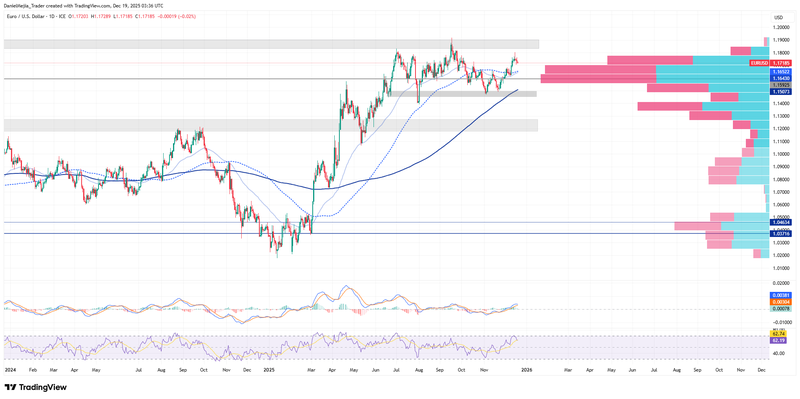
Figure 1. EUR/USD pair (2024-2025). Source: Data from the Intercontinental Exchange (ICE); own analysis conducted via TradingView.


