
 Help
Help
Japan prepares for a tighter policy
The Japanese government on Wednesday nominated academics Toichiro Asada and Ayano Sato to the Bank of Japan’s nine-member board, signaling the Takaichi administration’s approach to monetary policy. Asada, professor emeritus at Chuo University, will replace Asahi Noguchi, a former dove who supported BOJ’s last two rate hikes.

Bringing rates toward 1.5–1.75%.
Japan’s 17.1 trillion stimulus package.
GDP growth has averaged around 4% over the past two years.
Yen pressure and market implications
The Japanese yen has weakened to roughly 157 per dollar, prompting market attention. A weaker yen increases import costs but supports exporters. The government’s aggressive spending and proposed tax cuts could further boost inflation and elevate bond yields. With inflation sustaining above 2%, the Bank of Japan is expected to consider incremental interest rate hikes, likely twice a year through 2026 and 2027, bringing rates toward 1.5–1.75%. This gradual approach balances supporting growth while preventing overheating in the economy and financial markets.
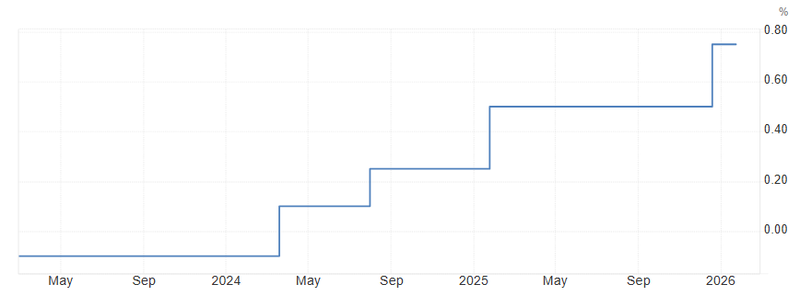
Source: Bank of Japan
Fiscal position strong and sustainable
Japan’s ¥17.1 trillion stimulus package approximately 10% of GDP comes on top of a well-managed fiscal structure. The country’s primary deficit stands at 1.4% of GDP, significantly lower than peers like the US at roughly 3%. Furthermore, Japan has made measurable progress in reducing its debt-to-GDP ratio since the pandemic. Sustained inflation above 2% also provides a subtle debt relief effect, effectively reducing nominal liabilities in real terms.
While Japan’s headline GDP growth of 1.0% may seem modest, adjusting for demographic trends tells a stronger story. Per-capita GDP grew 4.2% in 2024, keeping pace with peers such as the US, UK, South Korea, and Australia. Government spending remains largely aligned with population growth rather than total GDP, meaning modest aggregate growth does not compromise fiscal sustainability.
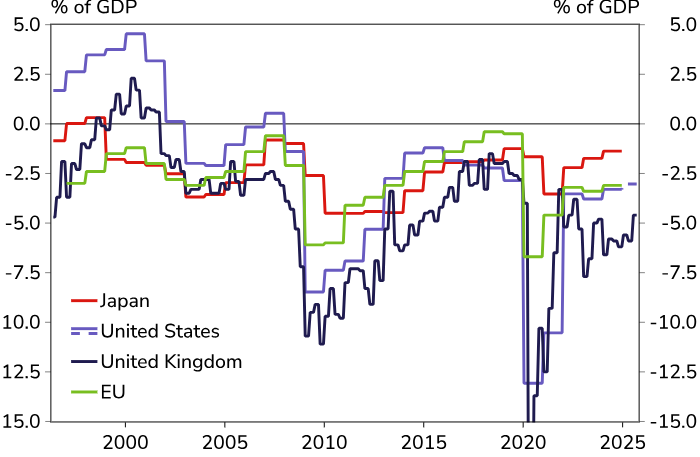
Source: Macrobond
Debt dynamics and interest costs
Low borrowing costs reinforce fiscal stability. Interest payments remain roughly 1% of GDP, while nominal GDP growth has averaged around 4% over the past two years. This combination allows Japan to maintain moderate deficits without increasing its debt-to-GDP ratio, provided per-capita growth remains strong. Aging demographics present long-term challenges, particularly regarding social spending, but rising participation and productivity gains are expected to offset some of these pressures.
1.5–1.75% target may be pushed into 2027
Looking ahead, the Bank of Japan appears set for a gradual tightening path. Rising inflation, robust per-capita growth, and low interest costs provide structural support for incremental rate increases. Markets are likely to anticipate roughly two rate hikes per year through 2026 and 2027, though each step will depend on wage growth, inflation data, and yen performance. A key trigger will be the outcomes of spring wage negotiations, which historically influence inflation expectations.
If wage growth accelerates beyond current inflation trends, the BOJ could accelerate the pace of rate hikes. Conversely, if wages remain subdued, the 1.5–1.75% target may be pushed into 2027. The central bank will likely maintain a cautious, data-driven approach, avoiding abrupt moves that could destabilize markets or undermine fiscal sustainability.
Technical outlook
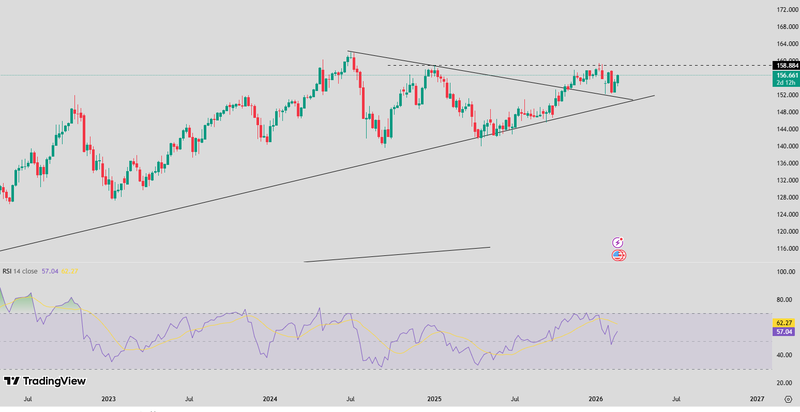
USD/JPY remains in a medium-term uptrend since mid-2025, supported by dovish US monetary policy in contrast with a gradually hawkish BOJ.
Short-term momentum shows signs of consolidation after testing the 157–158 resistance zone, indicating market participants are digesting potential BOJ moves and fiscal signals.
Support zone near 154.50–155, a zone that has historically acted as a floor during prior pullbacks.
A break below 154 could open the door toward 152.00, which served as a previous accumulation level during late 2025.
If BOJ rate hikes materialize as expected in H2 2026 and the yen strengthens, USD/JPY could test the 155–156 support zone, giving temporary relief to exporters.
Conversely, if US dollar strength persists amid global risk-off sentiment or delayed BOJ tightening, the pair may attempt a test of the 160 barriers, which could trigger renewed market positioning in futures and carry trades.
Source: Trading View


