
 Help
Help
Japanese consumer confidence falls amid economic concerns; Yen weakens
Japanese consumer sentiment retreated significantly in March as escalating energy costs and a sustained depreciation of the Yen intensified inflationary anxieties. The Bank of Japan (BoJ) now finds itself navigating a complex policy quandary: the necessity of tightening monetary policy to stabilise the domestic currency and anchor inflation versus the pressure of maintaining accommodative measures to support a fragile growth environment.

The consumer confidence index plummeted to 33.3 in March, falling significantly short of market forecasts. Key sub-indices, including overall livelihood, income growth, and employment prospects, all recorded sharp contractions.
The BoJ faces the difficult choice of raising interest rates to combat imported inflation—exacerbated by a 13% decline in the Yen since early 2025—or prioritising the protection of an economy with weakness in the GDP growth.
A weakened Yen continues to inflate import costs, while global energy supply shocks threaten to destabilise price levels ahead of the critical April monetary policy meeting.
While USD/JPY is currently testing the psychological resistance at ¥160, technical indicators such as bearish RSI divergences and overbought MACD signals suggest a potential consolidation or corrective phase.
Japanese consumer confidence falls sharply amid rising inflation risks and economic anxiety
According to data released by the Cabinet Office of Japan, the consumer confidence index contracted from 39.7 in February to 33.3 in March, falling significantly below the analyst consensus of 38 points. An analysis by Trading Economics reveals that every component of the index registered a decline. Most notably, the "overall livelihood" sentiment dropped from 39.7 to 29.7, "income growth" eased from 42.5 to 39.8, the "employment outlook" weakened from 44 to 37.6, and the "propensity to purchase durable goods" fell from 33.9 to 26 points.
A Reuters report suggests that Japanese households are increasingly concerned about the adverse impact of surging energy prices, which threaten to push headline inflation higher. Consequently, market analysts remain divided on whether a rate hike during the Bank of Japan’s monetary policy meeting on 27–28 April would be appropriate, or whether the central bank should maintain its current stance to avoid dampening the economic outlook for the coming months.
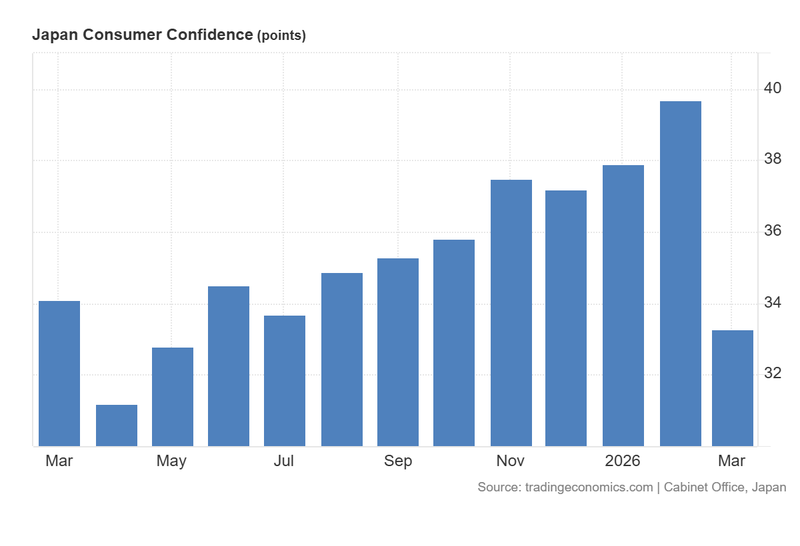
Figure 1. Japan Consumer Confidence (2025–2026). Source: Data from the Cabinet Office of Japan; Figure obtained from Trading Economics.
The Bank of Japan’s economic dilemma
The Bank of Japan is currently facing pressure from multiple fronts. On one hand, the escalating risk of energy-driven inflation threatens to elevate price levels that have already proven resistant to downward adjustment. Simultaneously, the Japanese Yen has steadily depreciated against the US Dollar over the past year, accumulating a 13% decline since April 2025. A stronger US Dollar intensifies inflationary pressure via imported goods and services, as foreign trade settled in Dollars becomes increasingly expensive. Collectively, these factors advocate for a more restrictive monetary stance from the BoJ.
On the other hand, the broader Japanese economy has struggled to sustain momentum, oscillating between marginal expansion and contraction levels. Projected GDP growth for 2025 stands at just 0.4%, following a modest 0.1% increase in 2024. This underlying economic fragility exerts significant pressure on the Bank of Japan to persist with accommodative measures to prevent a broader stagnation.
Technical analysis of the USD/JPY pair
From a technical perspective, the USD/JPY pair currently exhibits bullish momentum as it tests a critical resistance level within a long-term consolidation pattern. Key observations include:
- Trend Context: In the long term, the pair remains within a broad consolidation range, reflecting persistent market indecision. However, the medium-term trajectory maintains a technically bullish structure—defined by a sequence of higher highs and higher lows—as the price tests a pivotal resistance zone.
- Resistance Levels: Should the immediate short-term resistance at ¥160 be breached, the next significant technical ceiling is the peak of ¥161.50. A decisive break above this level would signal the potential for further extension.
- Support Levels: If the short-term support at ¥156.80 is invalidated—a level where the 50-day and 100-day Simple Moving Averages (SMA) converge—the next critical floor is identified at ¥153.80. This level serves as the base of the current bullish channel; a breach of this zone would significantly increase the probability of a deeper market correction.
- Momentum Indicators: The Moving Average Convergence Divergence (MACD) is currently testing resistance levels, suggesting that the pair is in overbought territory. Furthermore, the Relative Strength Index (RSI) is exhibiting a short-term bearish divergence from overbought levels, signalling a potential pause in the uptrend or a period of consolidation. Fundamental developments are likely to provide the catalyst for the next predominant market reaction.
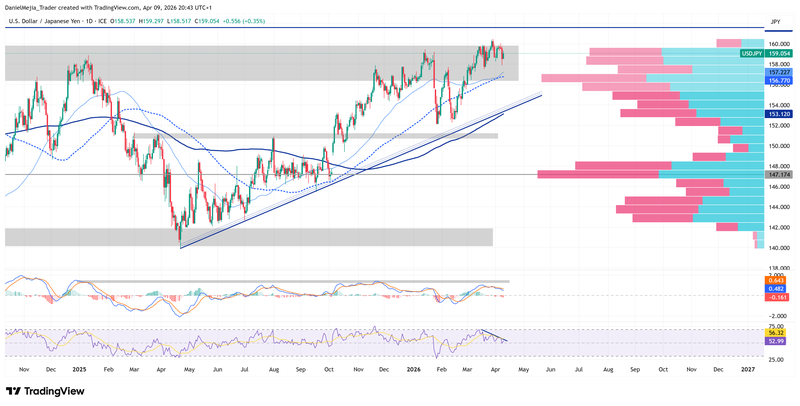
Figure 2. USD/JPY Pair (2024–2026). Source: Data from the Intercontinental Exchange (ICE); Own analysis conducted via TradingView.


