
 Help
Help
Micron driving growth in AI memory
Micron is emerging not just as a leading memory chip manufacturer but as a strategic cornerstone in the global AI infrastructure boom. Sustaining its current momentum requires more than just strong quarterly results; it demands a long-term vision, and Micron’s recent initiatives signal exactly that.

Capital expenditures projected to reach $20 billion in fiscal 2026.
Gross profit reached $14.8 billion, up 165% YoY.
Consolidation range around $397 over the past two months.
Future investments
The company is aggressively investing for the future, with capital expenditures projected to reach $20 billion in fiscal 2026. This massive allocation underscores management’s confidence that current demand for memory chips is not just a temporary spike but the foundation of a durable, AI-driven super cycle.
A significant portion of this investment is earmarked for global expansion. Supported by the U.S. CHIPS and Science Act, which reduces the risks of long-term semiconductor investments, Micron is building next-generation fabrication facilities in Idaho and New York, strengthening domestic capacity and supply chain resilience. In parallel, the company has commenced commercial production at a new assembly and test facility in India, diversifying its geographic footprint and reducing reliance on a single region.
Historically, the memory industry has been cyclical, but Micron’s management suggests that the current AI infrastructure build-out is a structural demand driver. With memory supply expected to remain substantially below demand through 2026, Micron’s billions in strategic investments are positioning it to capitalize on long-term growth while maintaining its role as a key AI economy enabler.
Financial performance
Micron’s recent results underscore both operational strength and growing investor confidence, reflecting its strategic positioning in the rapidly expanding AI and data center markets. Earnings per share grew 39% compared to the previous quarter, demonstrating strong profitability despite the memory industry’s historical cyclical nature. Revenue for 2025 increased 48.9% year-over-year, fueled by robust demand for DRAM and NAND products used in AI servers, cloud infrastructure, and high-performance computing.
Gross profit reached $14.8 billion, up 165% YoY, highlighting not only higher sales but also the benefits of operational efficiency and advanced manufacturing processes. Net income surged an astonishing 997.6% compared to the prior year, a result of operational leverage, improved product mix, and scaling advantages from new fabrication facilities.
The stock’s price-to-earnings ratio, currently about 95% above its four-quarter average of 19.2, suggests that the market is factoring in not just near-term gains but also Micron’s long-term strategic positioning within the AI memory ecosystem. Looking forward, if AI adoption continues at its projected pace, demand for high-performance memory could exceed supply for several years, supporting further margin expansion and earnings growth. Analysts are increasingly bullish on 2026 revenue and EPS potential, signaling that Micron’s investments in next-generation fabs and geographically diversified production may translate into sustained leadership, higher market share, and long-term shareholder value.
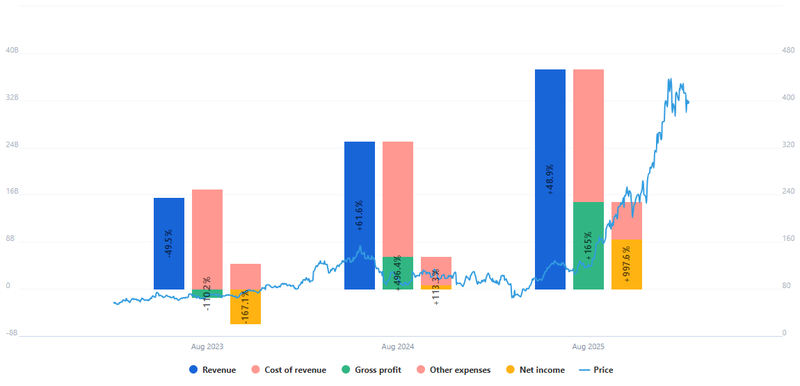
Source: Fullratio
Technical outlook
MU shares have been trading in a consolidation range around $397 over the past two months, reflecting a period of price stability following recent gains. RSI near 48 indicates neutral momentum, suggesting that the stock is neither overbought nor oversold. Support is observed around $363, while recent highs mark a reference point for the upper end of the current trading range.
The upcoming earnings report on March 18 is likely to provide additional market information and could influence short-term price movements. Micron’s combination of ongoing capital investment, global expansion, and operational scale highlights its position within the memory industry and its exposure to AI-related demand growth.
Overall, the technical and operational context suggests that the stock is experiencing a period of consolidation, with market participants monitoring broader trends in AI adoption and memory demand as part of the industry’s longer-term trajectory.
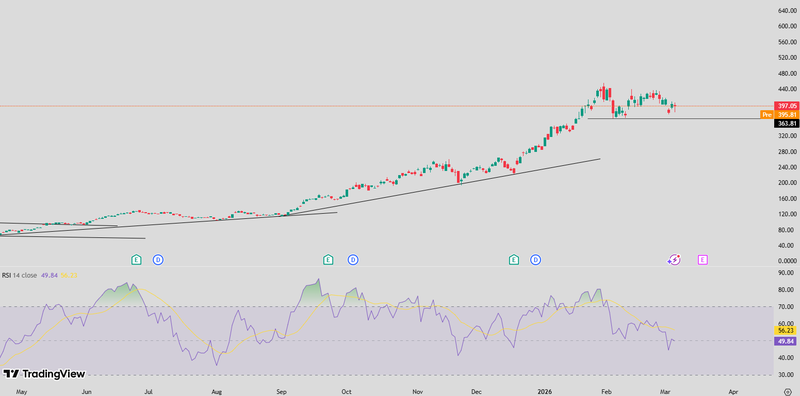
Source: Trading View


