
 Help
Help
Nasdaq slips despite strong YoY gains from Broadcom and Oracle
The Nasdaq index closed with losses despite significant year-on-year revenue growth from Broadcom and Oracle—two prominent AI-related companies.

Oracle's total revenue rose by 14.2% (YoY), while earnings per share (EPS) increased by 54%; however, the share price fell by 14.5% over two days as investors anticipated stronger top-line results.
Broadcom achieved a YoY total revenue increase of 28% and a rise of 37% in EPS, surpassing analysts’ forecasts; nevertheless, the semiconductor firm's share price declined by 11.44%.
Consequently, the Nasdaq-100 fell by 1.91% due to mounting uncertainty regarding returns on AI investments and fears of overvaluation within the technology sector.
Nasdaq declines amid uncertainty regarding AI returns and elevated tech valuations
The Nasdaq-100 index declined at the close amid uncertainty regarding technology company valuations and doubts concerning the tangible returns on high-capital artificial intelligence (AI) investments. Although key AI-related companies—Broadcom and Oracle—achieved considerable year-on-year revenue growth, market participants engaged in a significant selling of technology stocks, dragging the Nasdaq index lower and breaching a short-term bullish pattern to the downside.
Broadcom's share price dropped 11.44% to $359.90 per share, even though the company exceeded analysts’ expectations in its third-quarter results. The semiconductor company reported total revenue of $18.02 billion, surpassing the consensus estimate of $17.45 billion. Furthermore, Broadcom achieved earnings per share (EPS) of $1.95, above the forecast of $1.87. This revenue figure represents a year-on-year growth of approximately 28%; meanwhile, the year-on-year growth in EPS was approximately 37%.
Concurrently, Oracle's share price accumulated a decline of 14.5% over two days, following the company's failure to meet analysts’ expectations for Q3 revenue. The consensus estimate was $16.19 billion, whereas the enterprise reported total revenue of $16.06 billion. However, Oracle exceeded forecasts for earnings per share (EPS), reaching $2.26 against an expected $1.64. On an annual basis, Oracle's total revenue rose by 14.2%, while EPS increased by 54%.
Although the financial results for both Broadcom and Oracle indicate significant growth in revenue and earnings, market participants drove share prices lower due to increasing uncertainty. This reaction demonstrates that investors are adopting a highly critical stance regarding the results of AI-focused companies.
Technical analysis of the Nasdaq index
From a technical perspective, the Nasdaq index maintains its long-term bullish trend, although it is currently breaking below a short-term bullish pattern. Key observations include:
- Trend context. In the long term, the Nasdaq index retains a bullish trend characterised by higher highs and higher lows, and continues to respect its long-term moving averages (50, 100, and 200 periods). However, the price is breaching the lower boundary of a short-term bullish channel, while technical indicators exhibit a weakening of bullish momentum.
- Resistance levels. Should the resistance at 26,100 (historical high) be breached to the upside, the next relevant ceiling corresponds to 27,000 (a significant psychological level). A decisive break above these levels would suggest potential for further upside.
- Support levels. If the support at 24,200 (short-term support and the 100-day moving average) is broken to the downside, the next relevant floor is 22,200 (proximate to the 200-day moving average and a structural support level). A loss of the 22,200 zone would increase the probability of a deeper correction.
- Momentum indicators. The MACD displays a bearish divergence, signalling a weakening of the bullish trend. Meanwhile, the RSI is exhibiting a downward trend characterised by lower highs.
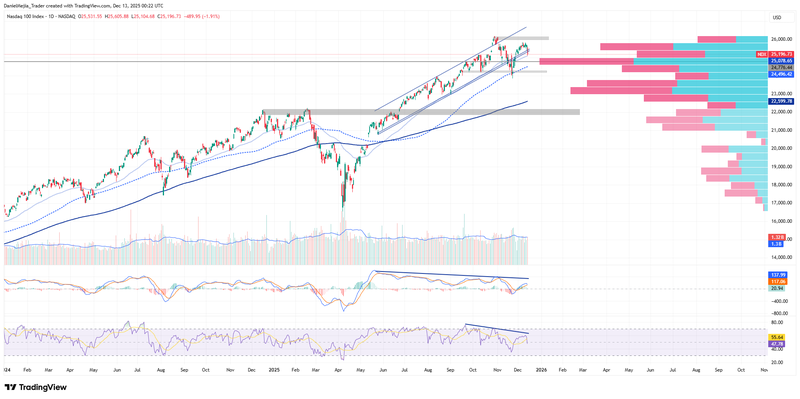
Figure 1. Nasdaq index (2024-2025). Source: Data from the Nasdaq Exchange; own analysis conducted via TradingView.


