
 Help
Help
Oil prices slide on potential Venezuela supply boost
Crude oil benchmarks have undergone a two-day corrective phase, driven by market projections of a potential supply surplus. This shift in sentiment follows speculation regarding increased United States influence over Venezuela’s vast petroleum reserves. While geopolitical tensions currently constrain Venezuelan output, the long-term prospect of integrated production poses a significant downward risk to global price stability, despite the profound implications for Venezuelan national sovereignty.

Brent and WTI have recorded consecutive sessions of decline as oversupply fears outweigh current geopolitical risk premiums.
Recent maritime blockades have exacerbated storage constraints in Venezuela, yet the market is pricing in the long-term possibility of a recovery of Venezuelan output.
Brent remains entrenched in a long-term bearish channel, with traders eyeing the $60 psychological support level.
Oil market outlook: supply expansion risks and geopolitical uncertainty
Oil prices have entered a two-day corrective cycle as market participants recalibrate expectations regarding global supply. The primary catalyst is the anticipation of higher production yields should the United States successfully exert influence over Venezuela’s crude reserves. Although Venezuela possesses the world’s largest proven oil reserves, its actual output remains disproportionately low relative to its capacity.
The systemic underperformance of the Venezuelan energy sector is attributed to a combination of Western economic blockades and persistent domestic macroeconomic imbalances, which have stifled essential infrastructure investment. Furthermore, the implementation of a maritime blockade approximately one month ago—excluding the logistics networks of the U.S. major Chevron—has created a critical bottleneck. This has forced the state-owned enterprise, Petróleos de Venezuela (PDVSA), to contend with acute storage saturation, subsequently dragging down export volumes.
Despite the fact that reduced Venezuelan exports directly threaten supply chains in China—the primary importer of Venezuelan crude—global benchmarks have trended lower. Brent has depreciated by approximately 2.60% over two sessions, trading near $60 per barrel, while WTI has contracted by 3.34% to approximately $56.40.
Traders and hedgers are increasingly pricing in the scenario of U.S. intervention in Venezuelan energy management. If such a shift materializes, the resultant surge in production would likely induce a global oversupply in a period of tempered demand. However, analysts note that such an outcome would necessitate a breach of sovereign independence, potentially triggering broader global geopolitical instability.
Technical analysis of the Brent futures contract (BRNH26)
From a technical perspective, the Brent futures contract remains confined within a bearish channel pattern and is trading below its long-term moving averages. Key observations include:
- Trend context. In the long term, the Brent futures contract maintains its position within a bearish channel and trades below its 50, 100, and 200-period moving averages. In the immediate term, price action continues to respect the descending boundaries of its current channel, reinforcing the downward bias.
- Resistance levels. Should the resistance at $63.70 per barrel (representing short-term resistance and the Point of Control on the volume profile) be breached to the upside, the next significant ceiling is $66.30 (a structural resistance zone converging with the 200-period moving average). A decisive break above $66.30 would suggest the potential for an extension into higher price zones.
- Support levels. Should the support at $60 per barrel (medium-term support and a relevant psychological level) be breached to the downside, the next relevant floor is $55 (the lower boundary of the bearish channel). A loss of the $55 zone would increase the probability of a deeper correction.
- Momentum indicators. The MACD (Moving Average Convergence Divergence) is currently exhibiting a bullish divergence, hinting at a potential exhaustion of short-term selling pressure and a possible reversion. Nevertheless, the prevailing trend remains bearish, and any fundamental news regarding a supply expansion is expected to exert further downward pressure on prices.
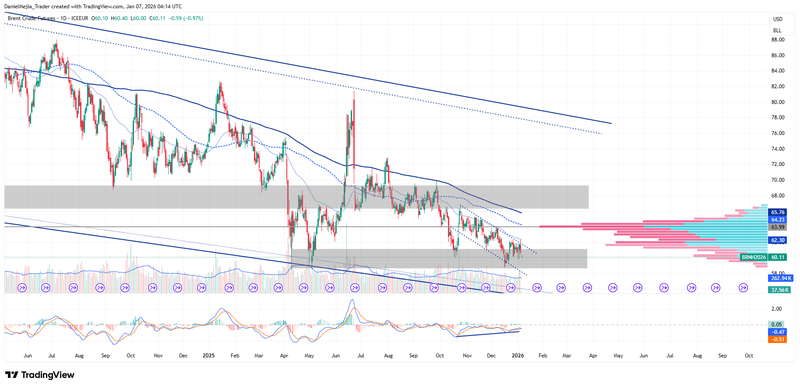
Figure 1. Brent futures contract BRNH26 (2024-2025). Source: Data from the ICE-EUR Exchange; own analysis conducted via TradingView.


