
 Help
Help
Pound slips as Bank of England leaves rates unchanged
The Bank of England (BoE) has elected to maintain its benchmark interest rate at 3.75%, highlighting a complex policy environment defined by persistent inflation and a cooling domestic economy. While price pressures remain elevated, the UK is experiencing growing weakness in both the labour market and consumer spending, complicating the path for future monetary intervention.

The BoE held its benchmark rate steady at 3.75%, a move that aligned with consensus market forecasts.
The Monetary Policy Committee (MPC) cited ongoing inflationary risks against a backdrop of easing employment and consumption; consequently, future policy adjustments will remain strictly contingent on incoming economic data.
Despite the "hawkish hold," the British pound retreated as investors weighed the risk of economic stagnation. While the long-term trend remains bullish, momentum indicators suggest a strengthening bearish impulse in the short term.
BoE holds benchmark interest rate steady amid persistent inflation risks
The Bank of England’s Monetary Policy Committee voted to keep the base rate unchanged at 3.75%, meeting analyst expectations. The decision was reached via a narrow 5-to-4 split—with five members voting for a hold and four dissenting in favour of a 25-basis-point cut—underscoring a significant divide within the Committee regarding the economic outlook. The central bank continues to grapple with an inflation rate of 3.4%, which remains substantially above the 2% target. Conversely, the labour market has shown signs of cooling, with unemployment reaching 5.1%—the highest level in around three years—alongside a progressive weakening in consumer demand. The BoE reiterated that its forward guidance remains data-dependent, with future pivots resting on official economic releases.
Market reaction was notably bearish for the domestic currency; despite the decision technically maintaining a restrictive monetary stance, the British pound depreciated by 0.89% to trade at $1.3529 against the US dollar.
Technical analysis of the GBP/USD pair
From a technical perspective, the GBP/USD pair continues to trade within a well-defined bullish channel. However, current market structure reveals several key nuances:
- Trend Context: In the long term, the British pound maintains its upward trajectory, remaining positioned above its 50, 100, and 200-period Simple Moving Averages (SMA). In the short term, however, the pair is struggling to clear significant structural resistance.
- Resistance Levels: Should the pair breach the immediate structural resistance at 1.3700, the next major target is the psychological ceiling of 1.4000, which aligns with the upper boundary of the bullish channel. A decisive move above this level would signal an extension into a new price territory.
- Support Levels: Should the short-term support at 1.3350 fail, the next critical floor is located at 1.3050, representing the lower boundary of the current bullish channel. A breach of the 1.3050 zone would significantly heighten the probability of a broader trend reversal or a deeper correction.
- Momentum Indicators: The Moving Average Convergence Divergence (MACD) is currently signalling a bearish crossover at historically elevated levels, suggesting the possibility for a short-term correction or a period of price stabilisation. Meanwhile, the Relative Strength Index (RSI) remains in neutral territory, reflecting the current market indecision.
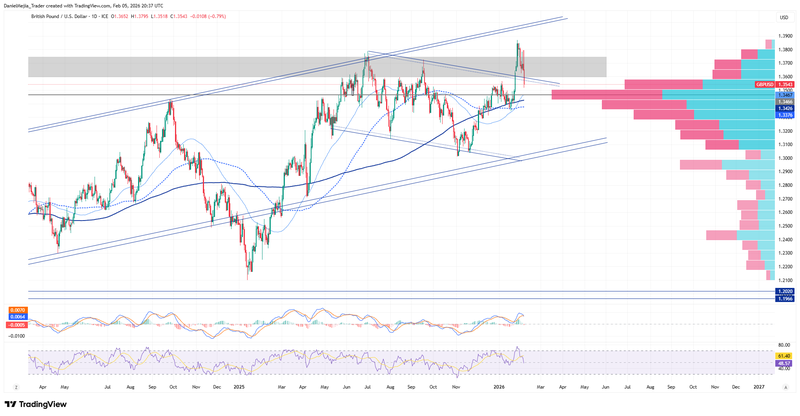
Figure 1. GBP/USD pair (2024-2026). Source: Data from the Intercontinental Exchange (ICE); own analysis conducted via TradingView.


