
 Help
Help
Sterling gains amid growing pressure on the BoE from elevated energy prices
The British pound advanced against the US dollar as market expectations shifted regarding the Bank of England’s (BoE) future monetary policy. Rising geopolitical tensions involving the US, Israel, and Iran have significantly disrupted Middle Eastern energy supply chains, prompting concerns of a renewed inflationary surge. If sustained, these elevated energy costs could compel the BoE to maintain a more restrictive stance for longer than previously anticipated.

Market consensus is undergoing a recalibration; the potential impact of surging energy costs on the inflation outlook may delay the commencement of the BoE’s easing cycle.
The BoE faces a challenging trilemma: persistent inflation above its mandate, a softening labour market, and a protracted deceleration in UK economic growth.
While the GBP/USD pair remains within a long-term bullish channel, short-term price action is characterised by a consolidative phase, reflecting broader market indecision.
The implications of surging oil prices for upcoming BoE monetary policy
According to reports from CNBC, analysts are revising their forecasts for the Bank of England's upcoming policy manoeuvres. While the market had previously priced in a potential initial interest rate cut for the March meeting, heightened uncertainty in the Middle East has introduced a severe upward bias to energy prices. Without a swift resolution, global inflation rates risk a significant rebound. The United Kingdom remains particularly vulnerable to such shocks, as it currently imports approximately 40% of its oil and 60% of its natural gas requirements. By the market close, the Brent crude futures contract—the primary benchmark for European energy—settled near $99 per barrel, its highest valuation since November 2022.
The spotlight is now firmly on the Bank of England as it navigates a complex macroeconomic environment. Although UK inflation has cooled to 3.0%, it remains notably above the central bank’s 2% target. Simultaneously, the labour market is showing signs of distress, with the unemployment rate climbing to 5.2%—a five-year high. Furthermore, economic momentum has stagnated; the UK’s Gross Domestic Product (GDP) registered a marginal growth rate of just 0.1% in Q4 2025. The BoE is scheduled to announce its next interest rate decision on 19 March.
Market sentiment reacted to these developments with the GBP/USD pair appreciating by 0.20% to close at approximately 1.3430. Investors appear to be discounting a more "hawkish" or restrictive stance from the BoE, premised on the assumption that prolonged geopolitical conflict could continue to exert upward pressure on energy-driven inflation.
Technical analysis of the GBP/USD pair
From a technical perspective, the GBP/USD pair continues to navigate within a well-defined long-term bullish channel. However, the immediate market structure reveals several significant nuances:
- Trend Context: In the long term, the British pound maintains its upward trajectory; however, the price is currently testing and breaking below its 50, 100, and 200-period Simple Moving Averages (SMA). In the short term, the pair is oscillating within a consolidative range, suggesting a lack of definitive directional momentum as participants await further fundamental catalysts.
- Resistance Levels: Should the pair breach immediate structural resistance at 1.3560, the next significant level is the ceiling at 1.3670 (a structural resistance). A decisive close above this level would signal a potential extension into new price territory.
- Support Levels: Should the short-term support at 1.3320 fail, the next critical floor is identified at 1.3060, representing the lower boundary of the current bullish channel. A breach of the 1.3060 zone would significantly heighten the probability of a broader trend reversal or a deeper market correction.
- Momentum Indicators: Both the Moving Average Convergence Divergence (MACD) and the Relative Strength Index (RSI) remain in neutral territory. Nevertheless, the downward trajectory of both indicators suggests that bearish pressure is building within the current consolidation.
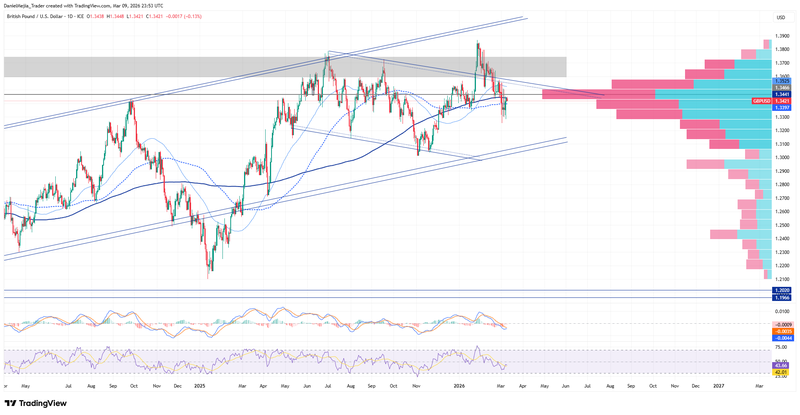
Figure 1. GBP/USD pair (2024–2026). Source: Data from the Intercontinental Exchange (ICE); own analysis conducted via TradingView.


