
 Help
Help
Best forex pairs for breakout trading
Breakout trading aims to catch strong forex moves after consolidation, making choosing the right currency pairs an important part of the strategy.

Trades following the breakout strategy enter positions when price breaks clearly beyond established support or resistance levels.
EUR/USD often delivers cleaner breakouts with more consistent follow-through.
USD/JPY offers moderate volatility and reacts reliably to US and Japanese data.
AUD/USD is highly responsive to shifts in risk appetite and commodity markets.
USD/CAD suits breakout trading due to its strong relationship with oil prices.
Understanding breakout trading strategy
Breakout trading is a strategy used to enter a position when the price of a currency moves beyond established levels of support or resistance. Traders using this approach monitor the market for consolidation zones, where price has been confined within a range for a period of time, indicating a balance between buyers and sellers. When the price breaks above resistance or below support, it signals that market sentiment is shifting, often triggering a sharp and sustained move. Successful breakout trading combines technical indicators, such as volume, volatility measures, and trend analysis, with an understanding of market fundamentals, like economic releases, central bank decisions, or geopolitical events. The key to managing risk lies in confirming the breakout with follow-through momentum and using strategic stop-loss placement to guard against false breakouts that briefly exceed the level but reverse quickly. Over time, traders can develop rules for identifying consolidation patterns, breakout triggers, and optimal position sizing, making the strategy both systematic and adaptable.
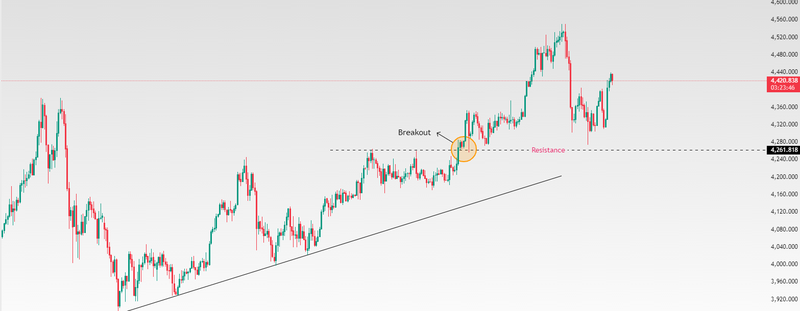
Source: Trading View
Most liquid pair in the market
The first pair that traders often consider for breakout strategies is EUR/USD, the euro-dollar pair. As the most liquid pair in the market, EUR/USD tends to produce cleaner and more sustained breakouts. Its liquidity ensures that price movements are less likely to be distorted by erratic order flows, making trends more reliable for traders who enter into a confirmed breakout. This pair is highly sensitive to economic data from both the Eurozone and the United States, such as Non-Farm Payrolls, CPI releases, ECB policy announcements, and trade balances. When these data points exceed or miss expectations, EUR/USD can experience sharp directional moves, making breakouts more pronounced. Additionally, the pair often respects established technical levels, including daily and weekly highs and lows, providing traders with clearer reference points for entering trades.
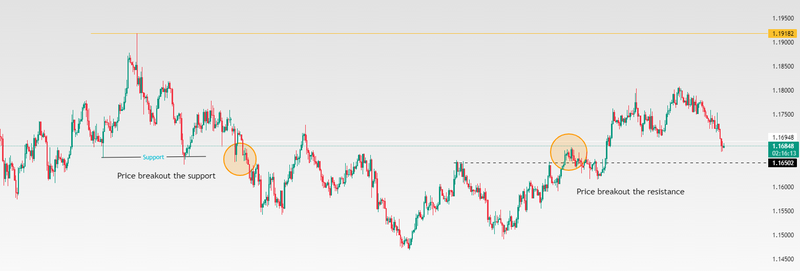
Source: Trading View
Yen moves create breakout opportunities
USD/JPY is a popular pair for breakout traders due to its responsiveness to both U.S. and Japanese macroeconomic data. The pair often reacts to shifts in interest rate expectations, Bank of Japan policy guidance, and geopolitical developments in Asia. Historical price behavior shows that USD/JPY tends to form well-defined consolidation zones during low-volatility periods, especially ahead of major U.S. data releases or BoJ meetings. Breakouts in this pair can be amplified by carry-trade flows, where investors borrow yen at low rates to fund higher-yielding currencies. However, risks include sudden intervention by Japanese authorities or unexpected shifts in U.S. Treasury yields, which can reverse breakouts quickly. Traders should watch technical confirmation such as strong closes beyond key support or resistance levels, coupled with increased volume, to validate a breakout.
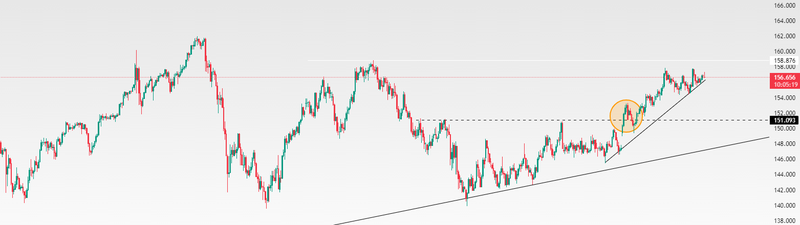
Source: Trading View
AUD/USD, commodity and risk sentiment driven
AUD/USD, the “Aussie,” is highly sensitive to risk sentiment and commodity prices, particularly metals and energy exports from Australia. Consolidation often precedes major economic data, central bank decisions, or shifts in Chinese growth indicators, given China’s role as Australia’s largest trading partner. Breakouts in AUD/USD frequently coincide with sudden shifts in global risk appetite; for instance, market optimism can push the pair above resistance, while risk aversion can trigger sharp downside moves. Traders need to account for volatility spikes during Asian and early U.S. sessions, as liquidity in these periods can accelerate breakout moves. The primary risk is false breakouts caused by abrupt shifts in risk sentiment, such as sudden commodity price swings or unexpected trade data, which can produce temporary spikes before the pair resumes its previous trend.
USD/CAD, oil prices and economic data
USD/CAD is a prime candidate for breakout trading because of its correlation with crude oil prices. The Canadian dollar often strengthens when oil rises, compressing USD/CAD, and weakens when oil falls, expanding the pair. Consolidation zones frequently appear ahead of Bank of Canada announcements, Canadian jobs reports, or major U.S. economic releases, setting the stage for potential breakouts. Volume and volatility often surge during North American trading hours, creating favorable conditions for traders looking to capitalize on decisive moves. However, risks remain, particularly from sudden changes in oil markets, geopolitical events affecting energy supply, or unexpected economic releases. Careful monitoring of both technical levels and oil fundamentals is essential to distinguish genuine breakout opportunities from temporary spikes or reversals.
FQAs
What is breakout trading in forex?
Breakout trading is a strategy where traders look for price movements beyond established support or resistance levels. The idea is to enter a trade when the market breaks out of a consolidation zone.
How do I confirm a genuine breakout?
Traders often wait for a candle to close beyond support or resistance, coupled with increased trading volume or momentum indicators. Aligning breakouts with the overall trend also helps avoid entering into market direction.
What are the risks of breakout trading?
Breakout trading carries risks such as false breakouts, sudden reversals, and unexpected policy or geopolitical shocks. Without proper risk management, traders can face rapid losses.
Can I use breakout trading for all timeframes?
Yes, breakout trading can be applied across timeframes. Day traders may focus on intraday charts like 15-minute or 1-hour, while swing traders may use daily or weekly charts. However, higher timeframes tend to produce more reliable breakouts with less noise.


