
 Support
 US NFP data exceeds expectations; European equities retreat amid geopolitical instability
US stocks hit record highs as April’s 115,000 job gains doubled expectations, signalling labour market resilience. Conversely, European indices retreated due to fragile Middle East peace talks and looming July 4 tariff deadline from the US President Trump.

US non-farm payrolls added 115,000 jobs in April, comfortably surpassing the forecast of 62,000 while maintaining a national unemployment rate of 4.3 per cent.
The S&P 500 and Nasdaq 100 reached all-time highs on the back of strong Q1 earnings, despite projections that the Federal Reserve may maintain restrictive interest rates through late 2026.
European indices declined by around 1 per cent as instability in the Middle East and risks to the Strait of Hormuz threatened energy security for import-dependent EU member states.
US NFP surpasses analyst forecasts as unemployment rate holds steady; US equities advance
According to data released by the US Bureau of Labour Statistics (BLS), non-farm payrolls (NFP) significantly exceeded analyst expectations in April, with 115,000 new positions added against a consensus forecast of 62,000. While this result underscores the continued stability of the labour market, it nonetheless represents a deceleration compared to the March reading, which reported 185,000 new positions. Simultaneously, the BLS confirmed that the US unemployment rate remained unchanged at 4.3 per cent.
The BLS report highlighted that job gains were higher in specific sectors: “Healthcare” added 37,000 positions, “Transportation and Warehousing” increased by 30,000, and the “Retail” sector grew by 22,000. Conversely, the federal government sector saw a contraction of approximately 9,000 positions.
As a result of these figures, market expectations for a Federal Reserve interest rate cut this year are diminishing. Data from the CME FedWatch Tool suggests a probability of over 70 per cent that interest rates will remain unchanged across upcoming FOMC meetings. Investors have now shifted their focus toward a potential US-Iran agreement, which could stabilise energy supply chains in the Middle East and mitigate global inflationary risks.
In response to the data, US stock benchmarks advanced in tandem, supported by solid Q1 2026 earnings results and a resilient labour market. The S&P 500 rose by 0.84 per cent to close at 7,398 points, while the Nasdaq 100 appreciated by 2.35 per cent to 29,234—both marking new record highs. Meanwhile, the Dow Jones Industrial Average saw a marginal gain of 0.02 per cent, closing at 49,613 points.
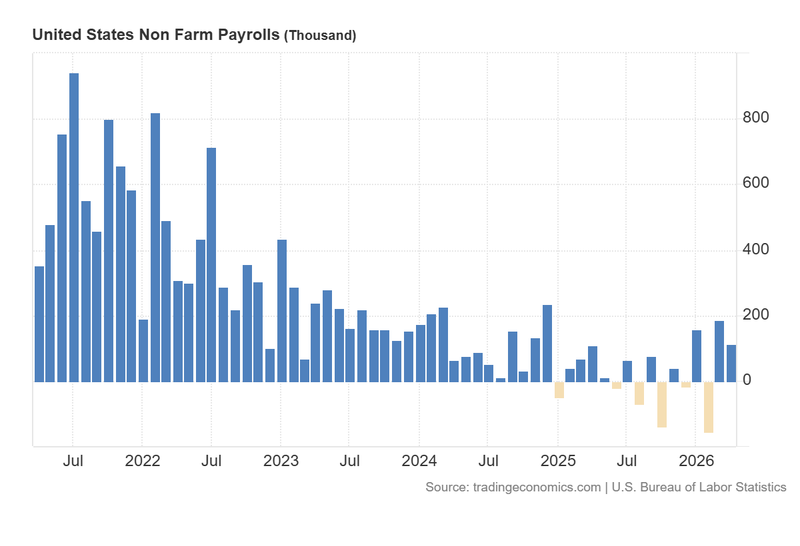
Figure 1. United States Non-Farm Payrolls (2021–2026). Source: Data from the US Bureau of Labour Statistics; Figure obtained from Trading Economics.
European stocks retreat amid Middle Eastern instability and trade tensions
European equity markets declined broadly amid concerns regarding the longevity of current diplomatic efforts between the US, Israel, and Iran. Although high-level talks have produced some positive rhetoric from Washington and Tehran, it remains uncertain whether a comprehensive resolution can be achieved swiftly. Continued sporadic hostilities in the Middle East—notably near the Strait of Hormuz—have heightened fears regarding the fragility of any potential peace agreement. European economies are particularly vulnerable to energy price volatility, given their significant reliance on crude oil, natural gas, and refined fuel imports from Asia and the Middle East.
Furthermore, European markets are exhibiting heightened nervousness regarding the President Donald Trump’s recent trade policy statements. According to Reuters, the US President cautioned that the European Union would face “much higher” tariffs if specific trade commitments were not fulfilled by 4 July. These remarks come amidst ongoing legal challenges in US courts regarding the legitimacy and application of such tariff impositions.
By the close of the session, European benchmark indices had retreated in unison. The French CAC 40 dropped by 1.09 per cent to 8,112 points, and the UK’s FTSE 100 index decreased by 0.43 per cent to 10,233. Meanwhile, the Spanish IBEX 35 fell by 0.95 per cent to 17,889, while the German DAX 40 index saw the steepest decline, depreciating by 1.32 per cent to close at 24,338 points.
