
 Support
Takaichi secures historic election win, cementing strongest mandate in postwar Japan
Prime Minister Sanae Takaichi delivered the largest single-party election victory in modern Japanese history, handing her government unrivaled legislative power and reshaping expectations for fiscal policy, markets and constitutional debate.

The Liberal Democratic Party won 316 seats, securing a two-thirds supermajority on its own
Markets rallied on expectations of expansionary policy, with stocks surging and bond yields rising
The result revives the prospect of constitutional revision and faster policy execution
Attention now turns to fiscal spending, the yen and the Bank of Japan’s policy path
A landslide that rewrites the political balance
Sanae Takaichi scored a decisive victory in Japan’s lower-house election, elevating her to the strongest political position held by any leader in the postwar era. Her ruling Liberal Democratic Party captured 316 seats in the 465-member chamber, giving it a two-thirds supermajority without relying on coalition partners.
The scale of the win marks a dramatic turnaround for the LDP, which only months earlier had lost control of parliament. Takaichi had staked her leadership on the snap election, pledging to step aside if the coalition failed to secure a majority. Instead, voters delivered an emphatic endorsement just months after she became Japan’s first female prime minister.
Markets react to a strengthened mandate
Financial markets moved swiftly to price in the implications of a more assertive government. Japanese equities surged, led by exporters and domestically focused stocks tied to fiscal spending. The benchmark Nikkei index recorded its strongest single-day gain in months, while yields on long-dated government bonds climbed as investors anticipated heavier issuance.
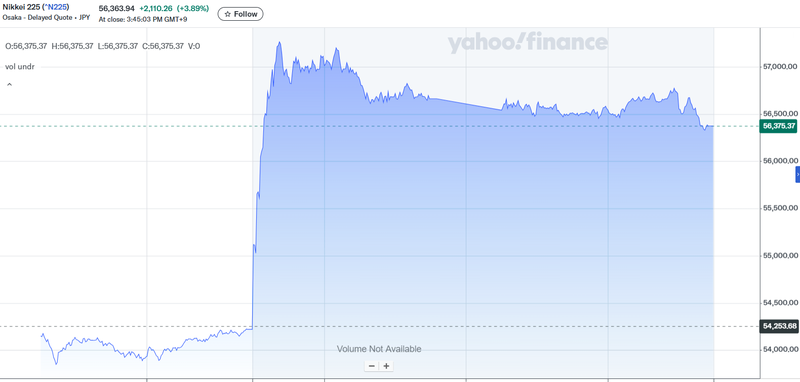
Source: Yahoo Finance
The yen initially weakened on expectations that expansionary fiscal policy could slow the pace of monetary tightening, before stabilizing as officials sought to calm markets. The so-called “Takaichi trade” — long stocks, short bonds and yen — re-emerged with force as investors adjusted positioning to reflect the new political reality.
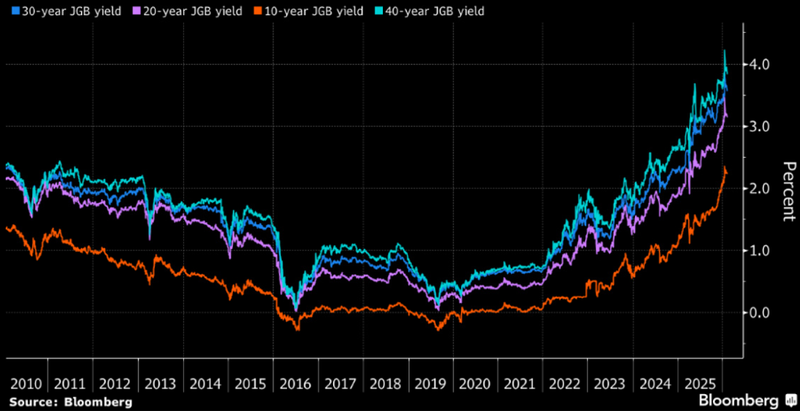
Source: Bloomberg
Legislation and constitution back in focus
With a supermajority in hand, Takaichi’s administration can now pass legislation with minimal resistance and revisit issues that had long been politically sensitive. Chief among them is constitutional revision, a topic that has divided public opinion but gained renewed momentum under her conservative agenda.
The strengthened mandate also gives the government greater freedom to pursue tax and spending measures aimed at easing the cost-of-living pressures that dominated the campaign. Proposals to suspend the sales tax on food, even temporarily, are now firmly back on the table, though financing such measures remains a concern for bond investors.
Implications for the yen and the central bank
Investors are closely watching how the new political balance interacts with monetary policy. A government leaning toward fiscal expansion could complicate the task facing the Bank of Japan, which is already navigating the fallout from a weak currency and rising inflation expectations.
Further yen depreciation toward levels that previously triggered official intervention would sharpen the tension between fiscal ambition and monetary restraint. Officials have signaled they are monitoring currency moves closely, underscoring the sensitivity around exchange-rate stability following such a decisive electoral outcome.
A more predictable, but bolder, policy outlook
The result delivers political stability at a time of global uncertainty, reducing near-term risks of leadership challenges or legislative gridlock. At the same time, it emboldens Takaichi to move faster on her agenda, from economic stimulus to security policy, reshaping Japan’s domestic and international posture.
For markets, the message is clear: Japan now has a leader with both the authority and the numbers to act. How far she chooses to go — and how investors respond to the balance between growth, debt and currency stability — will define the next phase of Japan’s economic story.


