
 Support
What is a Crypto Bull Run? Meaning, signs, and how to prepare
A crypto bull run is a period of sustained capital appreciation across digital assets, typically catalysed by systemic events such as the Bitcoin Halving or surges in institutional adoption. These cycles traditionally transition from a quiet accumulation phase to a state of speculative euphoria.

The Bitcoin Halving has served as a primary catalyst by restricting the growth of the circulating supply, often preceding bull cycles that typically persist for 12 to 18 months in cryptocurrencies.
The euphoria phase represents the period with highest risk; the "Fear of Missing Out" (FOMO) bias frequently drives retail participants to purchase assets at cyclical peaks, immediately prior to the institutional distribution stage.
The advent of ETFs has fundamentally altered cycle periodicity, rendering the crypto market increasingly sensitive to global macroeconomic and geopolitical shifts.
Tools such as the Crypto Fear & Greed Index and the Kelly Criterion are indispensable for mitigating emotional bias and managing capital allocation during volatile periods.
What is a Crypto Bull Run?
A crypto bull run refers to an extended duration period which the valuations of crypto-assets exhibit a significant and sustained upward trend. This phenomenon generally originates within Bitcoin before cascading into "Altcoins"—cryptocurrencies other than Bitcoin—thereby increasing the aggregate market capitalisation of the entire ecosystem. While a bull run is often perceived as an opportunistic period, the extreme volatility of the digital asset market necessitates advanced proficiency in risk management. Traders must maintain rigorous emotional discipline, as abrupt corrections can catastrophically impact the capital of market participants who make decisions based on impulse rather than a defined strategy.
Crypto Bull Run characteristics: Price trends, volume, and sentiment
Unlike traditional equities, the cryptocurrency market often lacks the fundamental metrics required for intrinsic value assessment. Consequently, market participants rely on the technical structure of price action, trading volume trends, and collective psychology (market sentiment) to identify a burgeoning bull run.
Price action that consistently reflects a sequence of higher highs and higher lows, supported by ascending trading volume, typically indicates a robust bullish trend. Furthermore, a generalised narrative in which cryptocurrencies capture mainstream media attention often validates the strength of the move. Technical analysis serves as a vital tool for evaluating trend maturity, while sentiment-based indicators—most notably the Crypto Fear & Greed Index—provide a broader perspective on whether the market is entering a state of overextension or "irrational exuberance."
Common Catalysts: Liquidity, Adoption, Narratives, and Macro Conditions
Specific systemic drivers have historically acted as the primary engines for crypto bull cycles. The most prominent is the Bitcoin "Halving", an algorithmic event that reduces the issuance of new Bitcoins by 50% approximately every four years. This creates a supply-side shock that has historically served as the precursor to substantial price appreciation.
However, the dynamics of these cycles have become increasingly complex. As digital assets achieve greater integration with traditional finance, they have become more sensitive to global macroeconomic factors and geopolitical instability. Due to its high-beta nature, the cryptocurrency market is categorised as a high-risk environment; it often experiences significant contractions during periods of broader economic or commercial uncertainty. Furthermore, crypto-assets now exhibit a high correlation with the monetary policy expectations of influential central banks, such as the Federal Reserve, and are highly reactive to regulatory developments that either facilitate or restrict digital asset acquisition.
Bull Market vs. Bear Market: Key differences
Given the sector’s high volatility and constant media scrutiny, the distinction between a bull and bear market is often readily apparent to participants. From a technical perspective, a bull market is defined by a structural succession of higher lows and higher highs, whereas a bear market is characterised by a persistent sequence of lower lows and lower highs.
How sentiment and risk appetite differ
While volatility remains a constant factor in both bullish and bearish regimes, the underlying market sentiment and risk appetite diverge significantly between the two.
In a crypto bull run, risk appetite is typically high (a "risk-on" environment), as traders pursue returns that exceed those available in traditional financial markets. The prevailing sentiment is overwhelmingly optimistic, frequently escalating into euphoria when the "FOMO" (Fear of Missing Out) cognitive bias takes hold. This collective rush to enter the market significantly boosts total market capitalisation. Additionally, during this phase, the pursuit of outsized gains often leads participants to utilise high leverage; while this amplifies potential returns, it exponentially increases the risk of total capital loss.
Conversely, in a bear market, risk appetite contracts (a "risk-off" environment). Market sentiment shifts rapidly toward pessimism, often resulting in "FUD" (Fear, Uncertainty, and Doubt). If leveraged positions are maintained during these downturns, they can exacerbate the decline; unsustainable margin calls trigger forced liquidations, creating a feedback loop of selling pressure that intensifies the prevailing sense of fear among participants.
When Bull Runs typically start and end
Historically, crypto bull runs have been intrinsically linked to the Halving cycle, occurring roughly every four years and lasting between 12 and 18 months. However, the maturation of the market—marked by the introduction of Exchange-Traded Funds (ETFs) for Bitcoin and Ethereum—has modified this periodicity. The influx of institutional capital means that macroeconomic data and geopolitical events now play a more significant role in determining the start and end of a cycle than in previous retail-driven eras.
Typical cycle phases: Accumulation, breakout, euphoria, and correction
The development of a crypto bull run generally follows a specific four-phase structure, though identifying these phases in real-time is challenging due to inherent market noise.
- Accumulation Phase: This phase typically follows a severe bear market when price action begins to consolidate or move "sideways." Although general market sentiment remains apathetic, institutional traders often utilise this lack of volatility to build significant positions. During this stage, price lows cease to descend, establishing a firm market floor.
- Breakout and Advance Phase (Markup): Here, the price decisively breaches the resistance levels established during consolidation, a move usually validated by a substantial increase in trading volume. As media reports become more optimistic, a broader range of market participants begins to acquire assets, particularly during minor pullbacks.
- Euphoria or "Bubble" Phase: This is the most publicised and high-risk stage. News coverage often becomes sensationalist, creating a sense of urgency for inexperienced or retail investors. The FOMO bias becomes the dominant market driver, pushing valuations to irrational levels.
- Distribution and Correction Phase: During this final stage, institutional investors and expert traders begin selling their positions to retail participants who are entering late in the cycle. This creates a period of consolidation where resistance levels prevent further gains despite high trading activity. Technical indicators often show bearish divergences at this point, signalling a potential reversal. Once the consolidation structure is breached to the downside, the market transitions into a bearish regime.
It is critical for participants to recognise that "false breakouts" (bull traps) are common. Inexperienced traders may misinterpret a temporary price spike as the start of a new phase, leading to significant losses. Therefore, a thorough synthesis of technical analysis and sentiment evaluation is essential for an accurate assessment of the current market cycle.
Quick guide to past Crypto Bull Runs
Throughout history, crypto bull runs have been defined by unique regulatory, geopolitical, or speculative drivers (see figure 1).
- 2013 Period: Characterised by early-stage accessibility and macroeconomic uncertainty.
- 2017 Period: Defined by the rise of Ethereum and the speculative frenzy surrounding Initial Coin Offerings (ICOs).
- 2020–2021 Period: Driven by pandemic-era stimulus liquidity and the initial wave of institutional adoption.
- 2024–2025 Period: Fuelled by the landmark approval of ETFs and a renewed surge in institutional interest.
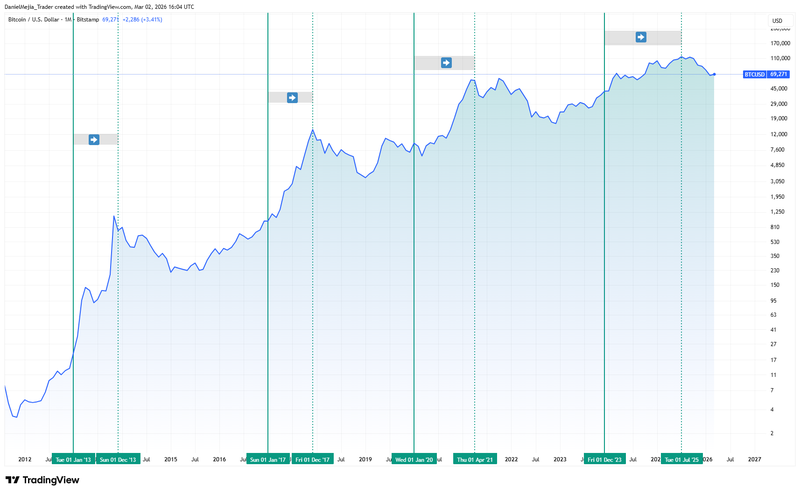
Figure 1. Bitcoin Prices: Period 2012–2026 (Logarithmic Scale). Source: Data from the Bitstamp Exchange; Own analysis conducted via TradingView. Note: Prices are displayed on a logarithmic scale to facilitate comparative analysis across different eras of market maturity.
How to strategise and prepare for a Bull Run
Successfully capitalising on a crypto bull run requires more than the mere identification of bullish patterns; it demands the rigorous application of risk management, capital preservation, and psychological discipline. Without the ability to withstand extreme volatility or the impact of shifting geopolitical conditions, a trader’s success is unlikely to be sustainable.
Risk Management: Position sizing, diversification, and leverage caution
A suite of capital management tools is essential, particularly for those trading via derivative instruments. Key practices include precise position sizing—to ensure no single trade can compromise the entire portfolio—and broad diversification. Furthermore, the responsible use of leverage is paramount. Mathematical frameworks, such as the Kelly Criterion, can be employed to determine the optimal percentage of capital to risk on a given trade based on its probability of success.
Common mistakes in bull markets: FOMO and ignoring downside risk
The immense media attention surrounding crypto bull runs often leads novice traders into emotional errors. The most prevalent is FOMO, where participants enter the market at local peaks after hearing reports of uninterrupted price gains. Such entries are inherently risky, as the probability of a sharp reversion or correction is significantly elevated at these levels.
Historically, even during the strongest bull markets, Bitcoin has experienced severe drawdowns (see Figure 2). Ignoring the potential for a severe contraction can lead to forced liquidations and significant emotional distress. Therefore, the integration of stop-loss orders and a commitment to capital preservation are critical components of a professional trading practice.
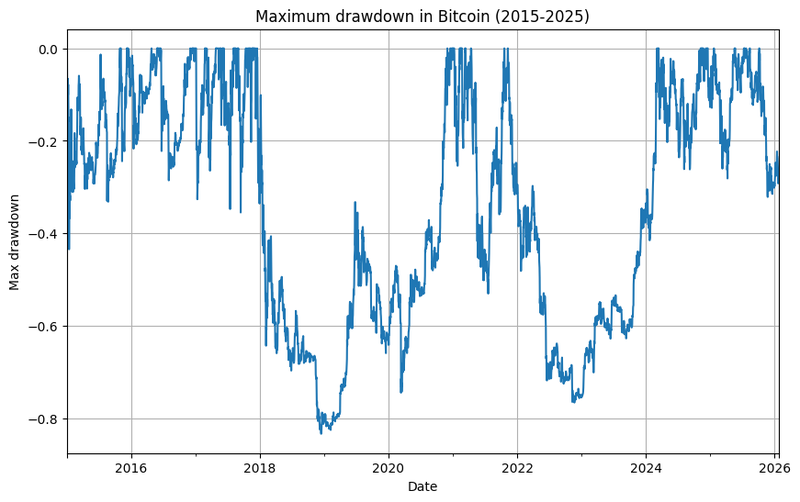
Figure 2. Maximum Drawdown in Bitcoin (2015–2025). Source: Own analysis based on data from Yahoo Finance.
Conclusion
Navigating a crypto bull run successfully requires a transition from emotional participation to clinical execution. While catalysts like the Bitcoin Halving and institutional ETF adoption provide a structural framework for growth, the market's intrinsic volatility remains a threat to those who operate without a defined strategy. Long-term sustainability in the digital asset space is not found in the pursuit of "euphoric" gains, but in the trader’s ability to synthesise technical data, manage capital with ironclad discipline, and remain resilient against the fear or greed driven corrections.
Frequently Asked Questions (FAQ) Section
What is the impact of the Bitcoin Halving on a bull run?
The Halving reduces the production of new Bitcoins by 50% every four years, creating a fundamental supply-side shock. Historically, this scheduled scarcity has been the primary engine for bull cycles, as a reduction in supply—amidst steady or rising demand—naturally drives valuations higher. However, in the current era, this technical event is increasingly influenced by broader macroeconomic conditions and institutional capital flows.
How is market sentiment different between a bull and a bear market?
A bull market is defined by a "risk-on" appetite, where optimism and greed often lead to euphoria. This environment encourages high leverage and speculative buying. In contrast, a bear market is a "risk-off" environment characterised by pervasive pessimism. During these periods, fear can transition into "FUD," leading to panic selling and a cascade of liquidations that accelerate the downward trajectory of prices.
What are the main phases of a crypto bull cycle?
standard cycle consists of four distinct stages: Accumulation, where institutional "smart money" builds positions during periods of low volatility; Markup, where prices breach resistance and public interest begins to swell; Euphoria, the peak stage driven by irrational FOMO and sensationalist media; and Distribution, where experienced participants exit their positions by selling to retail traders.
What common mistakes do traders make during a bull run?
The most frequent error is FOMO, which causes traders to buy assets when they are overextended and "expensive." Additionally, many participants suffer from overconfidence, neglecting essential tools like position sizing and stop-loss orders. Relying on excessive leverage without a mathematical framework for capital management, such as the Kelly Criterion, often leads to total portfolio depletion during the inevitable market corrections.


