
 Support
ECB rate hike bets move closer as inflation risks are rising again
The European Central Bank is facing a renewed inflation test as the Iran war pushes energy markets back into focus and revives memories of the region’s 2022 price shock. Governing Council member Peter Kazimir said a policy response may be closer than investors assume, while President Christine Lagarde stressed the ECB will not allow the latest conflict to trigger another damaging inflation spiral across the euro zone.

Kazimir said upside inflation risks now clearly dominate the outlook.
He warned firms and workers may react faster to rising costs than in 2022.
Lagarde said the ECB is better placed than before to absorb an energy shock.
Further rate cuts are effectively off the table for now, even if no immediate move is planned.
Inflation risks return to the center of the debate
The European Central Bank is again confronting the possibility that an external energy shock could spill into broader inflation, with policymakers signaling a far more cautious tone on rates as the geopolitical tension in Iran unsettles markets.
Peter Kazimir said the conflict’s impact on prices could force the ECB to raise borrowing costs sooner than many had expected. While he argued there is no need to act at next week’s meeting, he made clear that the balance of risks has shifted sharply upward and that policymakers must remain ready to respond quickly if needed.
Kazimir says the window for cuts has closed
Kazimir’s message was notably more hawkish than the market had been pricing only weeks ago. He said discussions about an inflation undershoot no longer make sense and added that considerations of further rate cuts are now definitively off the table.
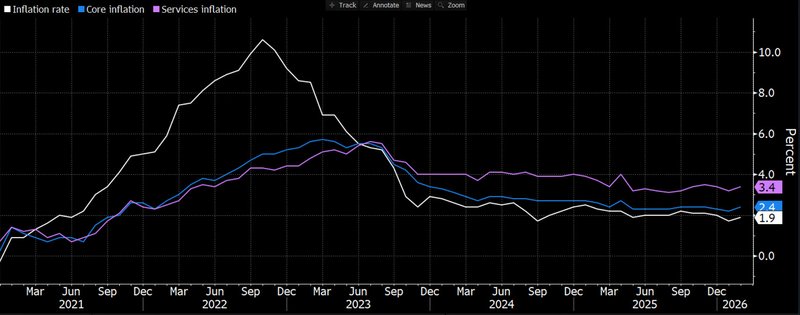
His concern is not limited to headline energy prices. In his view, the deeper danger is that businesses, having lived through the inflation surge of recent years, may now pass higher input costs to consumers more quickly, while workers may demand higher wages faster than they did before. That kind of second-round effect is precisely what central banks fear, because it can turn a temporary shock into a more persistent inflation cycle.
Source: Bloomberg
Markets are rethinking the ECB path
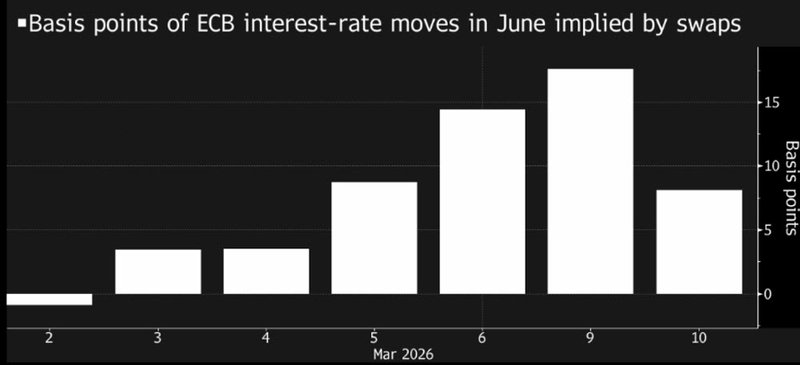
Investors have already begun shifting their expectations. Traders recently moved toward pricing in an ECB rate increase by June or later, driven by the prospect that higher oil and gas costs linked to the Middle East conflict could delay or even reverse the disinflation trend.
Those expectations eased somewhat after Donald Trump suggested the war could end soon, but the repricing itself shows how fragile the rates outlook has become. The euro held gains after Kazimir’s remarks, reflecting how seriously markets are taking the prospect that the ECB may need to lean hawkish again.
Lagarde strikes a calmer tone, but not a softer one
Christine Lagarde delivered a more measured message, yet not a dovish one. She said the ECB would ensure the Iran war does not inflict the same inflation damage on Europe that followed Russia’s invasion of Ukraine.
Her argument is that the euro zone is now in a stronger position than it was in 2022, with greater capacity to absorb shocks and a more flexible policy framework. Still, she acknowledged that the current environment is marked by exceptional uncertainty and volatility, making snap decisions risky.
Lagarde said policymakers would not rush into a move at the March meeting, stressing that the ECB must first assess evolving conditions. At the same time, she made clear that all options remain on the table, including rate increases if inflation pressures prove more durable.
The ECB is preparing for multiple scenarios
The next ECB meeting will come with updated quarterly forecasts, though even those projections risk being outdated quickly if energy markets remain volatile. Lagarde suggested the central bank may again rely on alternative scenarios rather than a single base case, a sign of how fluid the backdrop has become.
That approach reflects a central bank trying to avoid the mistakes of the previous inflation shock, when fast-changing external conditions left policymakers scrambling to catch up. This time, officials want to preserve optionality and move faster if price pressures start to broaden.
Growth concerns remain, but inflation is taking priority
Even with the renewed inflation threat, ECB officials are not yet embracing a stagflation narrative. Kazimir said he remains relatively optimistic on growth and is not overly worried about a prolonged mix of weak activity and high inflation.
Still, he warned governments against repeating the old reflex of broad-based fiscal support to shield households and companies from higher energy costs. In his view, such measures tend to be costly, poorly targeted and inflationary in themselves. Any relief, he argued, should be narrow and temporary.
The policy message is shifting
Taken together, the remarks from Kazimir and Lagarde show an ECB that is not panicking, but is clearly becoming less comfortable. The central bank is not ready to hike next week, and Lagarde is still preaching patience. But the tone has changed.
Source: Bloomberg
The message now is that the ECB will not assume the inflation fight is won simply because price growth had returned to target before the latest geopolitical shock. If energy costs begin feeding into wages, profits and consumer prices more broadly, the central bank is prepared to act again.
That means the debate in Frankfurt is no longer about when easing resumes. It is increasingly about how close the ECB may be to tightening once more if the Middle East crisis turns from a market shock into an inflation problem.


