
 Support
Australia’s sticky inflation keeps RBA on watch
On Wednesday, annual inflation is expected between 3.6% and 3.7%, easing slightly but still above the Reserve Bank of Australia 2–3% target band. Even if upcoming inflation data comes in slightly below the central bank’s own projections, the focus inside the Reserve Bank of Australia has clearly broadened beyond just CPI prints.

In Wednesday, annual inflation is expected between 3.6% and 3.7%.
May meeting could become a defining moment for 2026.
AUD/USD could approach multi-year highs.
Inflation is still sticky
In Wednesday, annual inflation is expected between 3.6% and 3.7%, easing slightly but still above the Reserve Bank of Australia 2–3% target band. While this is well below the 2022 peak above 7%, the final stage of disinflation is proving difficult.
The main obstacle is sticky services inflation, particularly rents, insurance, and labor-intensive sectors with wage growth still around 4%. Goods prices have cooled, but domestic cost pressures remain firm.
A 3.6% reading effectively acts as a near-term floor. Until inflation moves clearly into the 2% range, the RBA is unlikely to pivot toward rate cuts. Compared with Europe and North America, Australia appears several months behind in the disinflation cycle, suggesting policy easing may also come later unless growth weakens more sharply.
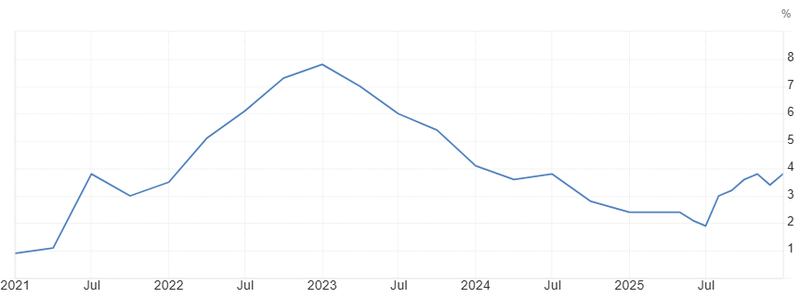
Source: Australian Bureau of Statistics
RBA May hike
Even if upcoming inflation data comes in slightly below the central bank’s own projections, the focus inside the Reserve Bank of Australia has clearly broadened beyond just CPI prints.
The Board is increasingly debating two structural questions: the size of the output gap and the level of the neutral rate. If policymakers conclude that the neutral rate the level that neither stimulates nor restricts economic activity is higher than previously estimated, then current policy settings may not be as restrictive as assumed. In that case, even moderating inflation would not automatically justify easing.
At the same time, if the economy is judged to be operating above capacity meaning demand continues to outpace supply the RBA could feel pressure to tighten further to ensure inflation returns sustainably to target. Strong population growth, resilient employment, and persistent services inflation all complicate that assessment.
Looking ahead, the May meeting could become a defining moment for 2026. A rate hike at that point would send a clear signal that the RBA is prepared to keep policy restrictive for longer than many of its global peers, reinforcing a “higher for longer” stance anchored in structural, not temporary, concerns.
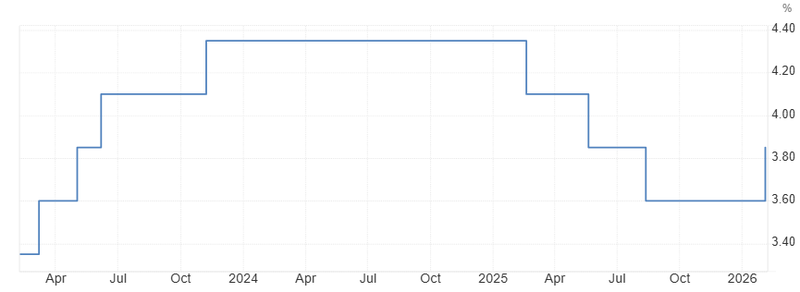
Source: Reserve Bank of Australia
AUD carry trade
The widening gap between a hawkish Reserve Bank of Australia and a generally dovish global backdrop is putting the Australian Dollar (AUD) in focus. Investors are increasingly drawn to the AUD via the classic carry trade borrowing in low-yield currencies like the Japanese Yen or Swiss Franc to buy the higher-yielding Aussie.
As the interest-rate differential expands, demand for AUD could intensify, supporting further appreciation. Predictively, if the RBA follows through with a rate hike in May while major peers such as the Fed and BoE are easing, AUD/USD could approach multi-year highs.
However, this strength comes with trade-offs. A stronger currency helps curb imported inflation, but it also makes Australian exports more expensive on the global market, potentially weighing on trade-dependent sectors. Policymakers will need to balance currency strength against broader economic growth as the yield advantage continues to attract capital.


