
 Support
S&P 500 snaps losing streak with strongest weekly gain since November
US stocks ended the week in positive territory as investors stepped back into the market after another burst of volatility tied to the Iran conflict. The rebound was enough to deliver the S&P 500 its best weekly performance since late November, though the broader tone remained fragile and heavily driven by geopolitical headlines.

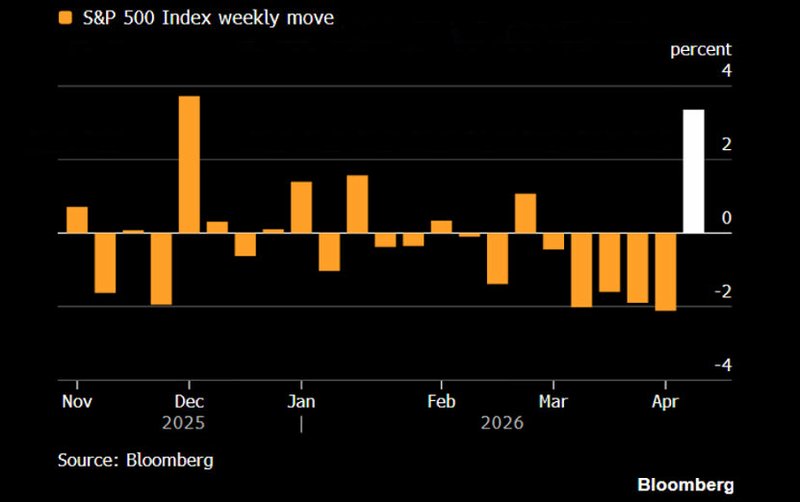
The S&P 500 rose 3.4% for the week, its best gain since November.
The index ended Thursday up 0.1% after a sharp intraday swing.
Markets remain highly sensitive to developments in the Iran war.
Dip-buying returned, but conviction in a lasting rebound is still limited.
A volatile session ends with modest gains
US equity indexes managed to finish slightly higher on Thursday, capping a strong week as dip-buyers re-emerged after President Donald Trump’s latest remarks on Iran rattled markets.
The S&P 500 closed up 0.1% after a wild session that saw the benchmark swing from a 1.5% drop to a 0.4% gain before settling modestly higher. In the holiday-shortened week, the index advanced 3.4%, its strongest weekly performance since late November.
That move also ended a bruising stretch of five consecutive weekly declines, the longest losing run since 2022.
Source: Bloomberg
Nasdaq rises, but Tesla limits upside
The Nasdaq 100 also added 0.1%, though gains were capped by a sharp drop in Tesla after the company posted one of its weakest sales quarters in years. Tesla shares fell 5.4% after reporting first-quarter deliveries of 358,023 vehicles, below analyst expectations of 372,160.
The Cboe Volatility Index hovered near 24, a sign that investor anxiety remains elevated even as equities recovered off the lows.
Iran headlines continue to dictate direction
Markets opened sharply lower after Trump’s late-Wednesday speech undermined hopes for an early reopening of the Strait of Hormuz. The president warned of additional military attacks in the coming weeks and stopped short of offering reassurance that the key shipping route would reopen soon.
That initial selloff faded later in the day after an Iranian state news agency reported that Tehran was drafting a protocol with Oman to monitor traffic through the strait, a headline that investors interpreted as at least a partial de-escalation signal.
The result was another session in which markets swung not on earnings or macro fundamentals, but on war rhetoric and shifting expectations around energy flows.
Dip-buyers return, but the mood stays cautious
The late rebound highlighted the willingness of US investors to buy weakness, especially after the market had already been heavily pressured in recent weeks.
Still, the tone was far from confident. The recovery looked more tactical than structural, with investors responding to short-term relief rather than betting on a durable easing in geopolitical risk.
That caution makes sense. The market has repeatedly bounced on hopes that the conflict could cool, only to reverse when new threats or attacks emerged. Without clearer signs of de-escalation, stocks remain vulnerable to sudden shifts in sentiment.
Weekly rebound follows a bruising period
This week’s gain was notable not just for its size, but for the context. Since the US and Israel launched strikes on Iran, the S&P 500 had struggled to hold onto any early-week strength. By Monday, the benchmark had come close to correction territory before staging a sharp rebound on reports that both Washington and Tehran wanted to bring the conflict to an end.
Thursday’s modest rise completed that recovery, at least for now. But the pattern remains unstable: markets rally on hope, then wobble when the hard details fail to follow.
Data stay supportive, but geopolitics dominate
Economic data on Thursday were broadly constructive. Initial jobless claims fell to one of the lowest levels in nearly two years, while the US trade deficit widened less than expected as both imports and exports increased.
Under normal circumstances, that kind of data might have helped reinforce a more durable risk rally. Instead, it played only a secondary role behind geopolitical headlines.
Sector moves reflect inflation and supply fears
Sector performance also revealed what investors are most worried about. Energy shares rebounded as higher oil-price expectations remained supportive, while travel and mining stocks came under pressure on the prospect of elevated fuel and input costs.
Metals and finished-goods names also weakened as investors braced for fresh tiered tariffs on steel and aluminum imports. Meanwhile, alternative asset managers fell after Blue Owl Capital said it would limit redemptions from two private credit funds.
The market also found pockets of optimism in aerospace and satellite-related stocks after NASA astronauts reached stable orbit, kicking off a new moon mission.
A strong week, but not yet a clear turning point
The weekly gain was meaningful, especially after the market’s recent bruising stretch. But it would be premature to call it a clean return of risk appetite.
For now, US stocks are still trading in a headline-driven environment where war developments, oil prices and political messaging matter more than almost anything else. The dip-buyers showed up this week. Whether they stay will depend on whether the next headlines bring de-escalation — or another shock.


