
 Support
Amazon shares fall on mixed quarterly results as US markets rise
Amazon’s shares experienced a significant decline during the trading session, driven by lower-than-expected earnings per share (EPS) and a substantial projected increase in capital expenditure for the current fiscal year. Despite Amazon’s retreat, US equity indices rallied in tandem on renewed expectations of Federal Reserve interest rate cuts.

Amazon’s shares depreciated by 6.5% after the technology and retail giant failed to meet analyst earnings forecasts. Concerns were further exacerbated by an aggressive Capex projection for 2026, leading investors to question whether near-term returns justify the investment scale.
The BoE’s Market Participants Survey signalled expectations for a 75-basis-point reduction in interest rates, as policymakers navigate the complex balance between persistent inflation and a softening labour market.
The Canadian dollar appreciated by 0.45% following a larger-than-expected decline in the unemployment rate, providing the Bank of Canada (BoC) with greater policy flexibility to support economic growth.
Amazon shares decrease amid robust revenue but lower-than-expected EPS
Amazon’s shares saw an aggressive sell-off during the trading session, falling approximately 6.5% to close at $208.31. Although the technology titan surpassed analyst expectations for total revenue, earnings per share (EPS) fell slightly short of consensus estimates. Amazon reported total revenue of $213.39 billion for Q4 2025, exceeding the forecast of $211.44 billion. Conversely, the firm posted an EPS of $1.95, marginally below the $1.97 estimate. These results represent a year-on-year growth rate of 13.6% in revenue and 4.8% in EPS; however, despite this generally healthy performance, market participants reacted negatively to the earnings miss.
Investor sentiment was further pressured by Amazon's projection of a 50% increase in capital expenditure (Capex) for 2026. This sparked concerns regarding the high capital intensity required for artificial intelligence (AI) infrastructure, particularly as the timeframe for definitive returns on AI investments remains uncertain. Despite the volatility in Amazon, broader stock indices rose: the S&P 500 increased by 2.10% to 6,941 points, and the Dow Jones Industrial Average gained 2.55%, surpassing the 50,000-point milestone for the first time. The Nasdaq 100 also appreciated by 2% to reach 25,039 points, as markets began pricing in lower interest rates following signs of cooling in the US private employment sector.
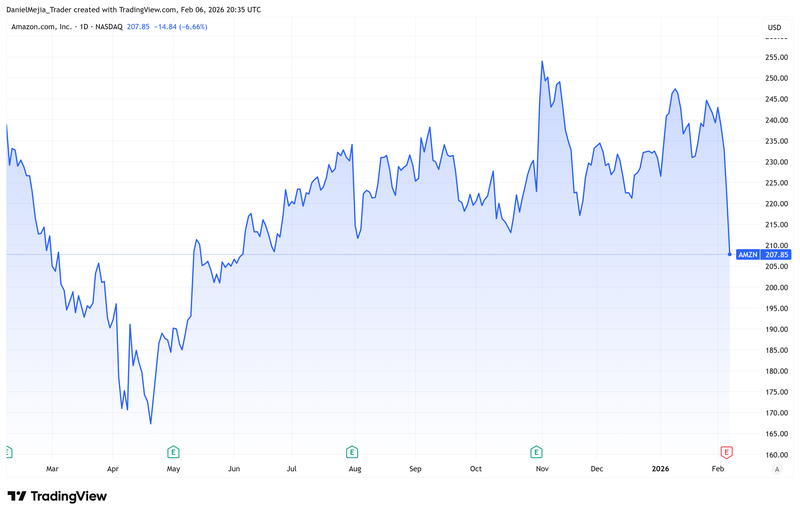
Figure 1. Amazon’s shares (1-year performance). Source: Data from the Nasdaq Exchange; Figure obtained from TradingView.
BoE survey indicates rate cut expectations amid growing UK economic weakness
Data from the Bank of England (BoE) suggests that market participants now anticipate a benchmark interest rate of 3% by March 2027—according to Reuters’ information. This would represent a total reduction of 75 basis points from the current level of 3.75%. Findings from the BoE's quarterly Market Participants Survey indicate a growing consensus that domestic economic fragility may compel the central bank to lower rates to bolster employment and consumer spending.
While the UK inflation rate remains above the BoE’s 2% target—currently standing at 3.4%—analysts expect the indicator to decelerate in the coming months, largely supported by a marked cooling in energy prices. However, geopolitical tensions between the US and Iran have introduced volatility into oil markets, potentially disrupting the expected decline in crude prices. Furthermore, it is relevant to note that higher unemployment—now at 5.1%—signals a weakening labour market and is likely to reduce domestic consumption.
In response to these developments, the British pound appreciated by 0.69% to 1.3620 against the US dollar. Simultaneously, the FTSE 100 index rose by 0.59% to 10,369, nearing its all-time record high.
Canada’s unemployment rate signals improvement after lower-than-expected reading
According to data from Statistics Canada, the unemployment rate fell from 6.8% in December to 6.5% in January. This release marks a positive shift for the Canadian economy, as the medium-term trend over the last three years had been trending upwards, reaching a peak of 7.1% in September 2025. This improvement provides the Bank of Canada with increased "room for manoeuvre"; with inflation currently at 2.4%—within reach of the central bank's target—the monetary authority may now have more flexibility to implement strategic measures to support broader economic activity.
Following the announcement, the Canadian dollar appreciated by 0.45%, reaching 1.3648 against the US dollar.
