
 Support
BoJ on watch for yen action; German inflation heats up
Officials from the Japanese Ministry of Finance and the Bank of Japan (BoJ) have indicated that direct currency intervention and further interest rate hikes may be required to mitigate intensifying inflationary risks. Concurrently, the German inflation rate surged in March, driven by a significant escalation in energy prices.

The Bank of Japan may raise interest rates if persistent yen depreciation continues, which could fuel domestic inflation; meanwhile, the Ministry of Finance remains poised to intervene in the foreign exchange market to curb speculative volatility.
German inflation accelerated from 1.9% to 2.7% in March, underpinned by rising energy costs stemming from Middle Eastern tensions—which have disrupted global supply chains and led to inventory imbalances.
Market participants are preparing for a pivotal week of data releases, including the Chinese manufacturing PMI, Eurozone inflation figures, and the highly anticipated US employment report.
Bank of Japan warns of potential intervention amidst continued yen depreciation
According to reports from Reuters, Atsushi Mimura—Vice Minister of Finance for International Affairs—stated that Japan may implement a direct intervention in the yen, citing current depreciation levels and the breach of critical technical thresholds. Mimura emphasised that the government is prepared to act decisively against speculative pressures in the currency market. Currently, the USD/JPY pair is trading near the ¥160 mark, a prominent psychological level not tested since July 2024.
Simultaneously, Bank of Japan Governor Kazuo Ueda noted that the BoJ is closely monitoring yen movements, as inflationary pressures resulting from a weakening currency could justify higher interest rates in the coming months. The Governor suggested that the BoJ intends to increase its short-term policy rate at an "appropriate pace" to prevent bond yields from ascending too rapidly, implying that future hikes could be conducted in a controlled, gradual manner.
Analysts observing the Japanese economy have expressed concerns regarding rising stagflation risks; inflation remains pressured by elevated energy costs and yen weakness, while the broader economy could face headwinds from rising borrowing costs. Currently, 10-year Japanese Government Bond (JGB) yields are trading near 2.36%, their highest level in two decades. Elevated long-term rates suggest significantly higher financing costs for both corporate growth projects and domestic householders.
Following these developments, the Japanese yen appreciated by 0.31% to ¥159.70 against the US dollar. Conversely, the Nikkei 225 index retreated by 2.79% to 51,885 points. Equity markets typically respond negatively when the economic outlook suggests a complex environment with restricted growth prospects.
German inflation surges in March driven by rising energy costs
Data released by the Federal Statistical Office of Germany (Destatis) reveals that headline inflation accelerated from 1.9% in February to 2.7% in March, aligning with consensus estimates. This represents the highest inflationary reading since January 2024, largely propelled by a 7.2% increase in energy prices. Meanwhile, core inflation—which excludes volatile food and energy components—remained stable at 2.5%.
Notably, services inflation held steady at 3.2%. This suggests that headline inflation may face multi-faceted pressure in the months ahead from energy, non-processed foods, and services, particularly if geopolitical tensions in the Middle East persist. The spike in German inflation serves as early evidence of the impact of rising energy costs on the European continent, given the region's heavy reliance on imported oil and natural gas.
Despite the inflationary uptick, the DAX 40 index rose by 1.18% to 22,562 points during a period of high volatility, as investors navigate prevailing geopolitical and economic uncertainties.
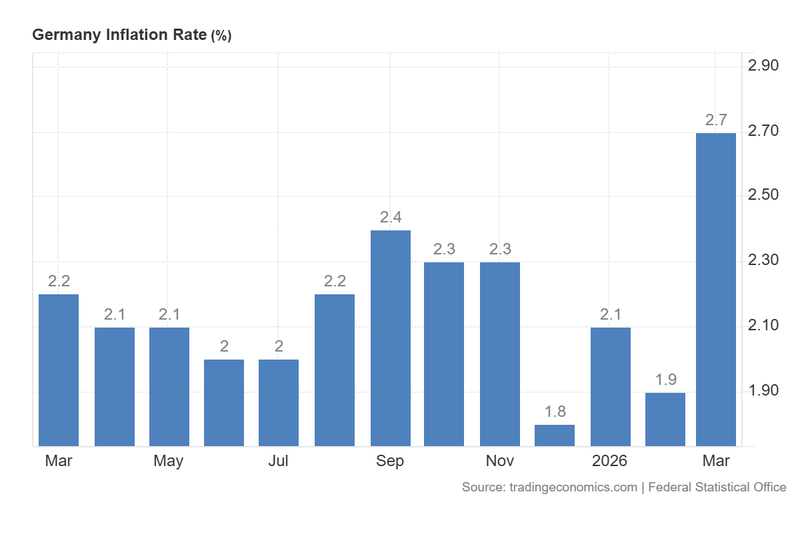
Figure 1. Germany Inflation Rate (2025-2026). Source: Data from the Federal Statistical Office of Germany; Figure obtained from Trading Economics.
Key economic events this week
During this week, several key economic indicators will be released. Some of the most important are the following:
Monday
- Germany: Inflation Rate
Tuesday
- China: NBS Manufacturing PMI
- European Union: Inflation Rate
- United Kingdom: GDP Growth Rate
- US: JOLTs Job Openings
Wednesday
- US: ADP Employment Change
- US: Retail Sales
- US: ISM Manufacturing PMI
- US: EIA Crude Oil Stocks Change
Thursday
- Australia: Balance of Trade
Friday
- US: Non Farm Payrolls
- US: Unemployment Rate
