
 Support
Brent above $100 as geopolitical tensions rise; Global stocks retreat
The primary oil benchmarks, Brent and WTI, have surged to their highest levels since August 2022, driven by mounting fears of severe energy supply disruptions that threaten global economic stability. Concurrently, global equity markets have retreated in unison as investors price in the risks of a renewed inflationary surge.

Brent futures appreciated by 9.22%, while WTI rose by 10.61%, following reports of significant supply chain disruptions in the Middle East.
Global stock markets declined as the prospect of rebounding inflation pressures central banks to maintain restrictive monetary stances.
According to the CME FedWatch Tool, market participants have pivoted away from pricing in interest rate cuts for the Federal Reserve’s upcoming sessions, a sharp reversal from previous forecasts that anticipated two rate reductions.
Oil markets rally as Middle East tensions intensify
The leading oil benchmarks, Brent and WTI, reached their highest valuations since August 2022 as geopolitical volatility in the Middle East reached a flashpoint. According to reports from Reuters, oil tankers were targeted in the Gulf, while the Strait of Hormuz remains closed by Iranian forces. The situation was further exacerbated by declarations from the new Supreme Leader, Mojtaba Khamenei, who asserted that Iran would maintain the closure of the Strait and target US strategic assets in retaliation for coordinated US-Israeli strikes. Simultaneously, Iraqi officials reported a total cessation of operations at domestic oil ports following attacks on two fuel tankers, allegedly by Iranian forces.
The International Energy Agency (IEA) characterised the situation as "the most significant oil-supply disruption in the history of global markets," following the announcement of a 400-million-barrel release from strategic stockpiles. This combination of events underscores the severity of the energy crisis, which now poses a systemic threat to the global economy.
In response, the Brent futures contract (BRNK6) rose by 9.22% to $100.46, while the West Texas Intermediate (WTI) futures contract (CLJ26) increased by 10.61% to $96.48 per barrel. Furthermore, gasoline futures (RBJ6) appreciated by 6.87%, reaching $2.98.
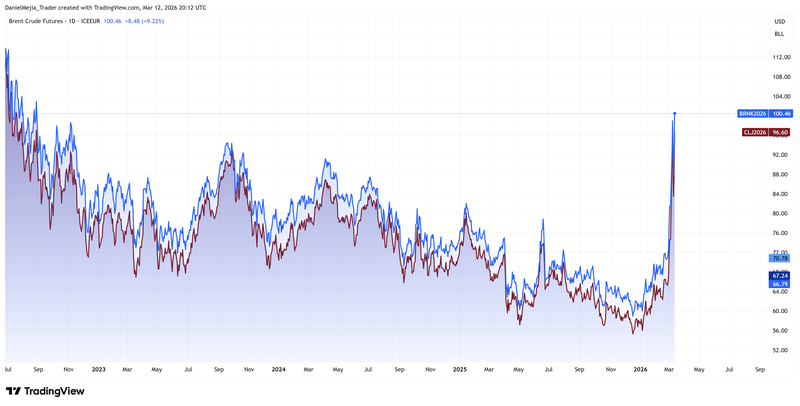
Figure 1. Brent and WTI Futures Contracts (2022–2026). Source: Data from the NYMEX and ICE-EUR Exchanges; Figure obtained from TradingView.
Global stock markets retreat amid inflationary concerns
Global equity markets moved lower in tandem as the surge in energy costs reignited fears of an inflationary rebound. Sustained elevated prices for energy commodities exert upward pressure on headline inflation, potentially forcing central banks to maintain benchmark interest rates at restrictive levels. Such monetary tightening typically acts as a headwind for equities, as higher borrowing costs diminish corporate growth capacity and weigh on valuations.
Prominent institutions, including the Bank of England and the European Central Bank, could consider more hawkish stances if price pressures persist—according to reports. The Federal Reserve, meanwhile, faces a particularly complex environment: domestic political pressure for rate cuts is being countered by the inflationary risk posed by rising energy costs. Data from the CME FedWatch Tool confirms that market participants are no longer pricing in any interest rate cuts for 2026, marking a significant departure from the two 25-basis-point cuts anticipated over the last two months
Consequently, global indices closed with broad-based losses. In United States, the S&P 500 fell 1.52%, the Dow Jones decreased 1.56%, and the Nasdaq 100 dropped 1.73%. In Europe, Germany’s DAX 40 slid 0.21%, Spain’s IBEX 35 fell 1.22%, the UK’s FTSE 100 declined 0.47%, and the French CAC 40 depreciated by 0.71%. In Asia, Japan’s Nikkei 225 dropped 1.04%, while the Hang Seng in Hong Kong depreciated by 0.91%.

