
 Support
Broadcom tops forecast; but AI jitters pressure markets
Broadcom reported stronger-than-expected third-quarter results, yet its share price tumbled as investors expressed renewed scepticism about the valuation of AI-exposed technology firms and the near-term returns on heavy AI capital expenditure. Elsewhere, the UK’s industrial sector remained in contraction but performed better than feared, and Japan’s industrial activity moderated on a year-on-year basis amid a softening macro backdrop.

Broadcom reported revenue of US$18.02bn (YoY +28%) and EPS of US$1.95 (YoY +37%), yet the share price fell c. 11.4% on investor disappointment and valuation concerns.
Market jitters about the financial returns from large AI investments contributed to a rotation away from some high-growth technology names, weighing on the Nasdaq-100.
UK industrial production contracted 0.8% year-on-year, a smaller decline than expected.
Japan’s industrial production decelerated from 3.8% to 1.6% (YoY); policymakers have announced a sizeable stimulus package even as the BoJ faces a delicate trade-off between growth and price stability.
Broadcom beats estimates but shares plunge on AI worries
Broadcom reported third-quarter revenue of US$18.02 billion, exceeding consensus forecasts of US$17.45 billion, and posted earnings per share of US$1.95, above the expected US$1.87. The results represent year-on-year growth of roughly 28 per cent in revenue and 37 per cent in EPS, with quarter-on-quarter advances also notable.
Despite the robust top-line and earnings performance, Broadcom’s shares fell sharply—approximately 11.44 per cent, closing at US$359.90—as investors reacted to broader concerns about the magnitude and timing of returns from AI-related capital expenditure across the technology sector. Market participants remain wary that elevated capex and M&A to secure AI capabilities may not translate into commensurate near-term profits, particularly for firms funding expansion through higher leverage.
The sectoral impact was evident in market moves: the S&P 500 fell 1.07 per cent to 6,827, the Dow Jones retreated 0.51 per cent to 48,458, and the Nasdaq-100 declined 1.91 per cent to 25,196—the latter reflecting the heavier weighting of AI and cloud-related names.
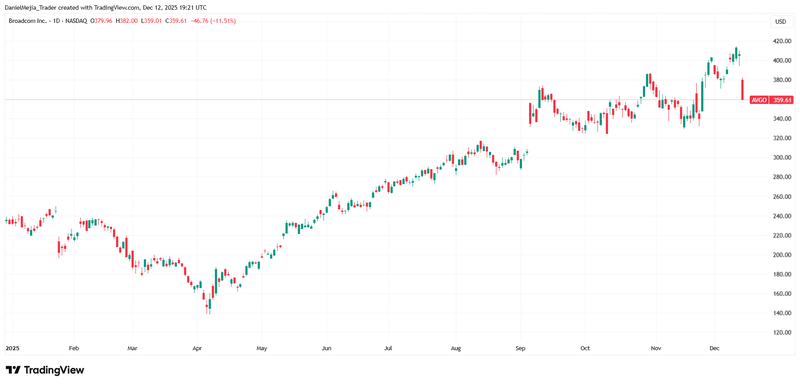
Figure 1. Broadcom share price (Year-to-Date). Source: Nasdaq; chart via TradingView.
UK industrial production contracts less sharply than expected
The Office for National Statistics reported that UK industrial production fell 0.8 per cent year-on-year, an outcome less severe than analyst forecasts of -1.2 per cent and an improvement from the prior -2.5 per cent reading. Although the data continue to indicate contraction, the softer decline suggests a modest stabilisation in activity against a backdrop of weak productivity, elevated inflation and rising unemployment.
Headline inflation has eased slightly to 3.6 per cent (from 3.8 per cent), but the unemployment rate rose to 5 per cent, the highest in three years. The combination of weaker output, sticky inflation and labour-market headwinds complicates the Bank of England’s reaction function; market consensus anticipates a possible 25 basis-point rate reduction in the next week, but uncertainty is in force because of the economic divergence.
The sterling traded marginally lower, reflecting the uncertain outlook for growth and policy.
Japan’s industrial production decelerates as stimulus is unveiled
Japan’s Ministry of Economy, Trade and Industry reported that industrial production slowed to 1.6 per cent year-on-year, down from 3.8 per cent previously. While the reading is modestly above the short-term average of roughly 0.43 per cent, it highlights a clear moderation in industrial momentum. This softening accompanies other signs of strain: headline inflation is around 3 per cent, above the Bank of Japan’s target, while Q3 GDP contracted by 0.6 per cent.
In response to the mixed outlook, in November the Japanese government announced a US$135 billion stimulus package intended to support growth. The Bank of Japan faces a delicate policy choice: it must weigh the inflationary implications of stimulus against the need to bolster activity. Market consensus is watching closely for possible BoJ rate adjustments, with commentary from policymakers likely to shape expectations about the path of monetary policy in 2026.
The weaker yen (-0.11 per cent today vs US dollar)—partly reflecting the divergence between fiscal stimulus and central-bank policy—provided some support to equity valuations (Nikkei +1.40 per cent), but the broader growth picture remains uncertain.
