
 Support
Fed and ECB officials highlight inflation risks; WTI gains on demand strength
Central bankers from the Federal Reserve (Fed) and the European Central Bank (ECB) are increasingly prioritising inflationary risks over employment concerns as energy prices surge amidst escalating Middle East tensions. Simultaneously, the energy market is witnessing an anomalous shift, with West Texas Intermediate (WTI) trading at a premium over Brent, driven by robust demand from European and Asian refineries seeking stable US crude supplies.

The Fed and ECB are prioritising price stability, signalling further restrictive measures as energy costs have surged by approximately 50% since 28 February.
March Non-Farm Payrolls (NFP) of 178,000 and a 4.3% unemployment rate suggest a degree of stability, providing central banks with more arguments to maintain a hawkish stance.
WTI has atypically surpassed Brent as global refineries pivot toward US crude amidst supply disruptions in the Middle East.
Market attention now shifts to upcoming inflation data from the US and China, alongside the FOMC minutes, to clarify the global interest rate trajectory.
Fed and ECB members assert inflation as the primary policy driver
According to reports from Reuters, Cleveland Federal Reserve President Beth Hammack and Chicago Fed President Austan Goolsbee both characterise inflation as a more pressing economic challenge than employment. This suggests a continued preference for a restrictive monetary stance over an accommodative alternative. This hawkish lean follows a significant surge in energy prices, which have appreciated by approximately 50% since the onset of the conflict between the US, Israel, and Iran on 28 February. While Fed members acknowledge the employment sector has entered a period of stagnation, they do not currently perceive an imminent risk of contraction.
Notably, the Non-Farm Payrolls data released last Friday—showing 178,000 new positions for March—bolstered the hypothesis of a "sideways" performance in the labour market, particularly as February’s reading had indicated a contraction. Furthermore, the unemployment rate declined from 4.4% to 4.3%, alleviating fears of a more severe downturn in the jobs sector.
In Europe, ECB policymaker Yannis Stournaras noted that monetary policy remains contingent on the scale and nature of energy supply disruptions resulting from the Middle East conflict—as reported by Reuters. Stournaras indicated that a more restrictive stance would be necessary if energy price volatility begins to drive up inflation expectations or wage developments.
Despite these hawkish signals, US and European equity markets closed mixed. Conversely, long-term bond yields in both regions rose in tandem, reflecting the heightened uncertainty within the current geopolitical landscape.
WTI surpasses Brent amid rising crude demand from Europe and Asia
The West Texas Intermediate (WTI) oil benchmark has moved to a premium over the Brent benchmark—an anomalous market movement, as the Brent reference typically commands a higher price. This outlier is largely attributed to European and Asian refineries increasing their intake of US crude to mitigate the supply shocks originating from the unresolved US-Israel-Iran conflict in the Middle East.
At the time of writing, the Brent futures (BRNM6) contract is trading at $109.77 per barrel, while the WTI futures contract (CLK6) is trading at $112.80 per barrel.
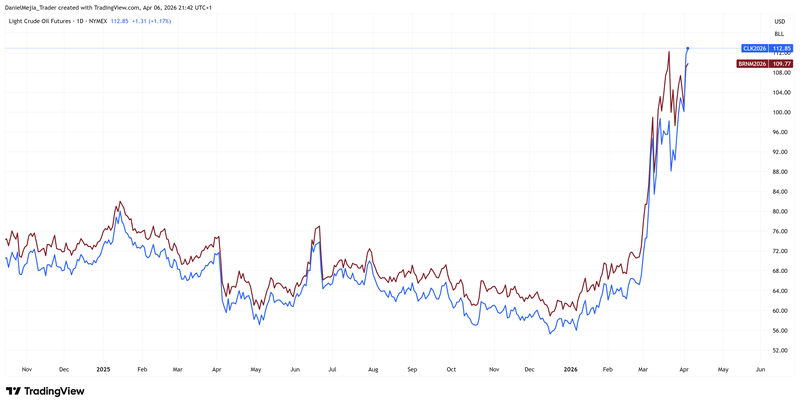
Figure 1. WTI Versus Brent Prices (2024–2026). Source: Data from the NYMEX and ICE-EUR exchanges; Own analysis conducted via TradingView.
Key economic events this week
During this week, several key economic indicators will be released. Some of the most important are the following:
Monday
- US: ISM Services PMI
Tuesday
- US: Durable Goods Orders
Wednesday
- New Zeeland: RBNZ Monetary Policy Decision
- US: FOMC Minutes
- US: EIA Crude Oil Stocks Change
Thursday
- Japan: Consumer Confidence
- Germany: Balance of Trade
- US: Personal Income and Spending
Friday
- China: Inflation Rate
- US: Inflation Rate
- US: Michigan Consumer Sentiment
- Canada: Unemployment Rate

