
 Support
Gold and silver set new records on Fed independence concerns
Silver and gold futures have achieved fresh record closes, propelled by a confluence of intensifying geopolitical instability and mounting scrutiny regarding the institutional autonomy of the Federal Reserve. However, despite unprecedented executive pressure on the central bank—including potential legal action against Chair Jerome Powell—market expectations for interest rate adjustments, as calibrated by the CME FedWatch Tool, remain steadfast.

Gold futures (GCG26) appreciated by 2.53% to $4,614/oz, while silver surged 7.25% to $85/oz.
Sustained accumulation by central banks and retail investors is driven by disputes in Greenland, tensions with Iran, and diplomatic friction across Latin America.
The Q4 reporting cycle begins this week, spearheaded by major financial institutions including JPMorgan Chase and Goldman Sachs.
Precious metals reach new highs as Fed uncertainty grows
Gold and silver futures have once again ascended to unprecedented levels as concerns mount regarding the erosion of the Federal Reserve's independence. The gold futures contract (GCG26) climbed 2.53% to settle at $4,614 per ounce, while silver outperformed with a 7.25% gain, closing at $85 per ounce. On a year-over-year basis, these metals have delivered extraordinary cumulative returns of 72% and 180%, respectively.
The demand for bullion remains robust, underpinned by a triad of factors: expectations of a possible monetary easing, aggressive reserve accumulation by central banks, and heightened risk-aversion. Geopolitical uncertainties have further intensified following reports that the US Department of Justice has threatened to trial Fed Chair Jerome Powell. According to Reuters’ information, Jerome Powell has characterised the accusations as a 'pretext' by the White House to exert greater influence over monetary policy.
This confrontation highlights a profound conflict of interest and casts a shadow over the central bank's future autonomy. Furthermore, international tensions remain a critical driver of market sentiment. The unresolved dispute over Greenland between the US and Denmark, persistent friction with Iran, and deteriorating diplomatic relations with Mexico, Colombia, and Cuba have bolstered the appeal of "hard assets." Consequently, the flight to safety is evident in the sustained acquisition of physical bullion, alongside increased inflows into exchange-traded funds (ETFs) and derivative contracts.
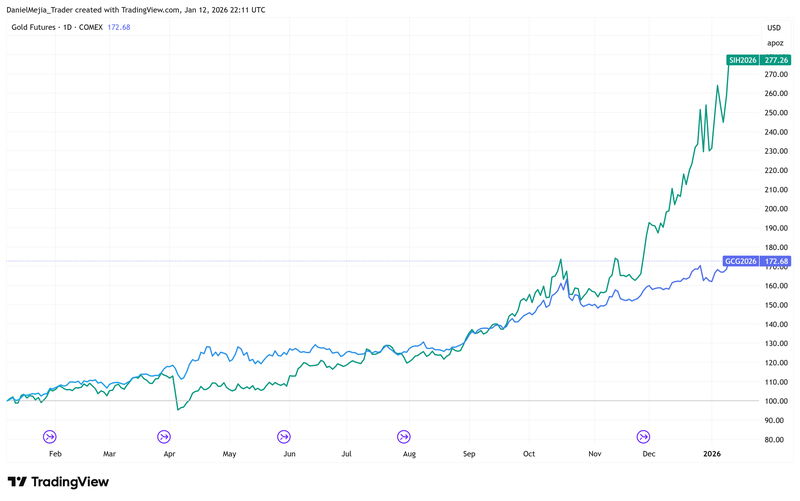
Figure 1. Gold and Silver futures contracts (year-over-year). Source: Data from the COMEX Exchange; Own analysis conducted via TradingView. Note: For comparison purposes, the contracts analysed in the figure are indexed to 100.
Stability in rate cut forecasts versus a strengthening neutral stance
Despite the escalating friction between the executive branch and the Federal Reserve, the probability of two 25-basis-point rate cuts this year remains priced into the markets. According to the CME Group’s FedWatch Tool, the prevailing consensus suggests that interest rates will remain unchanged until the June symposium, at which point an initial reduction is anticipated, followed by a second cut toward the year's end.
This timeline aligns with the remainder of Jerome Powell’s tenure, which concludes in May 2026. The market is currently speculating that his successor will adopt a predominantly 'dovish' posture—an outcome reportedly favoured by President Donald Trump. However, such a shift risks undermining the credibility of the Federal Reserve. The confidence of global investors in US equities and Treasury securities is historically rooted in the perceived strength and independence of the nation’s financial institutions.
The ultimate resolution of these tensions will likely be revealed by whether the Fed’s future pivots are data-dependent or politically motivated. With the spiralling cost of US sovereign debt consuming an ever-larger portion of the federal budget, the pressure to artificially lower borrowing costs to manage the public deficit remains a significant concern for institutional analysts.
Q4 US financial results
The Q4 earnings season commences this week, with the financial sector providing the first critical insights into the health of the US economy. Key institutions scheduled to report include:
Tuesday
- JPMorgan Chase & Co. (JPM)
Wednesday
- Bank of America (BAC)
- Wells Fargo&Co (WFC)
- Citigroup (C)
Thursday
- Goldman Sachs (GS)
- Morgan Stanley (MS)
- BlackRock (BLK)
Key economic events this week
Monday
- Australia: Westpac Consumer Confidence Change
Tuesday
- US: Inflation rate
Wednesday
- China: Balance of Trade
- US: Retail Sales
- US: EIA Crude Oil Stocks Change
- US: Continuing Jobless Claims
Thursday
- Germany: Full Year GDP Growth
- Germany: Inflation Rate
