
 Support
Markets attentive to the U.S.–Russia summit; oil declines
Financial markets remain focused on the US–Russia summit, where a ceasefire in the Russia–Ukraine conflict is being sought. Oil prices are slipping, while expectations for Fed rate cuts remain uncertain.

UnitedHealth leads Dow Jones index gains after Berkshire Hathaway increased its position.
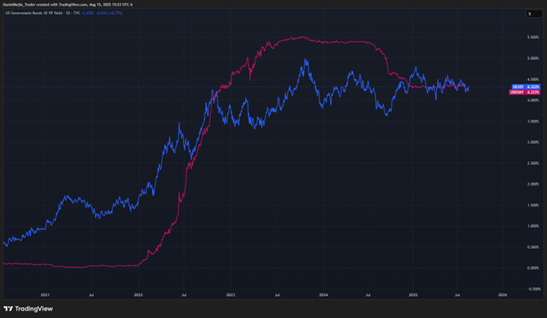
The Treasury yield curve flattens again during policy uncertainty.
Oil eases as investors await the August 15 U.S.–Russia talks.
Chicago Fed President Austan Goolsbee left open the possibility of supporting a rate cut.
UnitedHealth rallies on Berkshire Hathaway stake
UnitedHealth shares rose about 12% after the New York close, lifting the Dow Jones Industrial Average to a new all-time high. This marks one of the sharpest rebounds following the stock’s gradual 60% decline since its December 2024 peak. Healthcare stocks advanced roughly 1.65% on average, potentially their best weekly performance since October 2022.
Company valuations reset meaningfully in 2Q 2025: the P/E fell to 13.51, Price-to-Sales to 0.67, and Price-to-Book to 2.98—each below the 10-year historical average. Such metrics may have appealed to Warren Buffett’s firm, which emphasizes attractive valuations. Following the reversal, notable support has formed near $255 per share.
Yield curve remains flat amid policy uncertainty
The yield curve between long-term (10-year) and short-term (3-month) Treasuries remains flat. As shown in the referenced chart, the curve stayed inverted for months before reaching this flattening, which has persisted through 2025 and signals elevated odds of an approaching monetary-easing cycle.
A key factor keeping the curve flat is ongoing economic uncertainty that has prevented the Federal Reserve from beginning its easing path. Chair Jerome Powell has indicated that a restrictive stance remains in place, in part due to the gradual implementation of tariffs. While markets see a high likelihood of gradual benchmark-rate cuts, inflation has not yet returned to the Federal Reserve target.
Oil eases ahead of U.S.–Russia talks
Presidents Donald Trump and Vladimir Putin met today in Alaska. While the main objective is to cease the Russia–Ukraine war, the agenda is broad. Notably, Ukraine’s President Volodymyr Zelensky was not invited, despite European leaders requesting his inclusion.
During uncertainty over the summit’s outcome, oil prices fell about 1.64% on average across Brent and WTI, while gold was little changed. Russia is among the world’s largest crude producers and exporters; any agreement could relax sanctions on Moscow, boosting supply and weighing on prices. Additionally, slower industrial production in China (up 5.7% YoY) stoked demand concerns and pressured today’s prices.
Goolsbee signals rate-cut option remains on the table
Chicago Fed President Austan Goolsbee left open the possibility of supporting a policy-rate cut, while noting that rising services inflation could reflect a stagflationary backdrop linked to tariff effects. He emphasized that more data and reports are needed to decide whether to maintain or change the current policy view.
For now, the U.S. economy remains resilient, but labor data show softening. New hires continue to slow even as inflation indicators show signs of re-acceleration—a mix that complicates the Federal Reserve’s outlook. Although consumer price measures have not fully reacted to tariffs, firms may find it increasingly difficult to absorb tax costs, raising the risk of pass-through in the coming months.
