
 Support
Oil prices rise on US–Iran tensions; Walmart hits $1 trillion
The primary global oil benchmarks, Brent and West Texas Intermediate (WTI), advanced in tandem following an escalation in geopolitical tensions between the United States and Iran. Market sentiment was further influenced by an US–India trade agreement, which is expected to bolster global demand through increased Indian imports of American crude. Concurrently, Walmart Inc. achieved a historic milestone, surpassing a $1 trillion market capitalisation for the first time.

Brent and WTI rose by 1.55% and 3.27%, respectively, as conflict between the US and Iran intensified.
Walmart became the first traditional retailer to reach the $1 trillion valuation threshold, securing its position as the 11th largest company in the S&P 500.
The RBA increased its benchmark interest rate from 3.6% to 3.85% in response to persistent inflationary pressures.
Oil prices rise amid escalation in US–Iran tensions
The primary oil benchmarks, Brent Crude and WTI, rose sharply as tensions between Washington and Tehran increased. According to reports from Reuters, US military forces shot down an Iranian drone in the Arabian Sea, a confrontation that threatens to derail ongoing diplomatic efforts aimed at securing a regional peace accord. Market participants are increasingly concerned that further hostilities could lead to a blockade of the Strait of Hormuz, a critical maritime chokepoint.
Data from the US Energy Information Administration (EIA) highlights the strategic importance of this region: approximately 20 million barrels of oil transit the Strait of Hormuz daily, accounting for roughly 20% of global consumption. Furthermore, the EIA identifies Iran as the third-largest producer within the Organization of the Petroleum Exporting Countries (OPEC) for 2025. Given Iran’s substantial influence over oil production and logistics, any territorial friction has profound implications for global energy security.
Consequently, the Brent futures contract (BRN26) gained 1.55% to trade at $67.33 per barrel, while the WTI futures contract (CLH26) surged 3.27% to settle at $64.17. WTI prices were further supported by reports of a nascent trade agreement between the US and India, wherein New Delhi would increase imports of American crude in exchange for preferential tariff rates on Indian goods and services.
Walmart reaches $1 trillion market capitalisation for the first time
Walmart Inc. has made history by surpassing the $1 trillion market capitalisation threshold. At the close of trading, shares in the retail giant had appreciated by 2.94%, finishing at $127.71. According to Finviz data, this valuation places Walmart as the 11th largest firm in the S&P 500 and among the most valuable corporate entities globally. Notably, Walmart is the first traditional retailer to achieve this "trillion-dollar club" status.
The drivers behind this valuation surge include significant advancements in logistics and digital innovation. According to Reuters’ information, the company has successfully expanded its online marketplace, implemented one-hour delivery services, and grown its "Walmart+" membership programme. Additionally, Walmart has developed a $4 billion advertising business to enhance margins and invested heavily in Artificial Intelligence (AI) to automate its supply chain. These strategic pivots have resulted in increased market share and robust financial performance.
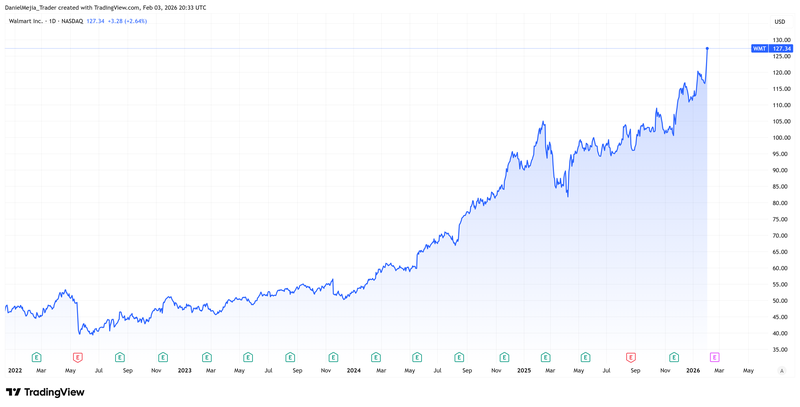
Figure 1. Walmart’s share price (2022–2026). Source: Data from the Nasdaq Exchange; Figure obtained from TradingView.
Reserve Bank of Australia increases interest rates in line with expectations
The Reserve Bank of Australia (RBA) reached a unanimous decision to increase its benchmark interest rate from 3.6% to 3.85%, meeting consensus forecasts. This hawkish move represents the first rate hike since December 2023, when rates peaked at a ten-year high of 4.35%. The RBA board noted that future policy adjustments will remain data-dependent, with the primary objective of restoring price stability.
Current figures place the Australian inflation rate at 3.8%, well above the central bank’s 2–3% target range. The RBA’s decision marks a pivot amongst Western central banks, many of which are now reconsidering the monetary easing trend observed over the previous eighteen months as inflationary pressures prove more persistent than anticipated.
Quarterly US financial results
The fourth-quarter earnings season continues this week. The following key institutions are scheduled to report, which may contribute to further volatility in US equity markets:
Tuesday
- Advanced Micro Devices (AMD)
- Merck & Company (MRK)
- PepsiCo Inc. (PEP)
- Amgen Inc. (AMGN)
- Pfizer Inc. (PFE)
Wednesday
- Alphabet Inc. (GOOGL)
- Eli Lilly and Company (LLY)
- AbbVie Inc. (ABBV)
- Qualcomm Incorporated (QCOM)
Thursday
- Amazon Inc. (AMZN)
- Bristol-Myers Company (BMY)
Key economic events this week
During this week, several key economic indicators will be released. Some of the most important are the following:
Tuesday
- Australia: RBA Interest Rate Decision
- US: JOLTs Job Openings
Wednesday
- European Union: Inflation Rate
- US: ISM Services PMI
Thursday
- Australia: Balance of Trade
- United Kingdom: BoE Interest Rate Decision
- European Union: ECB Interest Rate Decision
Friday
- Germany: Balance of Trade
- US: Non Farm Payrolls
- US: Unemployment Rate
- Canada: Unemployment Rate
