
 Support
Oil resilient despite substantial US stockpiles; Nvidia beats forecasts
Crude oil prices remained stable despite a significant weekly build in US inventories, which reached their highest level in three years. Simultaneously, Nvidia Corporation successfully exceeded analyst expectations for both revenue and earnings per share (EPS), maintaining a robust year-on-year growth trajectory. Meanwhile, Australia’s inflation rate remained unchanged, holding at its highest level since September 2024 and complicating the domestic monetary outlook.

Benchmark references, Brent and WTI, edged marginally higher despite a much larger-than-anticipated EIA inventory build and escalating geopolitical tensions between the US and Iran.
Nvidia reported fourth-quarter 2025 results that outperformed estimates, achieving a year-on-year growth rate of 73% in revenue and 82% in EPS.
Headline inflation in Australia held steady at 3.8%, surpassing forecasts and subsequently driving an appreciation in the AUD/USD pair.
EIA crude inventories register substantial build; Oil prices remain stable
According to data released by the US Energy Information Administration (EIA), crude oil stockpiles rose by 15.989 million barrels in the latest weekly assessment. This figure was considerably higher than the 1.8-million-barrel increase anticipated by analysts. This latest reading represents the most significant inventory build in three years and follows a notable drawdown of 9.014 million barrels reported the previous week.
While such a substantial increase in supply might typically exert downward pressure on prices—suggesting either a drop in demand or a supply glut—oil benchmarks reacted with only marginal fluctuations. The Brent crude futures contract (BRNK26) rose by approximately 0.60% to $70.99 per barrel, while the West Texas Intermediate (WTI) futures contract (CLJ26) appreciated by 0.40% to $65.67 per barrel.
Market sentiment remains underpinned by geopolitical frictions between the US and Iran. Although both nations are reportedly engaged in negotiations regarding the Iranian nuclear programme, the US administration has recently bolstered its military presence in the Middle East, near the Iranian border. Traders and hedgers remain highly focused on these developments, as any escalation could rapidly increase the geopolitical risk premium embedded in oil prices.
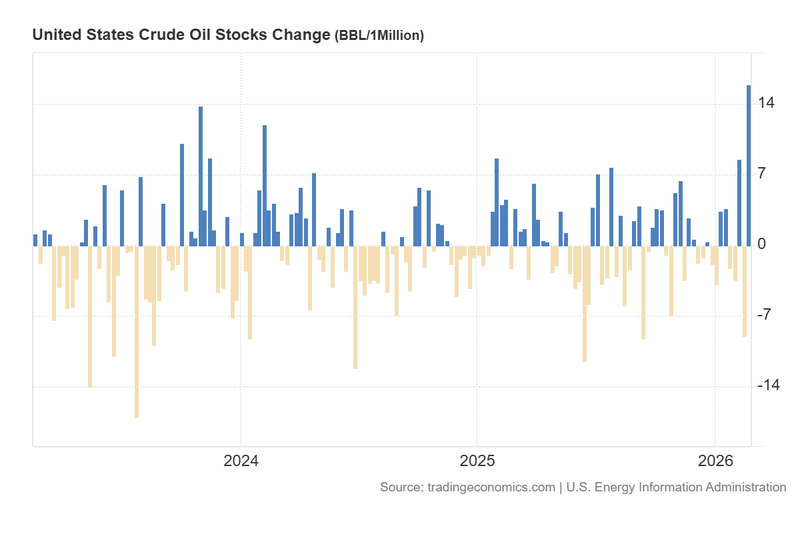
Figure 1. United States Crude Oil Stocks Change (2023-2026). Source: Data from the Energy Information Administration (EIA); Figure obtained from Trading Economics.
Nvidia quarterly report exceeds analyst estimates
Nvidia Corporation once again outperformed analyst forecasts for revenue and earnings per share, extending its consistent trend of beating market expectations. For the fourth quarter of 2025, the semiconductor giant reported total revenue of $68.13 billion, surpassing the consensus estimate of $66.13 billion (a 3% surprise). Furthermore, the firm reported an EPS of $1.62, exceeding the forecast of $1.54 (a 5.5% surprise). These figures represent an impressive year-on-year growth of 73.2% in revenue and 82% in EPS. However, despite these strong fundamentals, the company’s shares failed to rally significantly in after-hours trading.
Leading up to the Nvidia release, US equity indices advanced in tandem. The S&P 500 rose 0.81% to 6,946 points, the Dow Jones Industrial Average gained 0.63% to reach 49,482, and the Nasdaq Index appreciated by 1.41% to 25,329 points. Following the publication of the results, the S&P 500 futures index edged down marginally by 0.15%.
Australian inflation rate remains unchanged and above analyst estimates
Data from the Australian Bureau of Statistics reveals that the headline inflation rate remained steady at 3.8% in January. This exceeded the 3.7% anticipated by analysts and remains well above the Reserve Bank of Australia’s (RBA) target range of 2–3%. According to Trading Economics, the figures were mainly driven by an acceleration in goods inflation, which rose to 3.8% in January from 3.4% in December, primarily spurred by a sharp increase in electricity costs (climbing from 21.5% to 32.2%).
The persistence of inflation at its highest level since September 2024 places significant pressure on the RBA, which is currently managing conflicting economic signals, including a rising unemployment rate of 4.1%. In response to the data, the Australian dollar appreciated by 0.90% to 0.7120 against the US dollar, as market participants factored in the likelihood of the RBA maintaining a restrictive policy stance to curb price pressures.
