
 Support
RBA tightens policy on inflation fears; Oil surges as tensions persist
The Reserve Bank of Australia (RBA) has elected to raise its benchmark interest rate by 25 basis points, suggesting that global central banks are facing significant inflationary pressures following a sharp rise in energy prices, driven by instability in the Middle East. Market participants are now closely monitoring a series of upcoming monetary policy decisions from major Western central banks scheduled for this week.

The RBA increased its benchmark cash rate by 25 basis points to 4.10%, suggesting a potential shift in global policy stances in response to escalating energy costs.
The primary oil benchmarks, Brent and WTI, rose in tandem as the conflict in the Middle East enters its third week.
Investors are focused on a heavy slate of policy decisions this week from the Bank of Canada, the Federal Reserve, the Bank of Japan, the Bank of England, the European Central Bank, and the Swiss National Bank.
RBA increases interest rates on fears of inflationary pressures from prolonged Middle East conflict
The Reserve Bank of Australia (RBA) has raised its benchmark interest rate by 25 basis points to 4.10%, a move that aligned with analyst expectations. The RBA Board was divided, with the final tally showing five votes in favour and four against the hike. The Australian central bank cited the mounting risk of entrenched inflation should the conflict in the Middle East persist. Over the past month, the global benchmarks Brent and WTI have surged by 50% as the US–Israel–Iran conflict has progressively escalated.
The RBA is the first major Western central bank to resume rate hikes since the onset of the current energy crisis. The bank is currently working to contain a headline inflation rate of 3.8%, which remains significantly above its target range of 2%–3%.
Following the RBA’s hawkish decision, the Australian dollar appreciated by 0.51% against the US dollar, reaching the 0.7103 level. Market participants have now turned their attention to the decisions of other Western central banks later this week to determine how rising energy prices are affecting global inflation estimates.
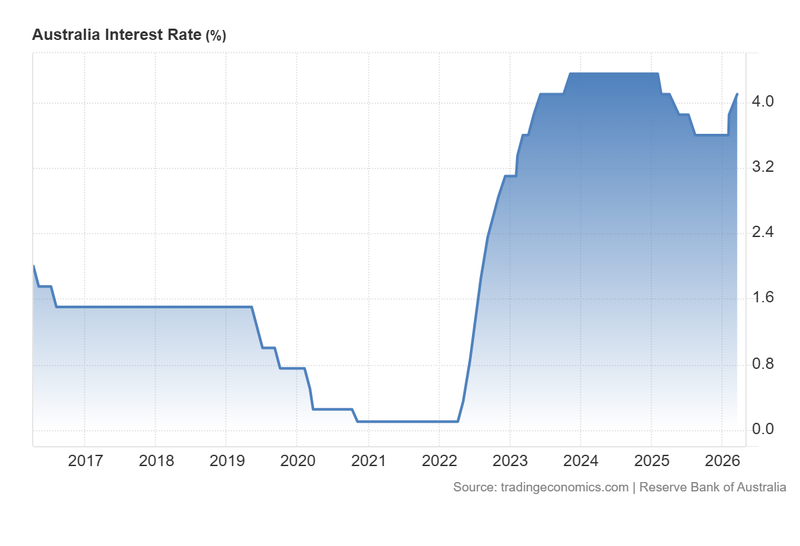
Figure 1. Australia Interest Rate (2016–2026). Source: Data from the Reserve Bank of Australia; Figure obtained from Trading Economics.
Oil prices rise as tensions in the Strait of Hormuz persist
Global oil benchmarks, Brent and WTI, continued their ascent amid growing concerns over the duration and potential resolution of the US–Israel–Iran conflict, which is causing severe energy supply disruptions in the Middle East. Following a coordinated strike by the US and Israel on Iranian territory, Iran moved to block the Strait of Hormuz—a critical maritime chokepoint through which approximately 20% of the world’s oil and natural gas supply transits. This action has severely impacted logistical routes and led to a relevant complication of regional inventories. The conflict has now persisted for over two weeks, and fears are mounting that further military strikes could impact energy infrastructure and regional value chains.
Additionally, according to reports from Reuters, several US allies have declined to support Washington’s plans to secure the Strait of Hormuz. This follows requests from US President Donald Trump for international assistance in escorting vessels through the region. NATO members have largely rejected direct involvement in the hostilities; notably, Germany’s Defence Minister stated that "it is not a German war" and emphasized that Germany did not initiate the conflict. France has also voiced opposition to a Western-led coalition in the Strait. Consequently, President Trump has accused some Western allies of "ingratitude" following the general refusal to join its plan.
Amid this geopolitical volatility, the Brent futures contract (BRNK6) increased by 3.20% to $103.42 per barrel. Simultaneously, the West Texas Intermediate (WTI) futures contract (CLJ6) appreciated by 2.90% to $96.21 per barrel, while gasoline futures (RBK6) rose by 4.33% to $3.08 per gallon.
Key economic events this week
During this week, several key economic indicators will be released. Some of the most important are the following:
Monday
- China: Industrial Production
- China: Retail Sales
- Canada: Inflation Rate
Tuesday
- Australia: RBA Interest Rate Decision
- Germany: ZEW Economic Sentiment
- Japan: Balance of Trade
Wednesday
- Canada: BoC Interest Rate Decision
- US: Fed Interest Rate Decision
- US: FOMC Economic Projections
- US: EIA Crude Oil Stocks Change
Thursday
- Japan: BoJ Interest Rate Decision
- Switzerland: SNB Interest Rate Decision
- UK: BoE Interest Rate Decision
- European Union: ECB Interest Rate Decision

